Foolproof Hajj arrangements ensure stoning ritual at Jamarat runs safely, smoothly

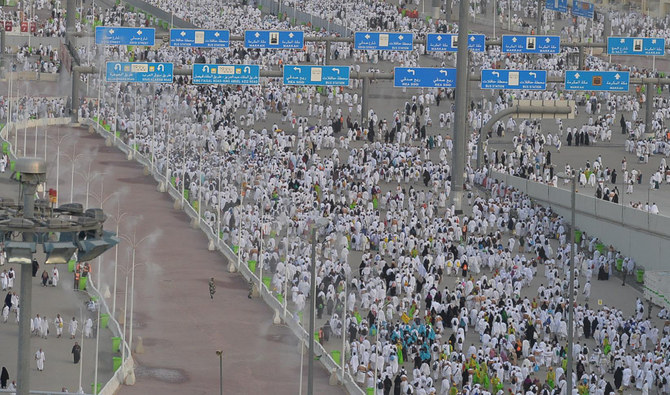
Multiple pathways were provided on all five levels of the complex. (SPA)
Short Url
Updated 11 July 2022
Follow

Foolproof Hajj arrangements ensure stoning ritual at Jamarat runs safely, smoothly

  • High-tech monitoring helps maintain order
  • Top officials oversee operations at holy sites

MINA: Pilgrims at Hajj 2022 continued the “stoning of the devil” ritual for the second day at the massive Jamarat complex in Mina on Sunday. They each threw 21 pebbles at the three pillars that symbolize Satan.

Multiple pathways were provided on all five levels of the complex to ensure a steady flow of pilgrims who, after completing the ritual, spent time in prayer and supplication in their tents. Most of them will depart Mina after completing their remaining rituals on Monday.

The five-level Jamarat complex has been designed to ensure that large numbers of pilgrims can complete the ritual as quickly and easily as possible. They are only permitted to move through it in one direction to prevent congestion and delays.


Pilgrims hurl stones inside the Jamarat complex in Mina. (AN photo by Huda Bashatah)

After thorough preparations, all the necessary arrangements were in place to ensure the complex could cope with more than 300,000 pilgrims an hour. About 226 eco-friendly electric vehicles were provided on Jamarat Bridge to transport and serve them.

“Everything was easy, from organizing the crowd for the stoning in Jamarat, to the tawaf (walking around the Holy Kaaba at the Grand Mosque in Makkah),” said Nussaiba, a Palestinian pilgrim who only gave her first name.
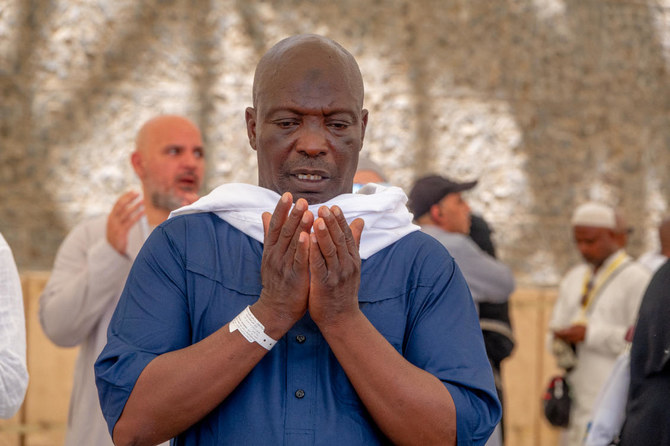


Pilgrims suplicate at the end of the ‘stoning the devil’ ritual. (AN photo by Huda Bashatah)

Hajj operations at the holy sites have been overseen by Prince Khaled Al-Faisal, the governor of Makkah, and Interior Minister Prince Abdulaziz bin Saud bin Naif. A number of agencies, including security authorities and health workers, have been involved in providing all the services that pilgrims might require.

The latest technology is being used to monitor the movement of pilgrims and ensure their safety and security. Cameras on the ground and in helicopters flying over the holy sites are connected to operation centers where information is analyzed in real time to ensure that any problems or emergencies are dealt with quickly and efficiently.
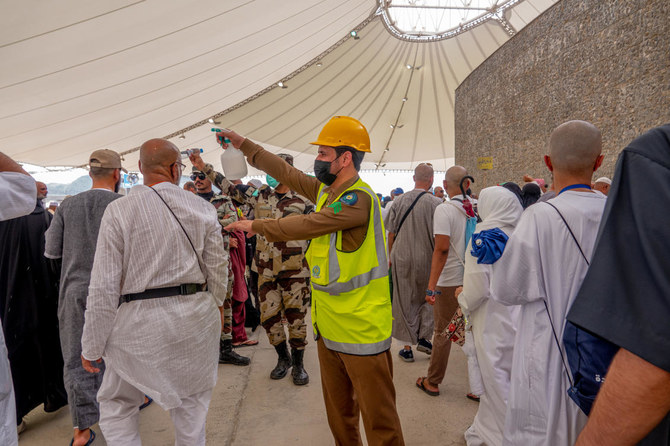


Security officials cool pilgrims with water sprays to beat the heat at the Jamarat complex. (AN photo by Huda Bashatah)

The Ministry of Health said there have been no outbreaks of disease during Hajj.

The Ministry of Hajj and Umrah has implemented a comprehensive health insurance program for foreign pilgrims as part of the Kingdom’s Vision 2030 program.


Druze: the great survivors
How the world's most secretive faithhas endured for a thousand years

Enter


keywords


Economic growth and resilience at heart of 2nd AlUla Emerging Market Economies Conference

Updated 03 February 2026
Follow

Economic growth and resilience at heart of 2nd AlUla Emerging Market Economies Conference

  • Event on Feb. 8 and 9 will bring together ministers, governors of central banks, policymakers, economic experts and international financial institutions
  • Emerging-market economies a ‘pivotal element’ in global economic system due to effect they have on growth and stability, says Saudi Finance Minister Mohammed Al-Jadaan

RIYADH: The second annual AlUla Conference for Emerging Market Economies, which Saudi Arabia will host next week, offers a platform to exchange views on global developments and discuss policies and reforms that support inclusive growth and strengthen economic resilience, the Kingdom’s finance minister said.

The event on Feb. 8 and 9 will bring together finance ministers, governors of central banks and policymakers, alongside economic experts and representatives of international financial institutions.

Organized by the Saudi Ministry of Finance in partnership with the International Monetary Fund, it takes place as emerging-market economies face mounting challenges amid rapid global economic change.

Finance Minister Mohammed Al-Jadaan said the decision to host the conference reflects Saudi Arabia’s ongoing commitment to efforts that support global financial and economic stability, and highlights the growing influence of emerging economies on worldwide growth.

Emerging-market economies represent a “pivotal element” in the global economic system due to the direct impact they have on economic growth and stability, he added.

“The AlUla Conference for Emerging Market Economies provides a unique platform for exchanging views on global economic developments, and discussing policies and reforms that will support inclusive growth and enhance economic resilience, in light of broader international cooperation that contributes to confronting common challenges,” Al-Jadaan said.

Kristalina Georgieva, managing director of the IMF, said the event would help emerging economies deal with growing uncertainty driven by technological change, demographic shifts and geopolitical tensions.

“The AlUla conference provides a vital platform for emerging economies to discuss how they can navigate the risks and embrace the opportunities ahead,” she said.

“In these times of sweeping transformations in the global economy, policymakers face a more challenging and uncertain environment. Countries should work together to strengthen resilience through sound macroeconomic and financial policies.”