

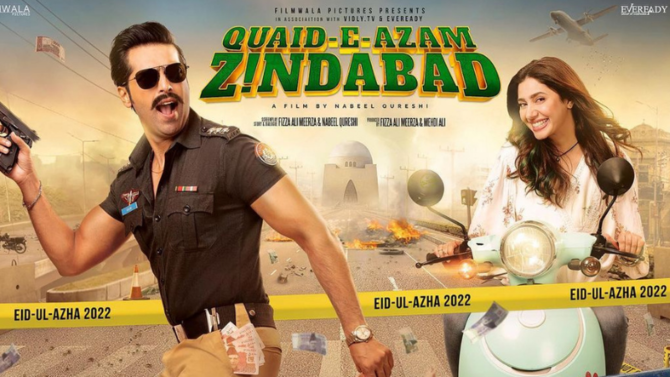
Mahira Khan, Fahad Mustafa starrer ‘Quaid-e-Azam Zindabad’ hits cinemas across Pakistan on Eid 

This photo shows the poster of Pakistani movie "Quaid-e-Azam Zindabad"
Short Url
Updated 10 July 2022
Follow

Mahira Khan, Fahad Mustafa starrer ‘Quaid-e-Azam Zindabad’ hits cinemas across Pakistan on Eid 

  • ‘Quaid-e-Azam Zindabad’ is a cop film that Khan describes as “masala film with an important message” 
  • Action-packed film simultaneously released on Sunday in 14 countries, including UAE, England and US 

KARACHI: Nabeel Qureshi’s highly anticipated ‘Quaid-e-Azam Zindabad,’ starring Pakistani megastars Mahira Khan and Fahad Mustafa, hit cinema screens across the country on the Eid holiday, with the cast saying this was a feature with many firsts: a cop film, and a musical masala movie with an important message. 

The movie, which encountered delays due the COVID-19 pandemic, brings Khan and Mustafa together on the silver screen for the first time and has generated a lot of anticipation and excitement among film fans and cinema-goers. 

The action-packed movie simultaneously released on Sunday in 14 countries, including the United Arab Emirates, England and the United States. 

“I genuinely think this is an entertaining film. It’s a relevant film. I have not seen a cop film in Pakistan before, I have not seen such action before,” Khan told Arab News in an interview ahead of the launch. “It’s a full on, what we say in Urdu, masala film, and it also has a very important message.” 

The movie has “a lot of firsts” and features characters one will remember for a long time, Mustafa, a film and television actor and producer best known for hosting the popular game show Jeeto Pakistan, said. 

“It’s the first cop film. Nobody [in Pakistan] has done that before or maybe lately nobody has done it,” the lead actor told Arab News. “We are only trying to create characters people can relate to for a very long time.” 



Pakistani artist Fahad Mustafa speaks about his movie Quaid-e-Azam Zindabad in exclusive interview with Arab News in Karachi. (AN Photo)

Speaking about her character, Khan said she stood for a “message,” whether it related to the harassment of women or human and animal rights. 

“She is a girl who doesn’t think about social norms, societal norms, she does what she wants to do and she has a very strong moral compass,” Khan said. “She believes this is right and this is wrong.” 

“And she also believes in giving second chances,” she said, chuckling as she glanced at Mustafa. 



Pakistani artist Mahira Khan speaks about her movie Quaid-e-Azam Zindabad in exclusive interview with Arab News in Karachi. (AN Photo)

The actor was confident his fans would love the film. 

“This is the film that can actually bring people out of their house and make them watch that cinematic experience,” Mustafa said. “So, I think this is the last hope. I really hope that they come out and we’d be able to do more films then.” 

The two actors had some interesting anecdotes to share, with Mustafa recalling a tough shoot with a lion on the set. 

“I had no clue I was scared of lions,” he said. “The lion was real and it was right there, and in the end, it is a lion, so what do you do?” 

“It was a little scary and fun but I don’t really want to remember that day, you know, it was not a fun shoot.” 

Khan recalled a scene where she was carrying a puppy on a bike. As the camera came close, the dog just turned its face and started kissing the lens. 

“We had these little moments,” a smiling Khan added. 

‘Quaid-e-Azam Zindabad’ is not the only Pakistani movie releasing on Eid, and will face tough competition from the much-awaited Humayun Saeed and Mehwish Hayat-starrer ‘London Nahi Jaunga.’ 

Mustafa said he believed both films needed each other. 

“It is not time to compete but collectively … as a unified group, we should be working together,” the actor said. 

“So much is riding on both the films” doing well, Khan added. “The box office will dictate how investors, distributors, filmmakers will all feel about cinema because at the end of the day, it is a business.” 

“Go watch London Nahi Jaunga,” both actors then said in unison. 



Pakistani artists Fahad Mustafa (L) and Mahira Khan speak about their movie Quaid-e-Azam Zindabad in exclusive interview with Arab News in Karachi. (AN Photo)

At the end of the day, the two stars said they were relieved to be returning to the big screen. 

“This is the real thing; this is what an actor lives for,” Mustafa said. 

Khan added: 

“Nothing like a film, nothing like cinema … Oh, we wanna do this forever … cinema has that magic.” 


Pakistan seafood exports rise 22 percent in last six months on strong Gulf, Asia demand

Updated 5 sec ago
Follow

Pakistan seafood exports rise 22 percent in last six months on strong Gulf, Asia demand

  • Fisheries is a vital pillar of the national maritime economy that supports livelihoods of millions of Pakistanis, particularly in coastal communities
  • Maritime Affairs Minister Junaid Anwar Chaudhry stresses the need for strict regulatory compliance, sustainable fishing to protect marine biodiversity

KARACHI: Pakistan’s seafood exports climbed 22% over the past six months buoyed by strong demand from Gulf and Asian markets, the country’s Press Information Department said, citing official data.

KARACHI: Pakistan’s marine fisheries sector posted strong growth as its seafood exports rose to 122,629.11 metric tons, valued at $253.24 million, between July and December 2025, the Press Information Department said on Friday, citing Maritime Affairs Minister Junaid Anwar Chaudhry.

Pakistan’s exports stood at 102,942.05 metric tons worth $208.25 million during the corresponding period of the previous year, according to the Marine Fisheries Department data. The sector recorded a year-on-year increase of 19.1% in volume and 21.6% in value.

Fisheries is a vital pillar of the national maritime economy that supports livelihoods of millions of Pakistanis, particularly in coastal communities along the Arabian Sea in Sindh and Balochistan provinces, according to the maritime affairs minister.

Historically contributing around 1% to GDP, the sector has rebounded from pandemic-era disruptions through expanded processing capacity, improved cold-chain logistics, and stricter certification aligned with international standards.

“The performance reflects the growing competitiveness of Pakistan’s marine fisheries in global markets,” Chaudhry, who noted sustained export momentum from July till December, was quoted as saying by the PID.

According to the data, frozen fish remained the leading export category, accounting for 26,669.37 metric tons valued at $53.33 million. Shrimps and prawns followed with earnings of $40.46 million, while frozen cuttlefish generated $36.13 million. Other products, including shrimp meal, crabs, sardines, mackerel, flatfish species and fish meal, also contributed to higher export receipts, underscoring diversification and growth in value-added processing.

“China retained its position as Pakistan’s largest export destination, importing more than 83,602 metric tons worth $149.2 million — nearly 59% of total seafood exports— driven by steady demand for high-quality frozen products,” PID said.

“Thailand ranked second with imports valued at $31.3 million, mainly shrimps and prawns, supported by Pakistan’s HACCP-certified (Hazard Analysis and Critical Control Point-certified) processing standards.”

The United Arab Emirates, Malaysia, and Japan followed, with rising shipments of cuttlefish and fish meal.

Chaudhry said that market diversification efforts have also expanded exports to the European Union, Saudi Arabia, Vietnam, Kuwait, and the United States.

Monthly export figures showed consistent growth, peaking at $56.42 million in November and $55 million in December, aided by seasonal demand and logistical improvements. Non-tax revenue from the fisheries sectors also increased to Rs127.7 million (approximately $460,000), up from Rs118 million a year earlier.

Chaudhry attributed the gains to government initiatives such as collaboration with the International Maritime Organization (IMO) on sustainable fishing practices and investments in port infrastructure in Karachi and Gwadar.

“These developments signal the fisheries sector’s rising contribution to foreign exchange earnings and economic stability,” he said, stressing the need for strict regulatory compliance and sustainable fishing to protect marine biodiversity.