

Tunisia’s president publishes amended draft of constitution with minor changes

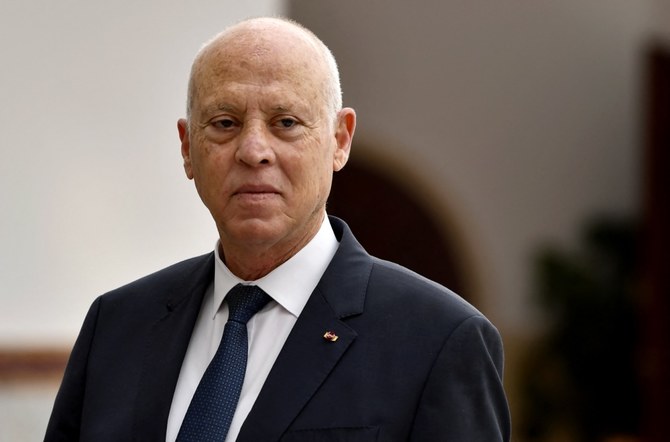
President Kais Saied. (AFP)
Short Url
Updated 09 July 2022
Follow

Tunisia’s president publishes amended draft of constitution with minor changes

TUNIS: Tunisian President Kais Saied has published an amended version of a draft constitution in an attempt to ward off criticism after the original was slammed for the nearly unlimited power it gave his office.

The new constitution, which will be put to a referendum this month, is the centerpiece of Saied’s plan to remake the North African country’s political system.

It was unveiled almost a year after Saied sacked the government, suspended parliament and added wide-ranging powers.

The legal expert who oversaw the constitution’s drafting has disavowed it, saying it was “completely different” from what his committee had submitted and warning that some articles could “pave the way for a dictatorial regime.”

The amended draft, published around midnight on Friday, makes changes to two articles, though it still retains a broad range of powers for the head of state.

Hours before the new text was released, Saied announced in an official video that “clarifications needed to be added to avoid confusion and interpretation.”

Changes have been made to an article that stated Tunisia “is part of the Islamic community” and that “the state must work to achieve the objectives of Islam” — it now adds “within a democratic system.”

The clause had been previously criticized for its ambiguity by those who advocated for a completely secular system, and international rights group Amnesty International had warned it could “provide a mandate to discriminate against other religious groups.”

The other amendment is to an article about rights and freedoms, which now clarifies that “no restriction may be placed on the rights and freedoms guaranteed in this Constitution except by law and necessity imposed by a democratic order.”

The rest of the document remains largely unchanged.

Saied wants a presidential system to replace the country’s 2014 constitution, which enshrined a mixed presidential-parliamentary system often beset by deadlock and marred by corruption.

Under his proposal, “the president of the republic carries out executive functions with help from the government,”  whose chief would be appointed by the president and not subject to confidence votes in parliament.

The document would water down the role of parliament, creating a new parliamentary chamber for “regions and districts,” chiming with Saied’s long-held vision for a decentralization of power.

The president would be the head of the armed forces and be charged with naming judges, who would be banned from striking.

Some Tunisians have welcomed Saied’s moves against the sclerotic system that emerged from the revolt that toppled President Zine El Abidine Ben Ali in 2011.


Death toll in Iran protests over 3,000, rights group says

Updated 17 January 2026
Follow

Death toll in Iran protests over 3,000, rights group says

  • The protests erupted on December 28 over economic hardship and swelled into widespread demonstrations calling for the end of clerical rule
  • President Donald Trump, who had threatened ‘very strong action’ if Iran executed protesters, said Tehran’s leaders had called off mass hangings

DUBAI: More than 3,000 people have died in Iran’s nationwide protests, rights activists said on Saturday, while a “very slight rise” in Internet activity was reported in the country after an eight-day blackout.

The US-based HRANA ​group said it had verified 3,090 deaths, including 2,885 protesters, after residents said the crackdown appeared to have broadly quelled protests for now and state media reported more arrests.

The capital Tehran has been comparatively quiet for four days, said several residents reached by Reuters. Drones were flying over the city, but there were no signs of major protests on Thursday or Friday, said the residents, who asked not to be identified ‌for their safety.

A ‌resident of a northern city on the ‌Caspian ⁠Sea ​said ‌the streets there also appeared calm.

The protests erupted on December 28 over economic hardship and swelled into widespread demonstrations calling for the end of clerical rule in the Islamic Republic, culminating in mass violence late last week. According to opposition groups and an Iranian official, more than 2,000 people were killed in the worst domestic unrest since Iran’s 1979 Islamic Revolution.

“Metrics show a very ⁠slight rise in Internet connectivity in #Iran this morning” after 200 hours of shutdown, the ‌Internet monitoring group NetBlocks posted on X. Connectivity ‍remained around 2 percent of ordinary levels, ‍it said.

A few Iranians overseas said on social media that ‍they had been able to message users living inside Iran early on Saturday.

US President Donald Trump, who had threatened “very strong action” if Iran executed protesters, said Tehran’s leaders had called off mass hangings.

“I greatly respect the fact that all scheduled ​hangings, which were to take place yesterday (Over 800 of them), have been canceled by the leadership of Iran. Thank you!” he ⁠posted on social media.

Iran had not announced plans for such executions or said it had canceled them.

Indian students and pilgrims returning from Iran said they were largely confined to their accommodations while in the country, unable to communicate with their families back home.

“We only heard stories of violent protests, and one man jumped in front of our car holding a burning baton, shouting something in the local language, with anger visible in his eyes,” said Z Syeda, a third-year medical student at a university in Tehran.

India’s External Affairs Ministry said on Friday that commercial flights were available and that ‌New Delhi would take steps to secure the safety and welfare of Indian nationals.