

At Pakistan’s largest cattle market, ‘Turkish’ double-humped camels the main event

A young man takes a selfie with a two-humped camel at the Karachi Cattle Market, Pakistan, on July 4, 2022 (AN Photo by S.A.Babar)
Short Url
Updated 07 July 2022
Follow

At Pakistan’s largest cattle market, ‘Turkish’ double-humped camels the main event

  • Owner Hajji Shahdad brought six of the “special” camels from his hometown Quetta, has sold off three
  • Over three thousand camels up for sale at Karachi Cattle Market, brought from all corners of Pakistan

KARACHI: While the Karachi Cattle Market, Pakistan’s largest, is generally a busy place ahead of the Eid Al-Adha holiday, one corner of the crowded bazaar stood out this week: the stall featuring three double-humped camels that their owner said were a Turkish breed.

Every year, sacrificial animals worth millions are bought and sold at the Karachi Cattle Market located on the outskirts of the megacity and spread over 2,000 acres of land. For sale this year are 425,000 animals, divided across 14 blocks in the bazaar.

While Muslims often slaughter sheep at the annual Eid Al-Adha “feast of the sacrifice” which falls on Sunday, many Pakistanis, especially the wealthy, think bigger, flocking to cattle markets to find camels for auction.

And so, while the loud voices of customers haggling over the prices of animals hung over the entire bazaar, they were the loudest at the Turkish camel stall, where a large crowd had gathered and many customers, young and old, posed for selfies.

A spokesperson for the cattle market, Asif Ali Syed, told Arab News over three thousand camels were up for sale at the bazaar.

“A thing which is less is rare, and people like rare [things],” Hajji Shahdad, the owner of the double-humped camels, told Arab News, saying he had brought six of the “special” camels from his hometown Quetta, the capital of Pakistan’s southwestern Balochistan province, and already sold off three.
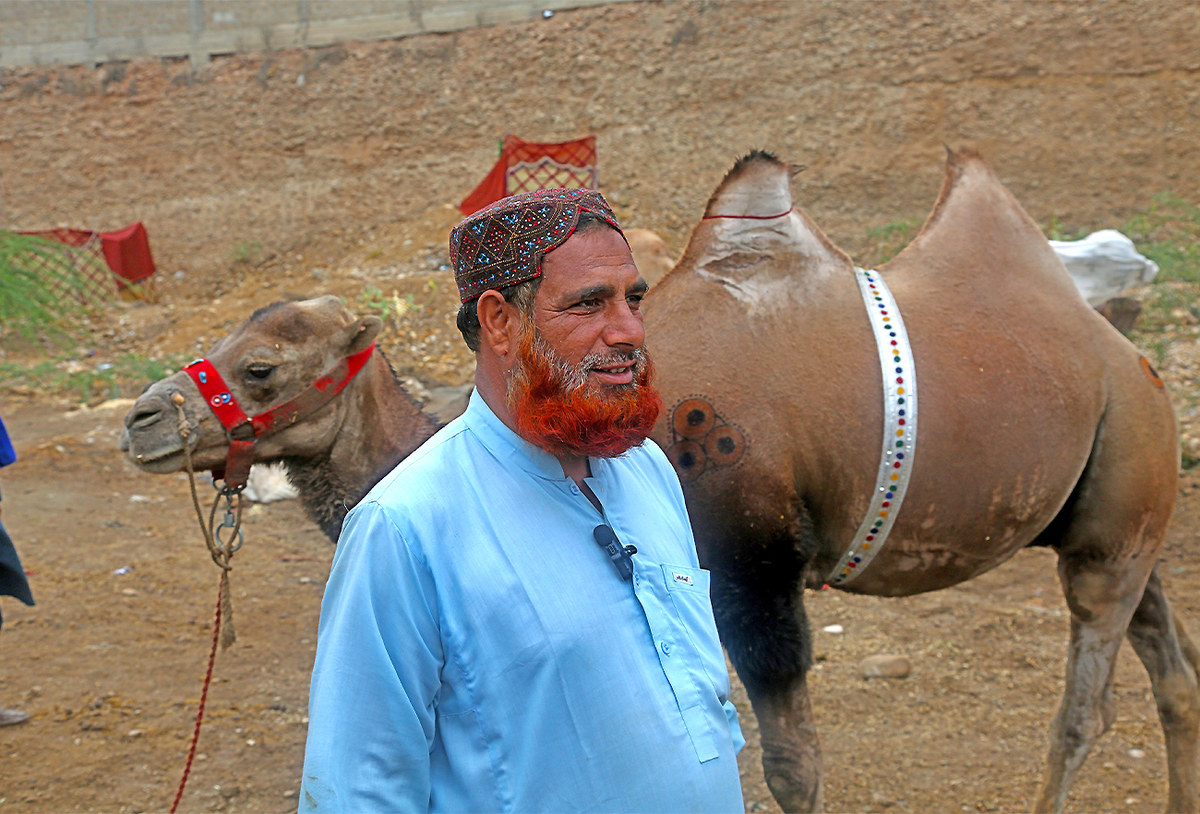


Haji Shahdad, a trader from Quetta, seen with one of his two-humped camels at the Karachi Cattle Market, Pakistan, on July 4, 2022 (AN Photo by S.A.Babar)

Arab News could not independently verify if the camels were Turkish, though Shahdad said they were purchased by traders on the border of Turkey and then brought to Quetta via Afghanistan. One type of double-humped camel, the large Bactrian camel, hails from Central Asia.

“We had heard Karachi is a hub for passionate people,” he said. “This is why we looked after them [camels] for six to seven months and then brought them here for sale.”

Shahdad described his camels as “powerful and loyal creatures” that unlike Pakistani camels did not need to wear nose pegs, which are used to stir and brake camels and control them.

“The camels that we have in Pakistan have nose-pegs but no such thing on this,” he said, tapping the nose of one of his camels. “You can take it anywhere by just holding the rope ... It also sits in vehicles with ease.” 
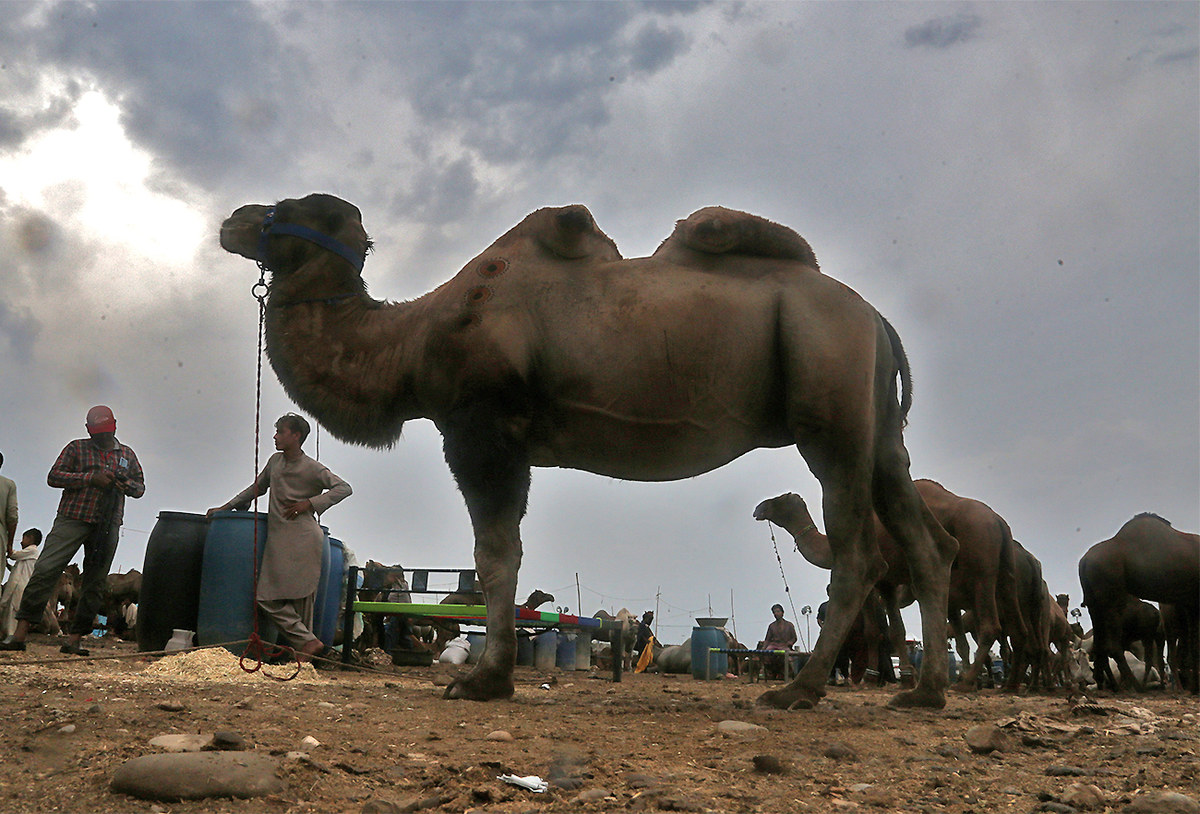


Two-humped camels at the Karachi Cattle Market, Pakistan, on July 4, 2022 (AN Photo by S.A.Babar)

But despite the camels’ unique traits, Shahdad said he was not able to fetch the prices he had hoped for.

While regular camels at the market sold for up to Rs800,000 ($3,850), he had sought a sum of Rs1,200,000-1,500,000 (up to $5,775) for his double-humped camels. 

But the best offers he got ranged between Rs800,000-1,000,000 ($4,800). 

“Everyone is offering prices according to their status,” Shahdad said, shrugging as he spoke about people’s reduced purchasing power this year due to soaring inflation, which has crossed 21 percent and is at a 13-year-high in Pakistan.

The livestock trader scoffed at other sellers who he said made up unique names and traits for their animals to spike the interest of buyers.

Reading off the names of some of the camels being sold at the market — Prince, or Sultan, which means emperor — Shahdad said he didn’t need gimmicks to sell his animals. 

“These are two-humped camels,” he said with a smile as he patted an animal, “and famous with this name only.”


Police lodge case over Karachi mall blaze under mischief, negligence and murder clauses

Updated 24 January 2026
Follow

Police lodge case over Karachi mall blaze under mischief, negligence and murder clauses

  • The fire broke out at the densely packed Gul Plaza in the heart of Karachi on Jan. 17 and has so far claimed 71 lives
  • Traders have estimated losses at $53.6 million, while the government has announced $35,720 for family of each victim

ISLAMABAD: Police in Pakistan’s southern port city of Karachi have registered a case over a deadly blaze at Gul Plaza, which has so far claimed 71 lives, under mischief, negligence and murder clauses, a senior police official said on Saturday.

The fire broke out at the densely packed commercial complex in the heart of Karachi on Jan. 17, trapping workers and shoppers inside. It burnt for over 24 hours before being brought under control, leaving the building structurally unsafe.

Authorities have not yet confirmed the cause of the fire. Police said preliminary indications pointed to a possible electrical short circuit, though officials stress conclusions will only be drawn after investigations are completed.

A week after the incident, police have registered the first information report (FIR) of the incident under sections 427, 436, 337-H (i) and 322 of the Pakistan Penal Code, according to Deputy Inspector General (DIG) Karachi South Asad Raza.

“The FIR of the Gul Plaza tragedy has been registered under the government’s prosecution, with case number 08/2026 at Nabi Bux police station,” Raza told Arab News.

Section 427 relates to mischief causing damage, 436 concerns mischief by fire or explosive substance, 337-H (i) details punishment for rash or negligent act, and 322 details punishment for homicide.

Deadly fires are a recurring problem in Karachi, a city of more than 20 million people, where overcrowded markets, aging infrastructure, illegal construction and weak enforcement of safety regulations frequently contribute to disasters. Officials say a blaze of this scale is rare.

Identification has been significantly slowed by the condition of the remains recovered from the site, Syed said, noting that many bodies were found in fragments, complicating DNA analysis and prolonging the process for families waiting for confirmation.

Traders have estimated total losses from the fire at up to Rs15 billion ($53.6 million). The Sindh provincial government this week announced compensation of Rs10 million ($35,720) for the family of each person killed in the blaze and said affected shopkeepers would also receive financial assistance.

Separately on Saturday, the Muttahida Qaumi Movement-Pakistan (MQM-P) party urged Prime Minister Shehbaz Sharif to constitute an inquiry commission to hold those accountable whose negligence led to the Gul Plaza inferno.

“Incapability, mistake, apathy, shamelessness, impudence — these should be exposed,” MQM-P’s Farooq Sattar said, calling for an “independent judicial inquiry” into the Gul Plaza tragedy to ensure the truth comes to light.

LAHORE HOTEL FIRE

Meanwhile, a fire erupted at a hotel in the eastern city of Lahore in Pakistan’s most populous Punjab province, according to Rescue 1122 service.

Six people were injured due to the blaze at the hotel in the city’s Gulberg area who were shifted to hospital.

“All necessary steps be taken to quickly control the fire, instructions,” Deputy Commissioner Muhammad Ali Aijaz directed authorities. “Immediate evacuation of all people from the building be ensured.”