

Pakistan central bank may raise rates by 125 bps to tame 13-year high inflation

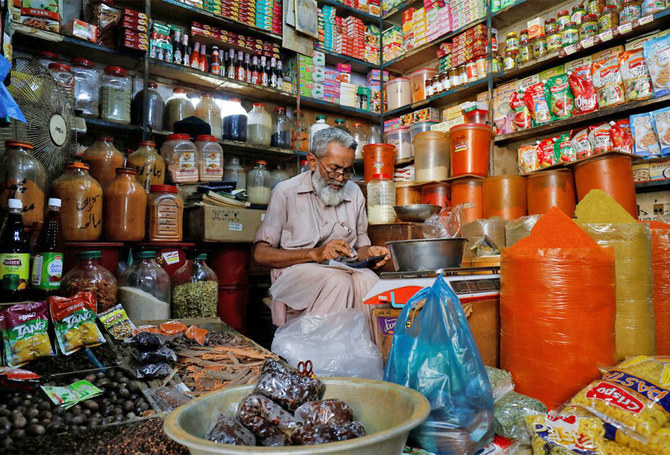
A shopkeeper uses a calculator while selling spices and grocery items along a shop in Karachi, Pakistan, on June 11, 2021. (REUTERS/File)
Short Url
Updated 05 July 2022
Follow

Pakistan central bank may raise rates by 125 bps to tame 13-year high inflation

  • The South Asian nation is wrestling with economic turmoil, a fall in reserves and a weakening currency
  • Another hike would increase government debt servicing costs as well as hurt industries, says an economist

ISLAMABAD: Pakistan’s central bank looks set to raise its key policy rate by 125 basis points at its review on Thursday, as it attempts to tackle 13-year high retail inflation, according to the median estimate in a snap poll of 10 economists and market watchers. 

The economists, analysts and senior professors surveyed were widely split on the quantum of increase by the State Bank of Pakistan (SBP), with views ranging from 50 to 200 basis points. 

Two respondents did not see a need for a rate increase. 

The central bank raised the benchmark interest rate by 150 bps in May, taking the total increase to 400 bps so far this year to counter rising inflation. 

The South Asian nation is wrestling with economic turmoil, a fall in reserves and a weakening currency. 

Data on Friday showed consumer prices in June leapt 21.3 percent from a year earlier, largely on account of a 90 percent spike in fuel prices since the end of May after the government scrapped costly fuel subsidies. 

With the current policy rate at 13.75 percent and inflation running well above, real interest rates in the economy have turned sharply negative. 

“The last monetary policy committee statement is proof that the State Bank of Pakistan is way behind the curve on anticipating inflation,” said Yousuf Nazar, an economist who writes for various publications and formerly with Citigroup. 

“Another hike would increase government debt servicing costs as well as hurt industries. 

It is not going to have much of an impact on exchange rate or overall demand,” he added. 

Most believed a hike was inevitable, given persistently high global energy prices, the abrupt ending of fuel subsidies as well as the need to control demand after SBP said in its last policy statement the economy had rebounded much more strongly than anticipated. 

“The overall policy mix is geared toward stabilization and demand management,” CEO of Macro Economic Insights Sakib Sherani said, adding that this will induce a sharp slowdown in the economy, possibly a recession, in the short run. 

But Fahad Rauf, head of research at Ismail Iqbal Securities, said he does not see the need to increase rates further. 

“The economy is already slowing down. The layoffs have started and are expected to increase further. 

Further cost pressures would only enhance the burden on industries and workers,” Rauf said. 

“The fiscal arm is working now, tough measures have been taken. SBP needs to wait for the results before further tightening,” he added. 

With Pakistan expecting a restart of the much-awaited bailout package from the International Monetary Fund after the country agreed on some tough economic policy adjustments to promote stability, the SBP’s decision is being closely watched. 


Death toll in Pakistan shopping plaza fire rises to 67, officials say

Updated 22 January 2026
Follow

Death toll in Pakistan shopping plaza fire rises to 67, officials say

  • Rescue teams still searching for damaged Gul Plaza in Karachi where blaze erupted on Saturday, says police surgeon
  • Karachi has a long history of deadly fires, often linked to poor safety standards, weak regulatory enforcement

KARACHI: The death toll from a devastating fire at a shopping plaza in Pakistan’s southern port city of Karachi jumped to 67 on Thursday after police and a hospital official confirmed that the remains of dozens more people had been found.

Police surgeon Dr. Summaiya Syed said rescue teams were still searching the severely damaged Gul Plaza in the Karachi, where the blaze erupted on Saturday.

Most remains were discovered in fragments, making identification extremely difficult, but the deaths of 67 people have been confirmed, she said. Asad Raza, a senior police official in Karachi, also confirmed the death toll. Authorities previously had confirmed 34 deaths.

Family members of the missing have stayed near the destroyed plaza and hospital, even after providing their DNA for testing. Some have tried to enter the building forcibly, criticizing the rescue efforts as too slow.

“They are not conducting the search properly,” said Khair-un-Nisa, pointing toward the rescuers. She stood outside the building in tears, explaining that a relative who had left to go shopping has been missing since the blaze.

Another woman, Saadia Saeed, said her brother has been trapped inside the building since Saturday night, and she does not know what has happened to him.

“I am ready to go inside the plaza to look for him, but police are not allowing me,” she said.

There was no immediate comment from authorities about accusations they have been too slow.

Many relatives of the missing claim more lives could have been saved if the government had acted more swiftly. Authorities have deployed police around the plaza to prevent relatives from entering the unstable structure, while rescuers continue their careful search.

Investigators say the blaze erupted at a time when most shop owners were either closing for the day or had already left. Since then, the Sindh provincial government has said around 70 people were missing after the flames spread rapidly, fueled by goods such as cosmetics, clothing, and plastic items.

The cause of the fire remains under investigation, though police have indicated that a short circuit may have triggered the blaze.

Karachi has a long history of deadly fires, often linked to poor safety standards, weak regulatory enforcement, and illegal construction.

In November 2023, a shopping mall fire killed 10 people and injured 22. One of Pakistan’s deadliest industrial disasters occurred in 2012, when a garment factory fire killed at least 260 people.
