

PM Sharif approves five-day holiday for Eid Al-Adha

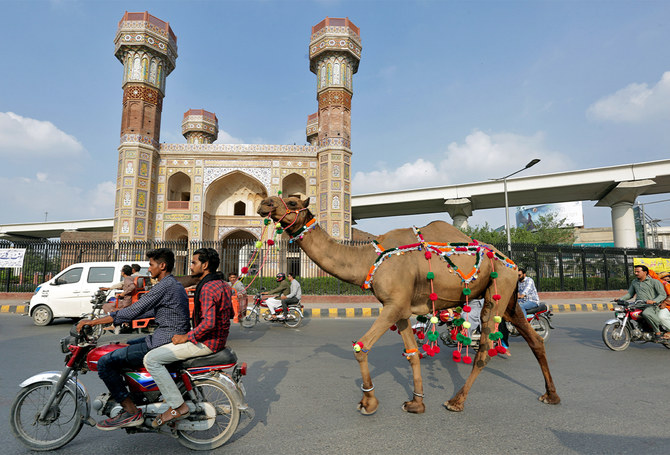
A Pakistani man leads his camel to market ahead of the Eid Al-Adha holiday in Lahore, Pakistan, on July 3, 2022. (AP)
Short Url
Updated 04 July 2022
Follow

PM Sharif approves five-day holiday for Eid Al-Adha

  • The festival that marks the end of Hajj and is celebrated by Muslims around the world
  • Pakistan’s moonsighting committee has said the country will celebrate Eid on July 10

ISLAMABAD: Prime Minister Shehbaz Sharif on Sunday approved a five-day holiday for the upcoming Islamic festival of Eid Al-Adha, as nearly one million people gathered in Makkah to perform Hajj this year.

The second major religious festival for Muslims across the world, Eid Al-Adha falls on the tenth day of Dhu Al-Hijjah, the last month of the lunar Islamic calendar, marking the end of the annual Hajj pilgrimage.

Pakistan’s moonsighting committee announced last Wednesday the country would celebrate the Islamic festival on July 10.

“The Prime Minister has seen and is pleased to approve the Eid-ul-Azha holidays from 8th to 12th July, 2022 (Friday to Tuesday),” said an official notification circulated by the PM Office on Sunday. “Further action may be taken accordingly.”

Pakistan’s provincial administrations of Punjab and Sindh have already allowed markets to function for longer durations ahead of Eid to help people prepare for the festival.

Previously, the provincial governments had ordered businesses and markets to close by 9pm to conserve energy amid a growing power crisis in the country.

Pakistan has also reported rising number of coronavirus cases in recent days and its central pandemic response body has made it mandatory for people to wear masks on all domestic flights, railways and public transport while traveling.


Pakistan mulls 'Super App' for public services, document verification in major technology push

Updated 7 sec ago
Follow

Pakistan mulls 'Super App' for public services, document verification in major technology push

  • Pakistan has been urging technology adoption in public, private sectors as it seeks to become a key tech player globally
  • The country this month launched the Indus AI Week to harness technology for productivity, skills development and innovation

KARACHI: Pakistan is planning to launch a “Super App” to deliver public services and enable digital document verification, the country's information technology (IT) minister said on Sunday, amid a major push for technology adoption in public and private sectors.

Pakistan, a country of 240 million people, seeks to become a key participant in the global tech economy, amid growing interest from governments in the Global South to harness advanced technologies for productivity, skills development and innovation.

The country's information and communications technology (ICT) exports hit a record $437 million in Dec. last year, according to IT Minister Shaza Fatima Khawaja. This constituted a 23% increase month on month and a 26% increase year on year.

Pakistan's technology sector is also advancing in artificial intelligence (AI) and cloud computing, marked by the launch of Pakistan’s first sovereign AI cloud in November, designed to keep sensitive data domestic and support growth in the broader digital ecosystem.

“In developed countries, citizens can access all government services from a mobile phone,” Fatima said, announcing plans for the Super App at an event in Karachi where more than 7,000 students had gathered for an AI training entrance test as part of the ‘Indus AI Week.’

“We will strive to provide similar facilities in the coming years.”

Khawaja said the app will reduce the need for in-person visits to government offices such as the National Database and Registration Authority (NADRA) and the Higher Education Commission (HEC).

The Indus AI Week initiative, which ran from Feb. 9 till Feb. 15. was aimed at positioning Pakistan as a key future participant in the global AI revolution, according to the IT minister.

At the opening of the weeklong initiative, Prime Minister Shehbaz Sharif announced that Pakistan would invest $1 billion in AI by 2030 to modernize the South Asian nation’s digital economy.

“These initiatives aim to strengthen national AI infrastructure and make the best use of our human resource,” Khawaja said, urging young Pakistanis to become creators, inventors and innovators rather than just being the consumers of technology.