

PM Sharif approves five-day holiday for Eid Al-Adha

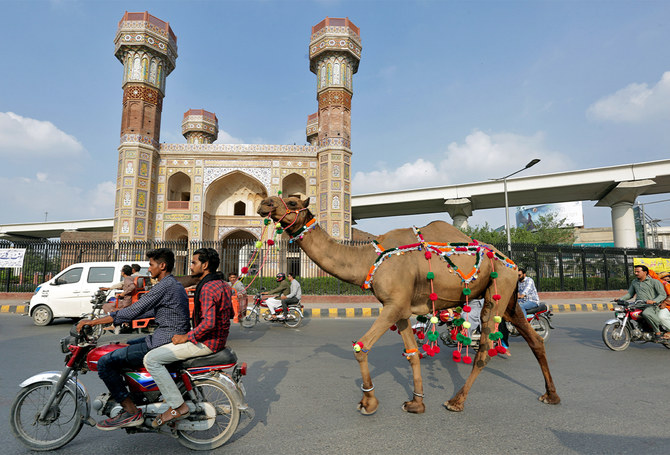
A Pakistani man leads his camel to market ahead of the Eid Al-Adha holiday in Lahore, Pakistan, on July 3, 2022. (AP)
Short Url
Updated 04 July 2022
Follow

PM Sharif approves five-day holiday for Eid Al-Adha

  • The festival that marks the end of Hajj and is celebrated by Muslims around the world
  • Pakistan’s moonsighting committee has said the country will celebrate Eid on July 10

ISLAMABAD: Prime Minister Shehbaz Sharif on Sunday approved a five-day holiday for the upcoming Islamic festival of Eid Al-Adha, as nearly one million people gathered in Makkah to perform Hajj this year.

The second major religious festival for Muslims across the world, Eid Al-Adha falls on the tenth day of Dhu Al-Hijjah, the last month of the lunar Islamic calendar, marking the end of the annual Hajj pilgrimage.

Pakistan’s moonsighting committee announced last Wednesday the country would celebrate the Islamic festival on July 10.

“The Prime Minister has seen and is pleased to approve the Eid-ul-Azha holidays from 8th to 12th July, 2022 (Friday to Tuesday),” said an official notification circulated by the PM Office on Sunday. “Further action may be taken accordingly.”

Pakistan’s provincial administrations of Punjab and Sindh have already allowed markets to function for longer durations ahead of Eid to help people prepare for the festival.

Previously, the provincial governments had ordered businesses and markets to close by 9pm to conserve energy amid a growing power crisis in the country.

Pakistan has also reported rising number of coronavirus cases in recent days and its central pandemic response body has made it mandatory for people to wear masks on all domestic flights, railways and public transport while traveling.


Pakistan finance chief calls for stronger emerging market voice during Saudi conference

Updated 12 February 2026
Follow

Pakistan finance chief calls for stronger emerging market voice during Saudi conference

  • Aurangzeb tells Saudi state media developing economies must assume larger global role
  • Minister says AlUla conference can strengthen coordination among emerging economies

KARACHI: Pakistan’s Finance Minister Muhammad Aurangzeb on Thursday called for developing economies to play a greater role in shaping global economic governance in an interview on the sidelines of the AlUla Conference for Emerging Market Economies in Saudi Arabia.

The conference, hosted by the Kingdom’s Finance Ministry, brings together top government functionaries, central bank governors and policymakers from emerging markets to discuss debt sustainability, macroeconomic coordination and structural reforms amid global economic uncertainty.

In a conversation with the Saudi Press Agency, Aurangzeb described the conference as a timely platform for dialogue at a moment of heightened geopolitical tensions, trade fragmentation and rapid technological change, including advances in artificial intelligence.

“It is not merely about discussions but about translating deliberations into concrete policy actions and execution over the course of the year,” he said, according to a statement circulated by the Finance Division in Islamabad.

The minister said emerging markets’ growing share of global output and growth should be matched by greater influence in international decision-making.

He noted these economies must strengthen collective dialogue and coordinated policy responses to address shared challenges, adding that the global landscape had evolved significantly since the inaugural edition of the conference.

Aurangzeb expressed confidence that the outcomes of the AlUla Conference would contribute to strengthening coordination among emerging economies and reinforcing their collective voice in shaping a more inclusive and resilient global economic order, the statement added.