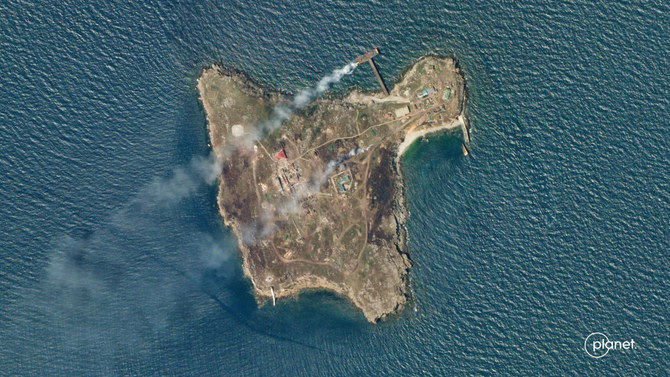
KYIV: Ukraine’s army accused Russia of carrying out strikes using incendiary phosphorus munitions on Snake Island Friday, just a day after Moscow withdrew its forces from the rocky outcrop in the Black Sea.
“Today at around 18:00... Russian air force SU-30 planes twice conducted strikes with phosphorus bombs on Zmiinyi island,” it said in a statement, using another name for Snake Island.
The Russian defense ministry on Thursday described the retreat as “a gesture of goodwill” meant to demonstrate that Moscow will not interfere with UN efforts to organize protected grain exports from Ukraine.
The Ukrainian army on Friday accused the Russians of being unable to “respect even their own declarations.”
Its statement was accompanied by a video that showed a plane drop munitions at least twice on the island, and what appeared to be white streaks rising above it.
Phosphorus weapons, which leave a signature white trail in the sky, are incendiary weapons whose use against civilians is banned under an international convention but allowed for military targets.
Ukraine has accused Russia of using them several times since it invaded its neighbor in late February, including on civilian areas, allegations Moscow has denied.
Ukraine claimed the Russians were forced to retreat from the island after coming under a barrage of artillery and missile fire.
Snake Island became famous after a radio exchange went viral at the start of the war, in which Ukrainian soldiers respond using bad words to a Russian warship that called on them to surrender.

Ukraine army accuses Russia of firing phosphorus bombs on Snake Island
https://arab.news/nuaha
Ukraine army accuses Russia of firing phosphorus bombs on Snake Island
- Russian air force SU-30 planes twice conducted strikes with phosphorus bombs on Zmiinyi island
- The Russian defence ministry on Thursday described the retreat as "a gesture of goodwill"
Fears mount for Palestine Action prisoners as one approaches 70th day of hunger strike
- Heba Muraisi ‘constantly suffering with headaches and lightheadedness’ as Kamran Ahmed admitted to hospital over heart complications
- Neurologist warns of potential physical and neurological damage due to strike
LONDON: Fears are rising that a group of prisoners on hunger strike in the UK could die as one of them approaches the 70th day of their protest.
Three people currently detained for activities related to the banned group Palestine Action are currently on hunger strike, with one of them, Kamran Ahmed, having required hospital treatment on five occasions since the start of the protest. He was admitted to hospital on the 58th day of his strike following heart complications.
Heba Muraisi, 31, is now on the 69th day of her hunger strike, with friends fearing for her safety.
“I think she’s lost over 10 kilograms now. She looks very different to the photographs that you’ll see of her,” Muraisi’s friend Amareen Afzal told Sky News.
“Her face is very gaunt; cheekbones are very prominent. She’s physically exhausted, very tired. She is constantly suffering with headaches and lightheadedness. Sometimes she gets so lightheaded she feels nauseous and that’s quite common.”
Muraisi and Ahmed are part of a larger group originally on strike over demands including an end to UK arms sales to Israel, the de-proscription of Palestine Action, and immediate bail, having been on remand for over a year.
UK law stipulates remand should only last six months, but Lord Timpson, the UK’s prisons minister, said the severity of the charges meant judges could decide to extend the period.
The protestors deny charges relating to two break-ins, one at a site belonging to Israel-linked arms manufacturer Elbit Systems, and the other at a Royal Air Force base in Brize Norton. Following those incidents, Palestine Action was banned in the UK under the Terrorism Act.
Afzal said of Muraisi: “She’s aware that she’s deteriorating and physically dying — that her body could fail her at any moment.
“I am obviously frightened for her and her life, I want her to be OK, but I’m incredibly proud of her and completely in awe of her resilience. I think that word can be a little bit overused but I think there is something about her strength that comes from her commitment to her values. It is awe-inspiring to me.”
A group of 50 British MPs signed a letter this week urging the government to “respond positively and with humanity” to the hunger strikers.
“Independent physicians have advised that they are into a critical phase stage, in which their condition is likely to decline very quickly and irreversibly,” the letter said.
A British neurologist specializing in hunger strikes, meanwhile, said the detainees on hunger strike are at risk of permanent damage, including dementia, blindness, and other neurological and physical issues.
Dr David Nicholl told Sky News: “The biggest risk immediately is what’s called refeeding syndrome. If you picture yourself having not eaten for a number of days, you need to gradually — very gradually — increase your calorie intake.
“Because your body’s not used to suddenly eating, there’s a risk of getting very sick and actually people have died having stopped the hunger strike, but having developed refeeding syndrome.”
A former Irish Republican hunger striker, meanwhile, told Sky News he nearly lost his sight after going without food for 55 days in 1981.
Pat Sheehan said he was expected to die during the strike, which claimed the lives of 10 people in prison during the conflict in Northern Ireland.
“I was the longest on hunger strike when it ended. And in theory, I would have been the next person to die,” he told Sky News. “At that stage, I weighed between 7 and 7.5 stone. I was completely yellow with jaundice. My eyesight had nearly gone completely. I could make out shapes coming into the room, but I wouldn’t have been able to identify anyone.”
Sheehan added: “I have always said that as I became weaker physically, there is absolutely no doubt that I became stronger psychologically.”
In a statement, Lord Timpson said: “Prison healthcare teams provide NHS care and continuously monitor the situation.”


