Huge Hindu pilgrimage begins in Indian-administered Kashmir

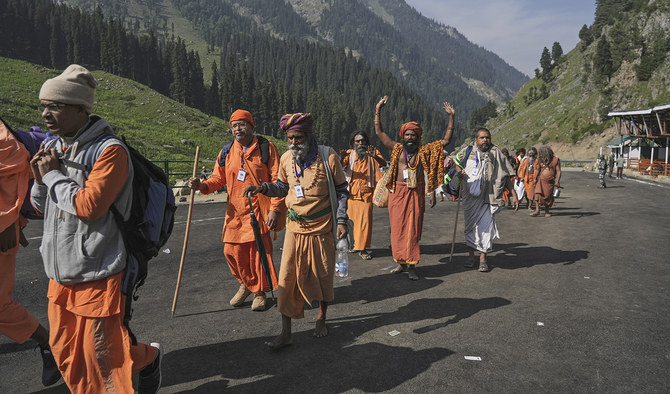
Hindu devotees begin the Amarnath Yatra annual pilgrimage to to an icy Himalayan cave, in Chandanwari, Pahalgam, south of Srinagar, Indian-controlled Kashmir, on June 30, 2022. (AP)
Short Url
Updated 30 June 2022
Follow

Huge Hindu pilgrimage begins in Indian-administered Kashmir

  • Critics accuse India of using Amarnath procession to reinforce its claim over disputed region
  • Million people expected to partake in pilgrimage suspended for two years due to coronavirus

PAHALGAM, India: Thousands of chanting devotees from across India began trekking up through Himalayan passes in Indian-administered Kashmir Thursday at the start of a huge pilgrimage, accompanied by a major security operation. 

Critics accuse the Hindu nationalist government of using the annual Amarnath procession to reinforce New Delhi's claims over the disputed Muslim-majority region. 

Authorities expect around a million people to take part in a pilgrimage to the cave shrine at 3,900 meters (12,800 feet) containing a holy stalagmite over the coming 43 days. 

The procession, which sees pilgrims trek uphill for several days or be transported by donkey or helicopter did not take place for two years because of the pandemic. 

On Thursday devotees chanted religious hymns as tens of thousands of Indian soldiers guarded the twin routes of Pahalgam and Baltal leading to the shrine to the Hindu god Shiva. 

Over 400 sandbag bunkers manned by armed soldiers dot the Himalayan landscape surrounding the shrine and along the routes to two base camps. 

Authorities restricted locals from visiting the two tourist resorts of Pahalgam and Sonmarg that serve as base camps during the pilgrimage. 

All traffic was being halted on the main highway to the start while convoys guarded by armed soldiers passed through, with all connecting roads blocked with coils of razor wire. 

Dilip Sharma, from the northern Indian state of Rajasthan, said he was ecstatic to be able to undertake the pilgrimage again after three years. 

"You can't imagine how happy I am at being able to pay my obeisance to the lord again. I want to thank the government of India for very good arrangements," Sharma told an AFP photographer along the trek to the shrine. 

The event used to be low-key, with a few thousand pilgrims attending, until an armed insurgency against the Indian rule of Kashmir erupted in 1989. 

Since then the religious practice -- and accompanying security mobilisation -- have grown, as has its political significance. 

The territory is divided between India and Pakistan and claimed by both. 

Rebels have often said that the pilgrimage is not a target but have warned in the past that if the religious event was used to establish Hindu domination of the territory they would act. 

In 2017 suspected rebels attacked a bus, killing 11 pilgrims. 

On Thursday some of the pilgrims chanted a slogan equating Hindu nationalist Prime Minister Narendra Modi to a deity, an AFP videographer said. 

As an additional security measure this year, authorities assigned all pilgrims a unique radio identification tag to closely monitor their movement. 


Italian PM pledges to deepen cooperation with African states

Updated 14 February 2026
Follow

Italian PM pledges to deepen cooperation with African states

  • The plan, launched in 2024, aims to promote investment-led cooperation rather than traditional aid

ADDIS ABABA: Italy pledged to deepen cooperation with African countries at its second Italy-Africa summit, the first held on African soil, to review projects launched in critical sectors such as energy and infrastructure during Italy’s first phase of the Mattei Plan for Africa.

The plan, launched in 2024, aims to promote investment-led cooperation rather than traditional aid.

Italy’s Prime Minister Giorgia Meloni addressed dozens of African heads of state and governments in Ethiopia’s capital, Addis Ababa, and reiterated that a successful partnership would depend on Italy’s “ability to draw from African wisdom” and ensure lessons are learned.

“We want to build things together,” she told African heads of state.  “We want to be more consistent with the needs of the countries involved.”

Ethiopian Prime Minister Abiy Ahmed said Italy had provided Africa with a gateway to Europe through these partnerships.

“This is a moment to move from dialogue to action,” he said. 

“By combining Africa’s energetic and creative population with Europe’s experience, technology, and capital, we can build solutions that deliver prosperity to our continents and beyond.”

After the Italy-Africa summit concluded, African leaders remained in Addis Ababa for the annual African Union Summit.

Kenyan writer and political analyst Nanjala Nyabola said tangible results from such summits depend on preparations made by countries.

African governments often focus on “optics instead of actually making summits a meaningful engagement,” she said.

Instead of waiting for a list of demands, countries should “present the conclusions of an extended period of mapping the national needs” and engage in dialogue to determine how those needs can be met.

Since it was launched two years ago, the Mattei Plan has directly involved 14 African nations and has launched or advanced around 100 projects in crucial sectors, including energy and climate transition, agriculture and food security, physical and digital infrastructure, healthcare, water, culture and education, training, and the development of artificial intelligence, according to the Italian government.