

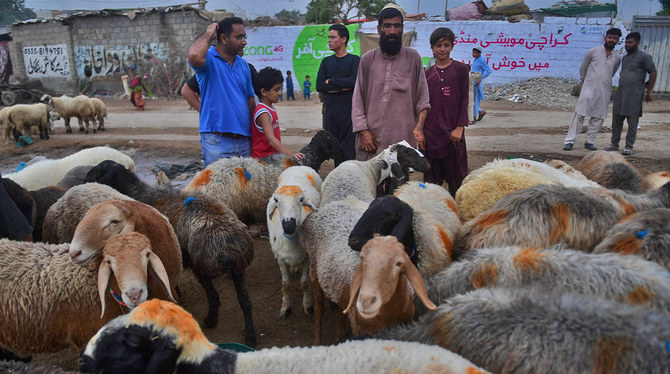

KARACHI: Organizers of the country’s largest annual cattle market in Karachi said this week they had been turning back since May truckloads of animals found to be infected with lumpy skin disease (LSD), while livestock authorities in Sindh said they were carrying out inspections to ensure unvaccinated animals did not enter the province from other parts of the country.
Prevalent in Africa since 1929, LSD is a viral infection that causes fever and multiple nodules on the skin and mucous membrane of animals. The disease is transmitted by bloodsucking insects like ticks and mosquitoes. It does not affect people and is rarely fatal.
In Pakistan, LSD was first reported in animals in the Punjab province in October 2021. A month later, a case was reported in Sindh’s Jamshoro district, prompting authorities to immediately set up a task force to control the disease.
LSD has since killed 571 cows in Sindh, where 52,566 out an 11 million cattle population has been infected, according to the Sindh livestock authorities. While a vaccination drive that began on April 4 brought the animal mortality rate in Sindh to almost zero, the virus continues to spread in the province.
“No comprehensive efforts to control the disease were taken by other provinces,” Dr. Nazeer Hussain Kalhoro, director-general of Sindh livestock department, told Arab News on Tuesday. “Therefore, the disease continues to spread there and it is a matter of concern if these animals access markets in the Sindh province.”
Kalhoro said the situation had prompted his department to devise a strategy, in collaboration with the federal government, so that only livestock vaccinated against LSD and foot-and-mouth disease (FMD) entered the Sindh province.
For this purpose, he said, eight camps had been set up at Sindh’s entry and exit points with Punjab and Balochistan provinces. Two more camps had been established at the Super Highway cattle market and Malir Bakra Mandi in Karachi.
Asif Ali Syed, a spokesperson for the country’s largest cattle market off Super Highway set up each year for the sale and purchase of sacrificial animals on Eid, said organizers had returned 18 truckloads of infected animals since May 27. Of those, he said, around 14 trucks had come from other provinces, mostly Punjab.
“Only four of them were from Sindh, while a majority were from Punjab. The latest of such trucks was returned last week,” he said.
Hinting that traders were still able to transport infected animals into the province, Syed said no animal with a health issue could enter the Super Highway market as there were teams of vets present at each gate to check for LSD and other diseases.
The market expects to receive 400,000 animals ahead of Eid this year, of which 275,000 have already arrived.
Though Kalhoro, the Sindh livestock official, said consuming the meat of animals infected with LSD did not affect humans, Dr. Zaied Khan, a veterinary expert, said the meat of animals that had recovered from the disease was not harmful but the antibiotics used to treat the virus could create immunity problems in humans.
“Meat is safe,” Khan told Arab News, “but if an animal is treated with heavy antibiotics and steroids, then it can cause immunity problems in humans.”


