Death toll in Jordan chlorine gas leak rises to 13

1 / 5
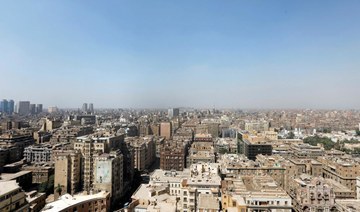
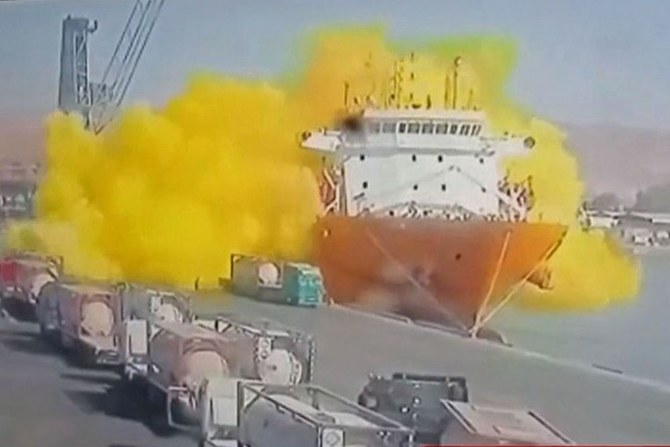
At least 11 people have died and more than 230 were being treated in hospital after a toxic gas leak from a storage tank in Jordan's Aqaba port. (Screenshot/Jordan TV)
2 / 5
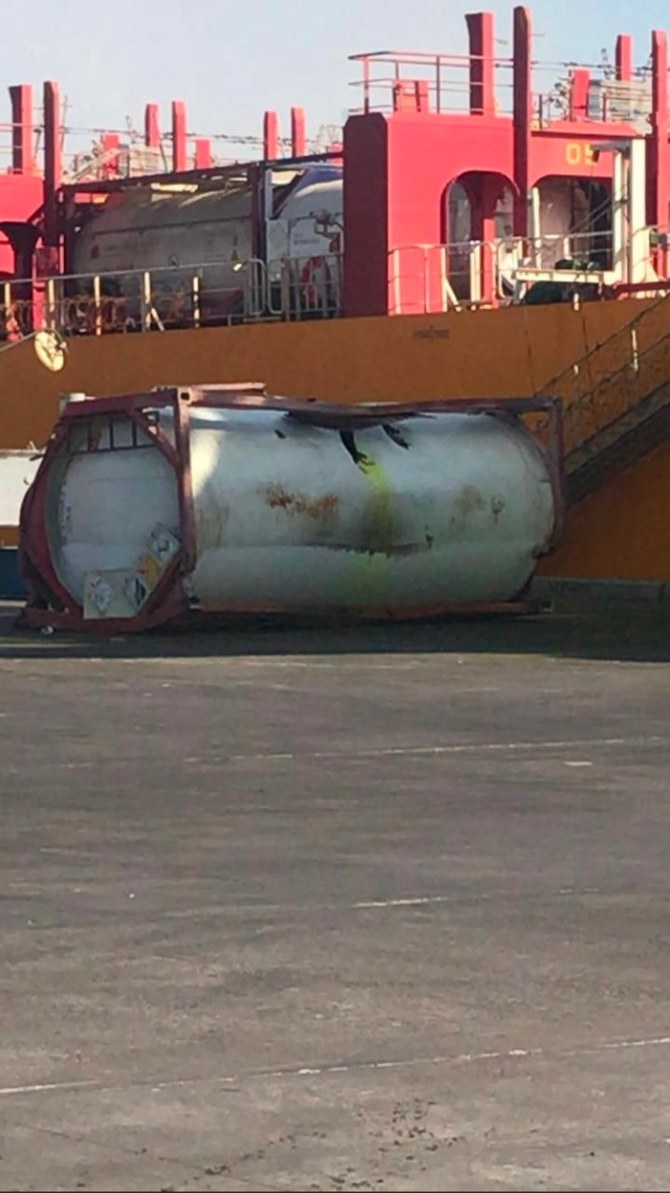
At least 11 people have died and more than 230 were being treated in hospital after a toxic gas leak from a storage tank in Jordan's Aqaba port. (Screenshot/Jordan TV)
3 / 5
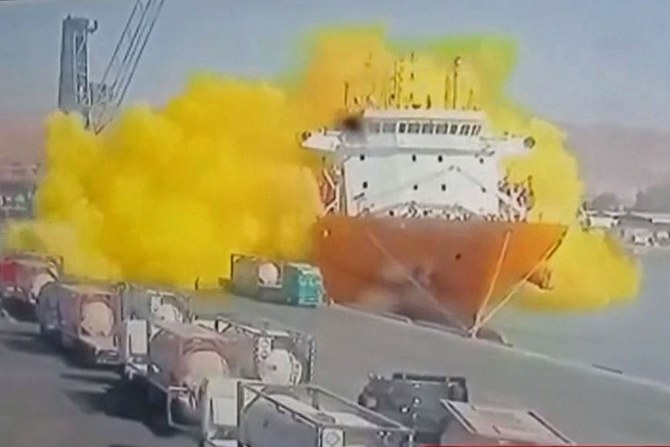
At least 11 people have died and more than 230 were being treated in hospital after a toxic gas leak from a storage tank in Jordan's Aqaba port. (Screenshot/Jordan TV)
4 / 5
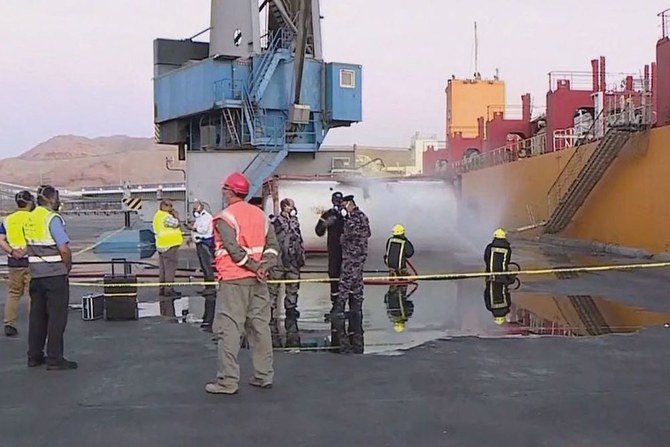
At least 11 people have died and more than 230 were being treated in hospital after a toxic gas leak from a storage tank in Jordan's Aqaba port. (Screenshot/Jordan TV)
5 / 5
At least 11 people have died and more than 230 were being treated in hospital after a toxic gas leak from a storage tank in Jordan's Aqaba port. (Screenshot/Jordan TV)
Short Url
Updated 28 June 2022
Follow

Death toll in Jordan chlorine gas leak rises to 13

  • Canister with 25 tons of chlorine plunges from crane
  • Workers flee for lives from deadly clouds

AMMAN: Thirteen people were killed, including at least four Asian migrants, when toxic chlorine gas escaped on the dockside in the Jordanian Red Sea port of Aqaba, officials said.

Eight of the casualties were Jordanian. The force of the blast sent a truck rolling down the harborside, while clouds of yellow gas billowed overhead and dock workers ran for their lives.

Nearby areas were evacuated and residents told to close and seal doors and windows and to avoid going out.

Public Security Department spokesman Amer Sartawy said “specialists and the hazardous substances team in the civil defense” were dealing with the incident.

Prime Minister Bishr Khasawneh and Interior Minister Mazen Al-Faraya immediately headed to the scene, visited a hospital where some of the injured were being treated, and formed an investigation team into the incident.

The accident happened when a tank filled with 25 tons of chlorine gas being exported to Djibouti fell while being transported. Video footage showed showed a crane hoisting the tank from a truck, and then the tank falling on to the deck of a ship and exploding.

The injured were transported to two state hospitals, one private facility and a field hospital.

Aqaba health director Jamal Obeidat said hospitals in the area were full and could not receive more cases. “The injured people are in medium to critical condition,” he said.

Aqaba port is the Jordan’s only marine terminal and a key transit point for much of its imports and exports. Its beaches are also a major tourist attraction, and were evacuated after Monday’s incident.

Dr. Mhammed Al-Tarawneh, a chest diseases consultant, said chlorine gas was extremely toxic, and the leakcould significantly affect areas surrounding the explosion.

He said contact with this gas could cause irritation of the mucous membranes and a red skin rash. Inhaling the gas could cause pneumonia, burning in the esophagus, diarrhea, headaches, vision impairment, and loss of consciousness.

Saudi Arabia extended its condolences to the families of the victims, the Saudi Press Agency said early Tuesday, citing a foreign ministry statement.

The Kingdom wished the injured a speedy recovery and hoped for Jordan security, peace and stability.

The US offered its condolences to the families of the victims of the blast. “We stand ready to support the government of Jordan as it responds to this tragedy,” US Ambassador Henry Wooster said. “I urge all US citizens in Aqaba to follow all public health guidance.”

The secretary-general of the GCC, Dr. Nayef Falah Mubarak Al-Hajraf, also expressed his condolences. “The GCC stands with the government and the Jordanian people in these difficult moments,” he said.

with AFP


Lebanon finance minister defends tax hike after outcry

Updated 5 sec ago
Follow

Lebanon finance minister defends tax hike after outcry

  • Jaber said the wage hike would cost the state $620 million, hence the decision to raise taxes was made to “preserve financial balance”
  • The decision was not unanimous, with Energy Minister Joe Saddi saying he had “objected”

BEIRUT: Lebanon’s finance minister defended on Tuesday his government’s decision to raise taxes to finance a hike in public sector wages, which sparked an outcry from a major union and a protest that briefly blocked a Beirut artery.
The cabinet’s decision the day before aimed to increase by sixfold rock-bottom wages and pension payments for hundreds of thousands of civil servants and retirees in a country still reeling from a devastating economic crisis that started in 2019.
In addition to the crisis, Lebanon is also suffering the aftereffects of a recent war between Iran-backed Hezbollah and Israel, with the international community conditioning aid on public reforms.
The new decision raises the value-added tax (VAT) to 12 percent, from 11 percent before, and adds 300,000 Lebanese pounds (around $3.30) per 20-liter can of gasoline.
Finance Minister Yassin Jaber said in a press conference on Tuesday that the wage hike would cost the state $620 million, hence the decision to raise taxes was made to “preserve financial balance, because any imbalance would lead us to a crisis.”
The decision was not unanimous, with Energy Minister Joe Saddi saying he had “objected... to approving any tax increases at this stage.”
Lebanon has around 320,000 public servants, including 120,000 security forces members, according to Jaber.
Their salaries have shrunk due to the severe depreciation of the Lebanese pound’s value over the past six years.
Under the decision, public sector wages would increase to about 28 percent of their value before the 2019 crisis, Walid Geagea, head of the Public Sector Employees Association, told AFP.
But Geagea rejected the government’s move, saying “you give us a sixfold increase and it goes away (by paying for) fuel and taxes.”
Bassam Tlais, head of Federations and Unions of the Land Transport Sector, said in a statement they “support improving wages, but we refuse to place this additional burden on citizens and the transport sector.”
“Our demand is to find fair alternatives that don’t burden people financially.”
Taxi drivers briefly blocked a road in central Beirut earlier on Tuesday to protest the decision.
Senior financial adviser Michel Kozah told AFP that the cabinet’s move “will create inflation,” adding that “the central bank will be forced to increase the money in circulation.”