MADRID: Spain is lobbying for NATO to pay more attention to security threats on its southern flank when the military alliance gathers for a summit in Madrid later this week.
But with the war in Ukraine entering its fifth month, the priority for Spain’s NATO partners remains firmly on deterring Russian in the east.
When NATO leaders convene in Madrid on June 28-30 they are due to revamp the alliance’s strategic concept, which outlines its main security tasks and challenges but has not been revised since 2010.
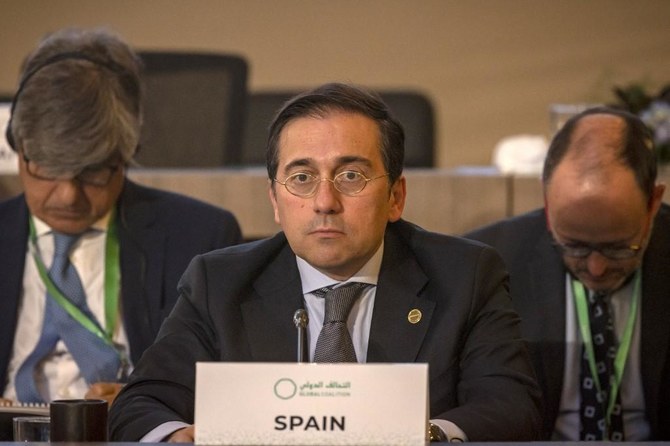
Spanish Foreign Minister Jose Manuel Albares has been pushing for NATO to broaden its scope to help deal with non-military threats such as “the political use of energy resources and illegal immigration” in Africa.
“The threats are as much from the southern flank as from the eastern flank,” he told a Madrid news conference on Wednesday.
Madrid is also concerned about lawlessness and violent Islamist movements in the Sahel region, a vast territory stretching across the south of the Sahara Desert.
“We have this war in Europe, but the situation in Africa is really worrying,” said Spanish Defense Minister Margarita Robles.
The issue is particularly acute for Spain, a main gateway into Europe for irregular migration from Africa and a country which relies on Algeria for gas supplies.
Last year Morocco allowed thousands of migrants to enter Spain’s North African enclave of Ceuta during a diplomatic crisis over the disputed Western Sahara, prompting Madrid to accuse Rabat of “blackmail.”
Although the two countries recently normalized their relations after Spain ended its decades-long position of neutrality over Western Sahara to publicly support Morocco’s stance, the migration crisis hasn’t come to an end.
On Friday at dawn, around 2,000 African migrants tried to storm the border with Melilla, the other Spanish enclave on Morocco’s northern coast. At least 23 died in the incursion, making it the deadliest incident to occur at the borders of the two Spanish enclaves — the only borders between the EU and Africa.
And earlier this month Morocco’s arch-rival Algeria suspended a co-operation treaty with Spain in response to Madrid’s U-turn over Western Sahara.
But with an active conflict on NATO’s eastern flank, it is going to be “an uphill struggle” to convince member states to make a commitment to the southern flank, said Sinan Ulgen, a NATO expert at the Carnegie Europe think-tank in Brussels.
“The war in Ukraine has changed the equation. The threat from Russia has become the main preoccupation for almost all the countries,” the former Turkish diplomat said.
In Washington, US national security spokesman John Kirby said “the focus right now is on the eastern flank.”
“But there remains a continued effort to make sure we are also paying attention to the southern flank,” he added.
In an interview published Saturday by Spanish daily El Pais, NATO secretary-general Jens Stoltenberg said the Alliance would “strengthen (its) cooperation with southern countries,” mentioning Mauritania in particular.
Aside from Russia, Washington’s other major concern is China, which is expected to be mentioned in NATO’s strategic concept for the first time.
To try to convince its NATO allies, Spain has sounded the alarm over the growing presence of Russian mercenaries in African nations like Mali and the Central African Republic, arguing instability could increase African migration to Europe.
Madrid has also suggested that Russia was behind Spain’s recent diplomatic spat with Algeria.
“Unfortunately the threats from the south are increasingly Russian threats from the south,” Albares said.
Ulgen said that another difficulty is that while other southern European nations want a greater NATO engagement in Africa, they have different priorities, making it hard to set a common alliance-led strategy.
“Rome, Paris, Madrid, Ankara still assess the political and security challenges differently. That is the fundamental reason why there is not a stronger push for NATO to have a bigger role” in the southern flank, said Ulgen.
In addition, many top US policymakers believe NATO should focus on territorial defense, not non-conventional threats, said Angel Saz, the director of the Center for Global Economy and Geopolitics at Spain’s Esade business school.
“And the only threat to territorial defense is Russia. The Sahel can destabilize Europe, but it will not conquer Spain or Italy,” he said.
Spain has “perhaps put too much emphasis” on the call for a greater NATO role in the southern flank and “it runs the risk of under accomplishing,” he added.


NATO summit host Spain seeks focus on southern security
https://arab.news/yxejx
NATO summit host Spain seeks focus on southern security

- When NATO leaders convene in Madrid on June 28-30 they are due to revamp the alliance’s strategic concept


Russia jails 15 for life over IS-claimed 2024 concert hall attack
- Eleven other men were also jailed for life for acting as accomplices and of having terrorist links
- Four more men were handed sentences of between 19 and 22 years over their links with the attackers
MOSCOW: A Russian court on Thursday handed life sentences to four gunmen from Tajikistan, and 11 others it said were their accomplices, for the 2024 Crocus concert hall attack that left 150 people dead.
The March 2024 shooting spree was claimed by Daesh and was the deadliest militant attack in Russia in more than two decades.
Relatives of some of the victims stood in the grand Moscow military court as the verdict was read out.
Shamsidin Fariduni, Dalerdzhon Mirzoyev, Makhammadsobir Fayzov and Saidakrami Rachabolizoda — all Tajik citizens who went on a shooting spree in the building before setting it on fire — looked down as the judge sentenced them to life.
Eleven other men — some Russian citizens — were also jailed for life for acting as accomplices and of having terrorist links.
Four more men — including a father and his sons — were handed sentences of between 19 and 22 years over their links with the attackers.
The gunmen entered the concert hall shortly before a show by Soviet-era rock band Picnic. They went on a shooting spree before setting fire to the building, trapping many victims. The attack wounded more than 600 people. Six children were among those killed.
Uliana Filippochkina, whose twin brother Grigory was killed in the attack, flew from Siberia’s Novosibirsk for the verdict.
She said she was “satisfied” with the ruling and that she had looked the men who killed her twin in the eyes during their final statements in the trial.
“They didn’t explain anything, they tried to escape responsibility, appealing to the fact that they had wives and children... That they were under the influence of drugs,” she said.
- ‘No remorse’ -
“There was no sympathy or remorse whatsoever,” she added.
Her brother went to the concert shortly before his 35th birthday. The family were only able to identify what was left of his body weeks later, burying his remains in Novosibirsk.
The verdict came ahead of the second anniversary of the killings.
“For us all it’s like yesterday,” Ivan Pomorin, who was filming the Crocus Hall concert at the time, told AFP.
Lawyers said some of the victims are still being treated for their wounds, while others have severe PTSD, unable to sleep, use public transport or be in crowded places.
The four gunmen — aged 20 to 31 at the time — worked in various professions, among them was a taxi driver, factory employee and construction worker.
They stood in the glass defendant’s cage, surrounded by security guards.
According to media reports, Mirzoyev’s brother was killed fighting in Syria, possibly leading to his radicalization.
Hours after the attack, Russian police brought them to court with signs of torture — including one barely conscious in a wheelchair.
- ‘Redeem guilt with blood’ -
The attack came two years into Moscow’s war in Ukraine, with Russia — bogged down by the offensive — dismissing prior US warnings of an imminent attack.
The Kremlin had suggested a Ukrainian connection at the time of the attack, but never provided evidence.
Russia’s Investigative Committee said after the verdict it was “reliably established” that the attack was “planned and committed in the interests of” Kyiv.
It accused the men of also plotting attacks in Dagestan.
TASS state news agency reported this month, citing a lawyer, that two of them — Dzhabrail Aushyev and Khusein Medov — had asked to be sent to fight in Ukraine instead of a life sentence.
Throughout its offensive, Russia has recruited prisoners for its military campaign, offering a buy-out from their sentences should they survive.
According to the lawyer quoted by TASS, Medov said he wanted to “redeem his guilt with blood.”
- Anti-migrant turn -
Russia — already undergoing a conservative social turn during the war — upped anti-migrant laws and rhetoric after the attack.
This has led to tensions with Moscow’s allies in Central Asia, some of whom have confronted Russia and called on it to respect the rights of their citizens.
Russia’s economy has for years been heavily reliant on millions of Central Asian migrants.
But their flow to Russia dipped after Moscow launched its Ukraine campaign and some Central Asians also held back from going to Russia after the post-Crocus migrant crackdowns.


