MADRID: Spain is lobbying for NATO to pay more attention to security threats on its southern flank when the military alliance gathers for a summit in Madrid later this week.
But with the war in Ukraine entering its fifth month, the priority for Spain’s NATO partners remains firmly on deterring Russian in the east.
When NATO leaders convene in Madrid on June 28-30 they are due to revamp the alliance’s strategic concept, which outlines its main security tasks and challenges but has not been revised since 2010.
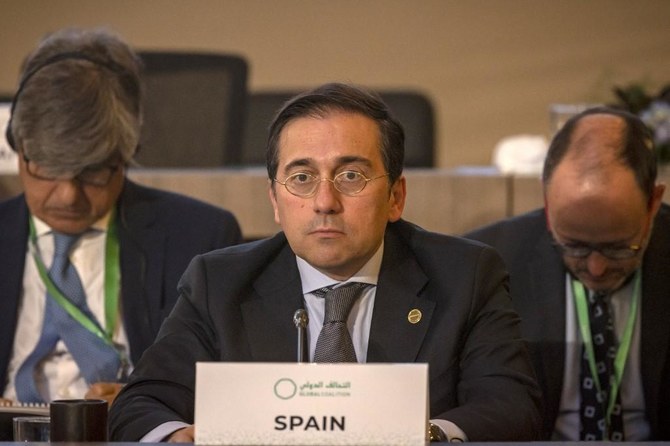
Spanish Foreign Minister Jose Manuel Albares has been pushing for NATO to broaden its scope to help deal with non-military threats such as “the political use of energy resources and illegal immigration” in Africa.
“The threats are as much from the southern flank as from the eastern flank,” he told a Madrid news conference on Wednesday.
Madrid is also concerned about lawlessness and violent Islamist movements in the Sahel region, a vast territory stretching across the south of the Sahara Desert.
“We have this war in Europe, but the situation in Africa is really worrying,” said Spanish Defense Minister Margarita Robles.
The issue is particularly acute for Spain, a main gateway into Europe for irregular migration from Africa and a country which relies on Algeria for gas supplies.
Last year Morocco allowed thousands of migrants to enter Spain’s North African enclave of Ceuta during a diplomatic crisis over the disputed Western Sahara, prompting Madrid to accuse Rabat of “blackmail.”
Although the two countries recently normalized their relations after Spain ended its decades-long position of neutrality over Western Sahara to publicly support Morocco’s stance, the migration crisis hasn’t come to an end.
On Friday at dawn, around 2,000 African migrants tried to storm the border with Melilla, the other Spanish enclave on Morocco’s northern coast. At least 23 died in the incursion, making it the deadliest incident to occur at the borders of the two Spanish enclaves — the only borders between the EU and Africa.
And earlier this month Morocco’s arch-rival Algeria suspended a co-operation treaty with Spain in response to Madrid’s U-turn over Western Sahara.
But with an active conflict on NATO’s eastern flank, it is going to be “an uphill struggle” to convince member states to make a commitment to the southern flank, said Sinan Ulgen, a NATO expert at the Carnegie Europe think-tank in Brussels.
“The war in Ukraine has changed the equation. The threat from Russia has become the main preoccupation for almost all the countries,” the former Turkish diplomat said.
In Washington, US national security spokesman John Kirby said “the focus right now is on the eastern flank.”
“But there remains a continued effort to make sure we are also paying attention to the southern flank,” he added.
In an interview published Saturday by Spanish daily El Pais, NATO secretary-general Jens Stoltenberg said the Alliance would “strengthen (its) cooperation with southern countries,” mentioning Mauritania in particular.
Aside from Russia, Washington’s other major concern is China, which is expected to be mentioned in NATO’s strategic concept for the first time.
To try to convince its NATO allies, Spain has sounded the alarm over the growing presence of Russian mercenaries in African nations like Mali and the Central African Republic, arguing instability could increase African migration to Europe.
Madrid has also suggested that Russia was behind Spain’s recent diplomatic spat with Algeria.
“Unfortunately the threats from the south are increasingly Russian threats from the south,” Albares said.
Ulgen said that another difficulty is that while other southern European nations want a greater NATO engagement in Africa, they have different priorities, making it hard to set a common alliance-led strategy.
“Rome, Paris, Madrid, Ankara still assess the political and security challenges differently. That is the fundamental reason why there is not a stronger push for NATO to have a bigger role” in the southern flank, said Ulgen.
In addition, many top US policymakers believe NATO should focus on territorial defense, not non-conventional threats, said Angel Saz, the director of the Center for Global Economy and Geopolitics at Spain’s Esade business school.
“And the only threat to territorial defense is Russia. The Sahel can destabilize Europe, but it will not conquer Spain or Italy,” he said.
Spain has “perhaps put too much emphasis” on the call for a greater NATO role in the southern flank and “it runs the risk of under accomplishing,” he added.


![]()

NATO summit host Spain seeks focus on southern security
Short Url
https://arab.news/yxejx
NATO summit host Spain seeks focus on southern security
- When NATO leaders convene in Madrid on June 28-30 they are due to revamp the alliance’s strategic concept


Latest updates


© 2026 SAUDI RESEARCH & PUBLISHING COMPANY, All Rights Reserved And subject to Terms of Use Agreement.