

Lebanon’s Aoun stresses importance of preserving Jerusalem in meeting with Hamas leader

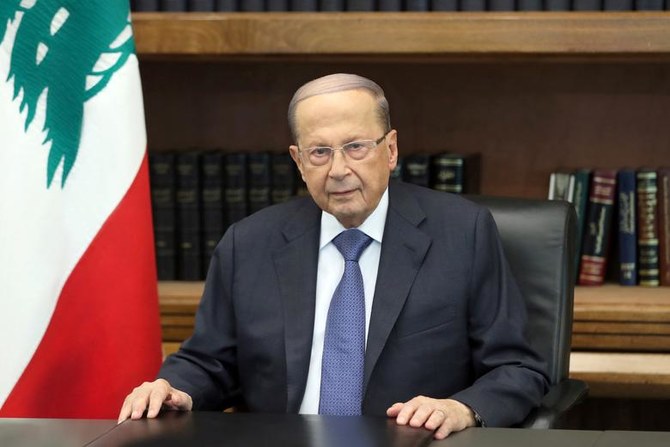
Michel Aoun expressed “the right of the Palestinian people to establish their independent state on all their national territory, with Jerusalem as its capital.” (Reuters/File Photo)
Short Url
Updated 24 June 2022
Follow

Lebanon’s Aoun stresses importance of preserving Jerusalem in meeting with Hamas leader

  • Palestinian people have the right ‘to establish their independent state,’ president says
  • ‘Hamas stands in solidarity with Lebanon,’ Ismail Haniyeh, head of group’s political bureau, says

BEIRUT: Lebanon’s President Michel Aoun on Friday reaffirmed his country’s position on the Palestinian cause during a meeting with Ismail Haniyeh, the head of the political bureau of Hamas.

Aoun expressed “the right of the Palestinian people to establish their independent state on all their national territory, with Jerusalem as its capital,” and stressed Palestinian refugees’ right to return home.

“Palestinians’ resistance to occupation is not terrorism,” Aoun said, adding that “no one can imagine Jerusalem without the Church of the Holy Sepulchre and other holy sites,” and stressing the need “to preserve Jerusalem, where Christianity, Islam and Judaism meet.”

After the meeting, Haniyeh said: “The Israeli occupation does not differentiate between a Muslim and a Christian in Palestine, especially in Jerusalem.

“Hamas stands in solidarity with Lebanon and condemns the Israeli enemy’s attempt to steal from Lebanon’s maritime resources.”

He added that he wished Lebanon “security, stability and more solidarity.”

Haniyeh’s visit to Lebanon is his third in two years and coincided with World Refugee Day. On his first visit, he said: “Our missiles will be launched from our land (targeting Israel) and we will not involve Lebanon.”

Raafat Murra, a Hamas official, said Haniyeh’s visit to Beirut “highlights the need to resolve the crisis of Palestinian refugees in Lebanon.”

Haniyeh’s office said one of the aims of the trip was “addressing the reality of the Palestinian cause and Palestinian refugees in Lebanon” as well as “consulting and cooperating with the Palestinian factions’ officials, in a way that serves the Palestinian cause.”

A Palestine Liberation Organization official in Lebanon, who chose to remain anonymous, told Arab News that “the PLO and Fatah are not involved with Haniyeh’s visit to Lebanon. This visit is part of the special program between Hamas and Hezbollah.”

During his time in Lebanon, Haniyeh also visited Grand Mufti Sheikh Abdel Latif Derian and Hezbollah chief Hassan Nasrallah.

Hezbollah said that “Haniyeh and Nasrallah underlined the importance of cooperation between the Axis of Resistance to serve the central goal, which is concerned with Jerusalem, holy sites and the Palestinian cause.”

The PLO official said that Hezbollah was “trying to solve the problems between Hamas and the Syrian regime.”

Asked about a Hamas announcement that Haniyeh’s visit to Lebanon was related to the Palestinian refugee camps, he said the refugees had their own authority — the PLO — and that Lebanon recognized the independent state of Palestine and deals with it to address all issues facing the camps.


Gaza fuel running short after Israel closes borders amid Iran war

Gaza is wholly ‌dependent on fuel ‌brought in by trucks from Israel ​and ‌Egypt.
Updated 57 min 46 sec ago
Follow

Gaza fuel running short after Israel closes borders amid Iran war

  • Israel’s military closed all Gaza border crossings on Saturday after announcing air strikes on Iran carried out jointly with the US
  • Israeli authorities say the crossings cannot be operated safely during war

CAIRO/JERUSALEM: Gaza is rapidly running out of its limited fuel supply and stocks of food staples may become tight, officials say, after Israel blocked the ​entry of fuel and goods into the war-shattered territory, citing fighting with Iran.
Israel’s military closed all Gaza border crossings on Saturday after announcing air strikes on Iran carried out jointly with the United States. Israeli authorities say the crossings cannot be operated safely during war and have not said how long they would be shut.
Few days’ worth of supplies
Gaza is wholly ‌dependent on fuel ‌brought in by trucks from Israel ​and ‌Egypt ⁠and a ​lack ⁠of fresh supplies would put hospital operations at risk and threaten water and sanitation services, local officials say. Most Palestinians in Gaza are internally displaced after Israel’s two-year war with Hamas militants.
“I expect we have maybe a couple of days’ running time,” said United Nations official Karuna Herrmann, who directs fuel distribution in Gaza.
Amjad ⁠Al-Shawa, a Palestinian aid leader in Gaza, ‌who works with the UN and NGOs, ‌estimated fuel supplies could last three or ​four days, while stocks ‌of vegetables, flour, and other essentials could also soon run out ‌if the crossings remain shut.
Reuters was unable to independently verify those estimates.
Israel’s COGAT military agency, which controls access to Gaza, said that enough food had been delivered to the territory since the start of ‌an October truce to provide for the population.
“(The) existing stock is expected to suffice for ⁠an extended period,” ⁠COGAT said, without elaborating. It declined to comment on potential fuel shortages.
The truce was part of broader US-backed plan to end the war that involves reopening the Rafah border crossing with Egypt, increasing the flow of aid into the enclave, and rebuilding it.
Hamada Abu Laila, a displaced Palestinian in Gaza, said the closures were stoking fear of a return of famine, which gripped parts of the enclave last year after Israel blocked aid deliveries for 11 weeks.
“Why is it our fault, in ​Gaza, with regional wars ​between Israel, Iran, and America? It is not our fault,” Abu Laila said.