

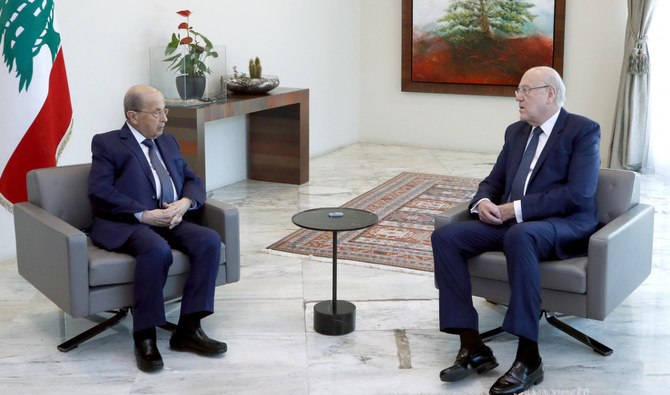

BEIRUT: Lebanese President Michel Aoun has called on voters to “make the right choice” in the upcoming parliamentary elections.
Aoun, whose term ends next October, also confirmed on Thursday that he will not leave office unless he “uncovers all corrupt elements since the responsibility for reforming the country lies with those who will succeed him.”
He stressed “the need to reform the judiciary and other institutions of the state,” adding that “there can be no reform as long as institutions are controlled.”
The Lebanese parliamentary elections are scheduled for May 15.
With 46 days remaining in the current parliamentary term, the government of Prime Minister Najib Mikati is due to end on May 22.
A total of 42 of 1,044 candidates, including six women, had withdrawn their candidacy by late on Wednesday.
Wednesday midnight was the deadline for the withdrawal of candidates who have not found a place in the electoral lists being formed to contest the elections.
Fatin Younis, director-general for political affairs and refugees, whose department receives candidacies, predicted that “the lists will be clear with the expiration of the deadline for registration at midnight on Monday, April 4.”
The countdown to the last deadline to register the lists began on Thursday.
Younis said: “Six lists have been registered on Thursday and the number is expected to rise on Friday, and rise again on Monday after the weekend.”
Younis said that “a problem related to the required documentation faced a number of candidates who wanted to withdraw on Wednesday, having found no place for them in the lists that are in place.”
She added: “They preferred to leave things as they are for their candidacy to drop automatically with the announcement of the lists.”
The announcement of the electoral lists has begun in the media.
Among them is a list headed by MP Fouad Makhzoumi, president of the National Dialogue Party, in the Beirut II district. It is the second list to be announced after the civil society list of the same district.
Most political parties have completed their lists, while others are still working on theirs or are facing disputes between the candidates.
A surprising alliance has emerged between the Socialist Progressive Party and the Lebanese Forces Party in some constituencies.
Wael Abou Faour, a member of the Socialist Progressive Party, said: “Each party will have its own status in other constituencies that are common between both parties.”
The Samir Kassir Foundation has issued a report on the handling of issues related to freedom of expression and democratic frameworks by parties taking part in the parliamentary elections.
The foundation monitored 27 parties and congregations and found that “non-sectarian movements are the most dedicated to discussing the issue of freedom of expression or democracy, including what are considered alternative parties that were founded or emerged after 2011.”
It said that “traditional parties tend to revive a more divisive discourse based on the distinction between ‘us’ and ‘them,’ and adopt a more focused position on this subject.”
The foundation added that “alternative movements generally rely on the idea of ‘combating assassinations’ as part of broader and more comprehensive ideas regarding their view of the existing regime and its repressive instruments as a whole.”
In parallel with the electoral developments, the lead investigating judge in Mount Lebanon, Nicolas Mansour, adjourned Central Bank Gov. Riad Salameh’s questioning until June 9 — after the date of the parliamentary elections — in the Public Prosecution’s case filed against him over claims of “money laundering and illicit enrichment.”
Salameh did not appear for questioning and was represented by his attorney, Chaouki Azan, who presented formal pleadings.
In parallel, judge Mansour decided to release the governor’s brother Raja Salameh, who was arrested on the same charge, in return for a financial guarantee and the seizure of his funds in Lebanon.
Raja Salameh’s attorney appealed to the Mount Lebanon Accusation Authority to reduce bail.




