

Jordan’s King Abdullah II backs idea of ‘Middle East NATO’

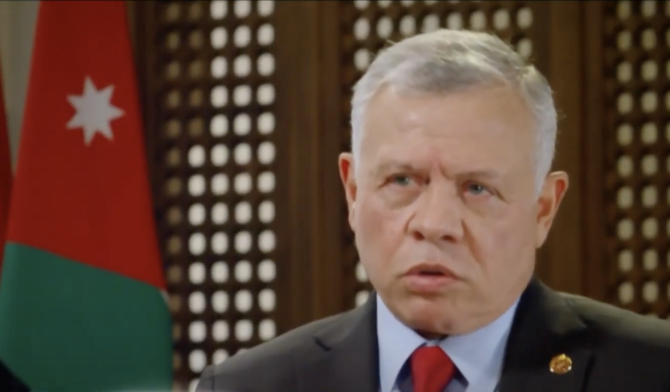
King Abdullah II of Jordan told CNBC he supports the idea of a Middle East military alliance built on the same lines as NATO. (Screenshot/CNBC)
Short Url
Updated 24 June 2022
Follow

Jordan’s King Abdullah II backs idea of ‘Middle East NATO’

  • Alliance could work as long as it has a clear mission statement, king says
  • Could help to address challenges arising from Russia’s invasion of Ukraine, Iran’s destabilizing activity in region

LONDON: King Abdullah II of Jordan said he supports the idea of a Middle East military alliance built on the same lines as NATO.

Speaking to CNBC’s Hadley Gamble, the king said such a grouping could work with like-minded countries, but stressed its mission statement would need to be clear from the outset.

“I’d like to see more countries in the area come into that mix. I would be one of the first people that would endorse a Middle East NATO,” Abdullah said.

“The mission statement has to be very, very clear. Otherwise, it confuses everybody,” he added.

The king said he already saw his country as a “partner” of NATO, with Jordan having worked closely with the organization and its troops having fought “shoulder to shoulder” with NATO forces in the past.

As well as security and military cooperation, a closer alliance in the Middle East could help to address the challenges arising from Russia’s invasion of Ukraine, especially with regard to energy and commodity prices, Abdullah said.

“All of us are coming together and saying ‘how can we help each other?’ which is, I think, very unusual for the region,” he said.

“If I’m okay and you’re not, I’m going to end up paying the price. I’m hoping what you’re seeing in 2022 is this new vibe, I guess, in the region to say, ‘how can we connect with each other and work with each other?’”

The king also discussed the destabilizing threat of Iran to the region’s security and the Israel-Palestine crisis, both of which he said had the potential to disrupt development plans in the region.

“If they’re not talking to each other, that creates insecurities and instability in the region that will affect regional projects.

“Nobody wants war, nobody wants conflict,” he said, adding that it remained to be seen whether countries in the region could work toward a vision where “prosperity is the name of the game.”


Israeli settlers target wells, disrupt water supply to 19 Palestinian areas near Ramallah

Updated 8 sec ago
Follow

Israeli settlers target wells, disrupt water supply to 19 Palestinian areas near Ramallah

  • Settlers broke windows, doors, control panels and cut the cables rendering the wells completely inoperable
  • Attacks by Israeli settlers on Palestinian homes and businesses have increased since October 2023

LONDON: Israeli settlers attacked water wells in the Ein Samia area, northeast of Ramallah, overnight, causing a disruption in the water supply for several hours, according to the Jerusalem District Water Department's report on Sunday.

The Palestinian Authority’s water authority reported that settlers targeted wells number two, four, and six in Ein Samia, disrupting their operation from Saturday at 10 p.m. until Sunday at 9 a.m. The attackers broke windows, doors, control panels and cut the cables, rendering the wells completely inoperable.

It warned that attacks on the primary water source jeopardized access to water for over 19 areas in the occupied West Bank, worsening the difficulties faced by residents near Ramallah.

Attacks by Israeli settlers on Palestinian homes and businesses have increased since October 2023.

These incidents include vandalism, arson, shootings, and the destruction of agricultural lands and water sources, often intended to pressure residents into leaving their land. Israeli authorities often provide protection for settlers during attacks, including military deployment to accompany them and suppress local resistance, the Wafa news agency reported.

Excluding East Jerusalem, which was occupied and annexed by Israel in 1967, some 500,000 Israeli settlers live in the West Bank, along with about 3 million Palestinian residents.