



BERLIN: “I’m interested in understanding why the world is haunted by injuries produced by modernity and its massive crimes, such as fascism, colonialism, slavery... What Algerian psychoanalyst Karima Lazali calls ‘The rogues of the Enlightenment,’” says French-Algerian artist Kader Attia, curator of the 12th Berlin Biennale, entitled “Still Present!”
The biennale, which runs until Sept. 18, attempts to render visible these ‘historical wounds’ of Western modernity, including systemic racism and capitalist extraction, drawing links between individual injury and collective trauma.
Ariella Aisha Azoulay’s “The Natural History of Rape,” for example, presents a largely textual post-World War II archive through anonymous diaries documenting the rampant sexual abuse of women in Berlin at the hands of the allied forces — their ‘liberators.’ The photographs she includes feature a destroyed city rather than violated bodies — a deliberate comment on the incompleteness of the historical archive.

French-Algerian artist Kader Attia is the curator of the 12th Berlin Biennale, entitled “Still Present!” (Jennifer Soike)
In sharp contrast are the explicit, desensitizing images of bloodied, tortured male bodies in Jean-Jacques Lebel’s “Soluble poison: Scenes from the American occupation in Baghdad” — a labyrinthine structure in which larger-than-life-sized prints on fabric of the disturbingly familiar shots taken by US soldiers in Abu Ghraib recur and blur, disrupted by grainy black-and-white imagery of a disfigured Iraq.
“With these works, we are looking at the space in between aggressors and victims. All crimes unify the victims and the perpetrators, psychoanalysts know that,” says Attia.
Lebel’s work was the most talked-about following the show’s opening, with many critics claiming that it appropriated Iraqi bodies. A common concern was that the exposure of injustice does not equate to reparation. Or even art.

Taysir Batniji's 'Suspended Time.' (Supplied)
The Iraqi artists whose works adjoined Lebel’s — including Raed Mutar, who contributed a melancholic painting, and Sajjad Abbas, who presented a public intervention on Iraq’s Green Zone — asked to be moved.
“The work of the curator isn’t just about the art, it’s also about structuring narratives from the different universes represented by the work,” Attia says. “Mapping the world needs to create an archipelago of voices, that’s why I invited artists from both Palestine and Israel, and other regions of the world. I’m imagining the biennale as a map — an archipelago of thinking about crime, but also of hope.”
The colonial conversation — a focus of the show — is, Attia believes, dominated by blind spots surrounding ecology and extraction, restitution and reparation, and fascism and colonialism.
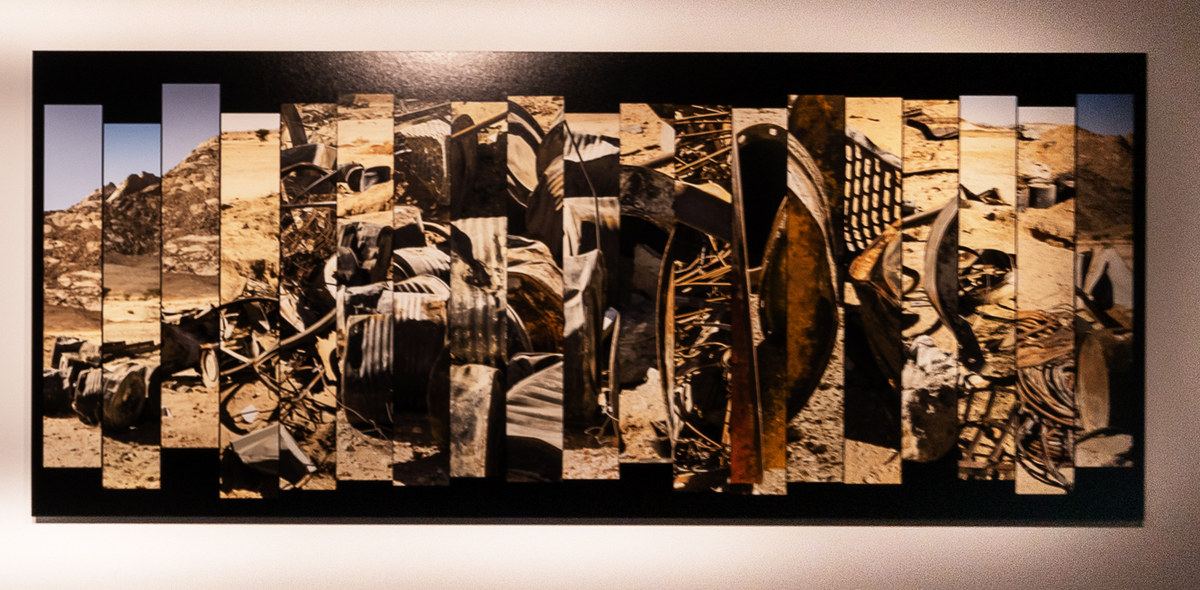
Ammar Bouras' work on display in Berlin. (Supplied)
“First, there is a need to decolonize feminism; to signify that there’s a feminism in the South that’s different from that in the North and give room for that. I believe that artists have the capacity to shine the light on these blind spots,” he says.
The late Egyptian artist Amal Kenawy’s 2009 work “Silence of the Sheep” (or ‘lambs’) is a case in point. It documents a staged performance in which she leads a ‘flock’ of crawling men through the streets of downtown Cairo, while a crowd of indignant men gather around the artist. Attia sees this reaction as a symbolic precursor of the Arab Spring protests that would follow.
Almost a third of the biennale’s artists hail from the Arab world. Asim Abdulaziz’s performative film “1941” is a living sculpture of sleek, shirtless Yemeni men knitting in an abandoned Hindu temple. Algerian artist Ammar Bouras creates a stunning mosaic-like montage of a recomposed Taourirt Tan Afella mountain, referencing the 1962 Béryl explosion caused by French underground nuclear tests in his homeland.

Basel Abbas and Ruanne Abou-Rahme's installation. (Laura Fiorio)
Basel Abbas and Ruanne Abou-Rahme stage a haunting audiovisual installation of juxtaposed screens — “Oh Shining Star Testify” — in which fragmented images of windswept akkoub sunflowers are interspersed with CCTV footage of 14-year-old Yusef Al-Shawamreh, who was shot dead by the Israeli military in 2014 as he crossed the Israeli ‘Separation Wall’ to forage for akkoub. “Give me your scarf to wrap my wound,” the text says.
The Turner Prize-winning Lebanese artist Lawrence Abu Hamdan has wrapped an entire room with a strip of unfurling pinkish-grey clouds that index Israeli military violations of Lebanese airspace for “Air Conditioning.” It also speaks to Attia’s interest in the hidden patriarchal imperial figure. As he puts it, “The oppressor is invisible.”
Taysir Batniji’s “Suspended Time,” made the year he left — and could not return to — Gaza, is a horizontal hourglass through which the sand cannot flow. Taking a lateral view of time, it could be a metaphor for Attia's notion of the frozen present, shaped by a violent understanding of the past. It ties in with Attia’s curatorial statement, in which he writes that art slows down time, free from algorithmic governance.
“Data can be analyzed to generate statistics on the economy of art or the networks affiliated to it,” he writes, “but it can never foresee what the art of tomorrow will look like.”


