

Pakistan says IMF talks progressing, hopes to get updated memorandum of targets this weekend

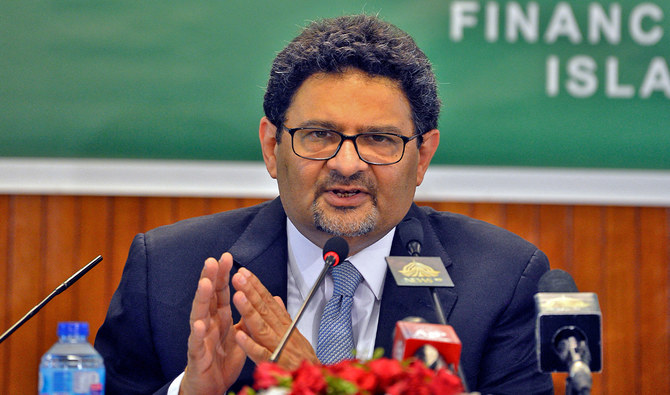
Pakistan's Finance Minister Miftah Ismail speaks during the launch ceremony of 'Economy Survey 2021-22' in Islamabad on June 9, 2022. (AFP/File)
Short Url
Updated 22 June 2022
Follow

Pakistan says IMF talks progressing, hopes to get updated memorandum of targets this weekend

  • Pakistan is seeking to receive latest tranche of $6 billion loan as its economy teeters on brink of crisis
  • Finance minister says $2.3 billion loan facility agreement signed with Chinese consortium of banks

ISLAMABAD: The Pakistani finance minister said on Wednesday Islamabad had made “important progress” in talks with the International Monetary Fund and hoped to receive an updated memorandum on macroeconomic and financial targets under a $6 billion program “over the weekend,” paving the way for the disbursement of a latest tranche of up to $1 billion.

Pakistan entered the IMF program in 2019. The last disbursement was in February and the next tranche was to follow a review in March, but the government of now ousted prime minister Imran Khan introduced costly fuel subsidies which threw fiscal targets and the program off track. Pakistan’s new government has removed the price caps, with fuel prices going up by around 70 percent in less than a month.

Pakistan is hoping to get the latest tranche as its economy teeters on the brink of crisis, with foreign exchange reserves drying up fast and the Pakistani rupee at record lows against the US dollar.

Pakistan had sought an increase in the size and duration of the program when its representatives met with IMF officials in Washington in April.

“We have made important progress [in talks],” Finance Minister Miftah Ismail told Arab News. “Now over the weekend we hope to get the MEFP [memorandum of economic and financial policies].”

Ismail denied reports that the IMF had declined to increase the size of the program: “IMF has not said yet whether it will augment the money. How can anyone say they have said no?”

In a text message to Arab News, Esther Perez Ruiz, the IMF’s resident representative in Islamabad, said:

“Discussions between the IMF staff and the authorities on policies to strengthen macroeconomic stability in the coming year continue, and important progress has been made over the FY23 budget.”

Pakistan unveiled a 9.5 trillion rupee ($47 billion) budget for 2022-23 this month aimed at tight fiscal consolidation in a bid to convince the IMF to restart much-needed bailout payments. However, the lender later said additional measures were needed to bring Pakistan’s budget in line with the key objectives of the IMF scheme.

The two sides held talks on Tuesday night and agreed on the budget and fiscal measures but still need to agree on a set of monetary targets, the finance minister told Reuters.

He said he did not expect any “hiccups” in the remaining talks and expected an initial memorandum on macroeconomic and financial targets and then an official agreement.

“I am also expecting that the duration of the program will be extended by a year and the amount of loan will be augmented,” Ismail said, adding that the IMF had not committed to it yet, but based on talks he expected it to come through.

In a Twitter post on Wednesday, Ismail said a Chinese consortium of banks had signed an approximately $2.3 billion loan facility agreement, which was signed by the Pakistani side yesterday, Tuesday.

“Inflow is expected within a couple of days. We thank the Chinese government for facilitating this transaction.”


Women traders face ruin as years of work turn to ash in deadly plaza inferno

Updated 5 sec ago
Follow

Women traders face ruin as years of work turn to ash in deadly plaza inferno

  • Traders estimate losses of over $53 million, more than 100 women workers, dozens of women-led businesses wiped out in Gul Plaza fire
  • In Pakistan, where women run a fraction of formal enterprises, disasters like Gul Plaza fire can erase decades of efforts overnight

KARACHI: Yasmeen Bano stood on the edge of MA Jinnah Road, staring at the blackened remains of Gul Plaza, a shopping center that for decades had been a gateway to financial independence for small traders in Pakistan’s commercial capital.

For Bano, a 55-year-old businesswoman, the charred structure represents far more than a shopping mall. It held the labor of two decades, the savings of a lifetime and the fragile economic security of her family, all wiped out in a deadly fire that tore through the multi-story plaza last week.

Bano began her ladies’ undergarments business in the mid-2000s, gradually expanding to own three shops in the bustling market, a rare achievement in a country where women face steep barriers to entrepreneurship. 

That progress vanished in hours as a blaze broke out on Jan. 17, trapping workers and shoppers inside and burning for more than 24 hours before being brought under control. Recovery operations are still underway as teams sift through unstable debris at the site, which housed over 1,200 shops.

“For 20 years, we worked day and night to build this business,” Bano told Arab News, standing near the wreckage. “I had three shops above, which were my own. All of them have been destroyed.”

Like many traders at Gul Plaza, she had restocked heavily ahead of the wedding season and the holy fasting month of Ramadan starting next month, when sales typically peak. Her inventory, worth around Rs15 million ($53,800), was entirely destroyed.

“All the season’s goods came on loan. Everything is finished,” she said. “Now we have nothing [left], we are insolvent financially.”

FRAGILE FOOTHOLD ERASED

Women entrepreneurs were among the hardest hit by the blaze, traders say. Many had invested personal savings, borrowed informally or relied on family credit to run small businesses that served as their households’ sole source of income.

In Pakistan, women own or lead only a small share of businesses. According to the World Bank and government data, fewer than 5 percent of women participate in formal entrepreneurship, with most operating in the informal sector, where access to insurance, credit protection and safety nets is minimal. In cities like Karachi, markets such as Gul Plaza have long offered women one of the few accessible entry points into commerce.

That precarious foothold has now collapsed.

Kainat Memon, an 18-year-old medical student, ran an undergarments shop with her widowed mother. Both were present when the fire broke out in the building, which housed around 1,200 shops selling garments, luggage, crockery and household goods.

“It was time to close the shop. Everyone was closing their shops... Suddenly there was a loud noise. People started saying that there is a fire,” she recalled.

“We were crying and our eyes were burning. We were having a hard time talking.”

The losses are devastating.

“We have incurred a loss of Rs7–8 million ($28,600) because we had stocked up. Ramadan was coming,” Memon said. “The goods are all burnt. We had invested all our savings. Now we are jobless. All our business is gone.”

For women traders, the losses extended beyond their own families. Many employed other women, often from low-income households, who depended on daily wages or monthly salaries.

“From the basement to the fourth floor, women work here. There are more than a hundred women working here,” said Aisha Farrukh, a 37-year-old trader whose family also lost its business in the blaze.

“Our workers are jobless. We can’t do anything for them now.”

Karachi has a long history of deadly fires in markets and factories, often linked to faulty wiring, overcrowding, illegal construction and weak enforcement of safety regulations. Police have said the Gul Plaza fire may have been triggered by a short circuit, though investigations are ongoing.

Farrukh questioned how quickly the fire spread through the building, saying safety measures were inadequate.

“The government would have to compensate for the financial losses but at this moment, it is difficult to understand how in 10 minutes the entire Gul Plaza turned to ash,” she said. 

“In front of our eyes, our 20 years of hard work turned to ash in under 20 minutes.”

LONG ROAD BACK

The scale of the losses has pushed many traders into insolvency. Tanveer Pasta, president of the Gul Plaza Market Association, said all shops in the plaza were destroyed, estimating total losses at up to Rs15 billion ($53.6 million).

“There were big importers sitting here,” he said. “Just three days before this fire, 31 [shipping] containers were unloaded.”

For women like Bano, Memon and Farrukh, the fire has stripped away not just income but autonomy, turning business owners into debtors overnight in an economy already strained by inflation and slow growth.

The traders are now appealing for government support, warning that without assistance, many women-led enterprises will never reopen.

“We are ruined now,” Farrukh said. “Whether it happened accidentally or because of someone, we need a solution.”