

Israel coalition to fast-track bill to dissolve parliament

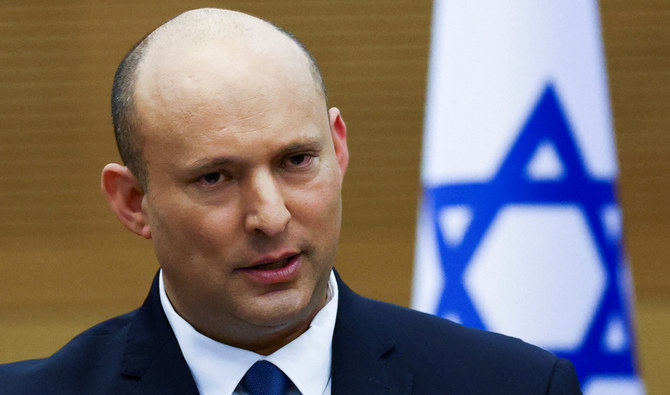
The development comes after Prime Minister Naftali Bennett announced on Monday that he would disband his alliance of eight ideologically diverse parties. (Reuters)
Short Url
Updated 21 June 2022
Follow

Israel coalition to fast-track bill to dissolve parliament

JERUSALEM: Israel’s outgoing coalition government will fast-track a bill this week to dissolve parliament, setting up the country for its fifth elections in three years, a Cabinet minister said Tuesday.

The development comes after Prime Minister Naftali Bennett announced on Monday that he would disband his alliance of eight ideologically diverse parties, a year after taking office, and send the country to the polls. A series of defections from his Yemina party had stripped the coalition of its majority in parliament.

Bennett cited the coalition’s failure earlier this month to extend a law that grants West Bank settlers special legal status as a main impetus for new elections. His key ally, Foreign Minister Yair Lapid, will become the caretaker prime minister until a new government is formed in the aftermath of elections, which are expected to be held in October.

Welfare Minister Meir Cohen, a member of Lapid’s Yesh Atid party, told Israeli public broadcaster Kan that the coalition would bring the bill to a preliminary vote on Wednesday.

“We hope that within a week we will complete the process,” Cohen said. “The intention is to finish it as soon as possible and to go to elections.”

New elections raise the possibility that longtime leader Benjamin Netanyahu, now opposition leader, will be able to stage a comeback. Netanyahu was ousted by the eight-party alliance after four inconclusive elections that were largely seen as referendums on the his fitness to rule.

The alliance’s factions range from dovish liberals opposed to Israeli settlements to hawkish ultranationalists who reject Palestinian statehood and were united solely in their opposition to Netanyahu.

Netanyahu is currently on trial for corruption, but has denied any wrongdoing and has repeatedly dismissed the charges as part of a witch hunt to drive him from office. Israeli law does not explicitly state that a politician under indictment may not become prime minister.

As politicians gear up for fall elections, several coalition members have floated the possibility of passing a law before the Knesset disbands that would bar a lawmaker accused of a crime from serving as prime minister.


Jailed Turkish Kurd leader calls on government to broker deal for Syrian Kurds

Updated 7 sec ago
Follow

Jailed Turkish Kurd leader calls on government to broker deal for Syrian Kurds

  • Clashes between Syrian forces and the SDF have cast doubt over a deal to integrate the group’s fighters into the army
ANKARA: Jailed Turkish Kurd leader Abdullah Ocalan said Tuesday that it was “crucial” for Turkiye’s government to broker a peace deal between the Kurdish-led Syrian Democratic Forces (SDF) and the Damascus government.
Clashes between Syrian forces and the SDF have cast doubt over a deal to integrate the group’s fighters into the army, which was due to take effect by the end of the year.
Ocalan, founder of the Kurdistan Workers’ Party (PKK) militant group, called on Turkiye to help ensure implementation of the deal announced in March between the SDF and the Syrian government, led by former jihadist Ahmed Al-Sharaa, whose forces ousted longtime ruler Bashar Assad last year.
“It is essential for Turkiye to play a role of facilitator, constructively and aimed at dialogue,” he said in a message released by Turkiye’s pro-Kurdish DEM party.
“This is crucial for both regional peace and to strengthen its own internal peace,” Ocalan, who has been jailed for 26 years, added.
“The fundamental demand made in the agreement signed on March 10 between the SDF and the government in Damascus is for a democratic political model permitting (Syria’s) peoples to govern together,” he added.
“This approach also includes the principle of democratic integration, negotiable with the central authorities. The implementation of the March 10 agreement will facilitate and accelerate that process.”
The backbone of the US-backed SDF is the YPG, a Kurdish militant group seen by Turkiye as an extension of the PKK.
Turkiye and Syria both face long-running unrest in their Kurdish-majority regions, which span their shared border.
In Turkiye, the PKK agreed this year at Ocalan’s urging to end its four-decade armed struggle.
In Syria, Sharaa has agreed to merge the Kurds’ semi-autonomous administration into the central government, but deadly clashes and a series of differences have held up implementation of the deal.
The SDF is calling for a decentralized government, which Sharaa rejects.
Turkish Foreign Minister Hakan Fidan, whose country sees Kurdish fighters across the border as a threat, urged the SDF last week not to be an “obstacle” to stability.
Syrian Kurdish leader Mazloum Abdi said Thursday that “all efforts” were being made to prevent the collapse of talks.