

New York Times traces source of bullet that killed Shireen Abu Akleh to Israeli convoy

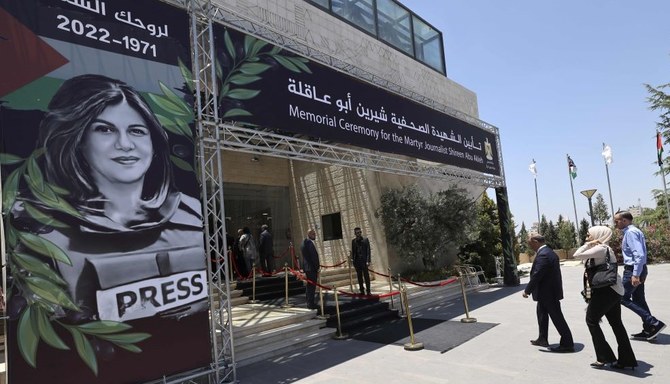
People arrive for a memorial ceremony for Shireen Abu Akleh, to mark the 40th day of the killing of the Al Jazeera journalist, in the West Bank city of Ramallah, June 19, 2022. (AFP)
Short Url
Updated 21 June 2022
Follow

New York Times traces source of bullet that killed Shireen Abu Akleh to Israeli convoy

  • An investigation by The New York Times found that the bullet that killed the reporter was fired from the approximate location of an Israeli military convoy
  • Israeli officials said a soldier might have shot Abu Akleh by mistake but also suggested the bullet might have come from a gun fired by a Palestinian

DUBAI: Veteran Palestinian American journalist Shireen Abu Akleh was most likely shot by an Israeli soldier from an elite army unit, a monthlong investigation by The New York Times has concluded.

The Al Jazeera reporter was killed on May 11 while covering an Israeli military operation in the occupied West Bank. Last week, the news network published an image of the bullet that it says killed its reporter, and identified it as a US-made 5.56mm round fired from an M4 rifle, a weapon commonly used by Israeli forces.

Israeli officials said a soldier might have shot Abu Akleh by mistake but also suggested the bullet might have come from a gun fired by a Palestinian. A preliminary investigation by the Israeli Army concluded it was “not possible to unequivocally determine the source of the gunfire.”

However, the investigation by The New York Times found that the bullet that killed the reporter was fired from the approximate location of an Israeli military convoy, most likely by a soldier from an elite unit.

It ruled out the Israeli suggestion that a Palestinian gunman might be responsible because there were no armed Palestinians near Abu Akleh when she was shot. The report also revealed that 16 shots were fired from the location of an Israeli convoy, contradicting Israeli claims that the soldier fired five bullets in the direction of the journalist.

The Times investigation did not find any evidence “that the person who fired recognized Ms. Abu Akleh and targeted her personally,” and was “unable to determine whether the shooter saw that she and her colleagues were wearing protective vests emblazoned with the word ‘Press.’”

The investigators pieced together the events of the day leading up to the shooting using videos collected from bystanders, journalists and security cameras; interviews with seven witnesses; the Israeli military’s accounts; audio analysis carried out by experts; and four visits to the site by Times reporters.

The killing of Abu Akleh and subsequent attacks by Israeli forces sparked an international outcry. A number of global media outlets, including CNN, The Washington Post, the Associated Press and investigative group Bellingcat, have conducted separate investigations into the reporter’s death, all of which concluded that Israeli forces were responsible.


Pioneering Asharq Al-Awsat journalist Mohammed al-Shafei dies at 74

Updated 08 January 2026
Follow

Pioneering Asharq Al-Awsat journalist Mohammed al-Shafei dies at 74

  • Egyptian was known for his fearless coverage of terrorist, extremist groups
  • One of handful of reporters to interview Taliban leader Mullah Omar in 1970s

LONDON: Mohammed al-Shafei, one of Asharq Al-Awsat’s most prominent journalists, has died at the age of 74 after a 40-year career tackling some of the region’s thorniest issues.

Born in Egypt in 1951, al-Shafei earned a bachelor’s degree from Cairo University in 1974 before moving to the UK, where he studied journalism and translation at the University of Westminster and the School of Oriental and African Studies.

He began his journalism career at London-based Arabic papers Al-Muslimoon and Al-Arab — both of which are published by Saudi Research & Publishing Co. which also owns Arab News — before joining Al-Zahira after Iraq’s 1990 invasion of Kuwait.

Al-Shafei joined Asharq Al-Awsat in 1991 and spent 15 years on the sports desk before shifting to reporting on terrorism. He went on to pioneer Arab press coverage in the field, writing about all aspects of it, including its ideologies and ties to states like Iran.

His colleagues knew him for his calm demeanor, humility and meticulous approach, marked by precise documentation, deep analysis and avoidance of sensationalism.

Al-Shafei ventured fearlessly into terrorist strongholds, meeting senior terrorist leaders and commanders. In the 1970s he was one of only a handful of journalists to interview Mullah Omar, the leader of the Taliban, and conducted exclusive interviews with senior figures within Al-Qaeda.

He also tracked post-Al-Qaeda groups like Daesh, Hay’at Tahrir al-Sham and Boko Haram, offering pioneering analysis of Sunni-Shiite extremism and how cultural contexts shaped movements across Asia and Africa.

During the war on Al-Qaeda, he visited US bases in Afghanistan, embedded with international forces, and filed investigative reports from active battlefields — rare feats in Arab journalism at the time.

He interviewed Osama bin Laden’s son, highlighting a humanitarian angle while maintaining objectivity, and was among the few Arab journalists to report from Guantanamo, where his interviews with Al-Qaeda detainees shed light on the group’s operations.

Al-Shafei married a Turkish woman in London in the late 1970s, with whom he had a son and daughter. He was still working just hours before he died in London on Dec. 31.