

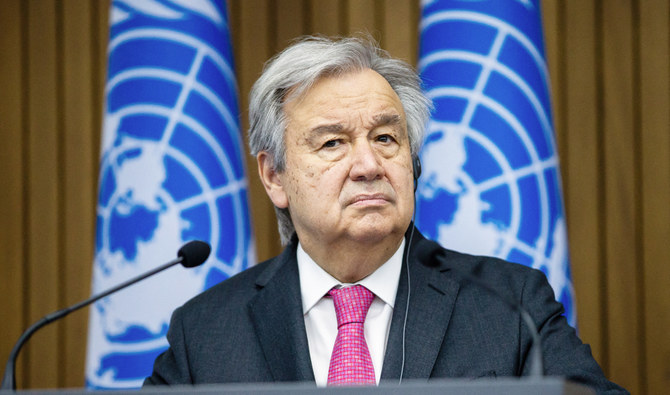

NEW YORK: UN Secretary-General Antonio Guterres on Monday urged members of the Security Council to stand united and extend for another year a cross-border mechanism for delivering aid to Northwestern Syria.
He described the need for the renewal of the mandate as a “moral imperative” to help the 4.1 million Syrians in the area who need aid and protection to survive, 80 percent of whom are women and children.
“Needs are at their highest since the start of the war 11 years ago,” Guterres told council members.
“The world’s largest refugee crisis continues to impact the region and the world.”
The secretary-general’s most recent report revealed that 14.6 million people in Syria are in need of humanitarian assistance, with 12 million of them classed as food insecure, “unsure where their next meal is coming from,” and 90 percent of the population living below the poverty line.
Guterres said infrastructure is falling apart after years of war, and economic activity is dwindling as a result of the continuing conflict, regional financial crises, Western sanctions and the effects of the COVID-19 pandemic.
“People are living on the brink, no longer able to cope,” he added.
The UN requires $4.4 billion in funding to provide assistance to people inside Syria and an additional $5.6 billion to support Syrian refugees elsewhere in the region.
“The generous pledges made at the Brussels VI donor conference need to be paid,” said Guterres. “I appeal to donors to follow through and increase their support.”
Monday’s meeting of the Security Council was its last about the situation in Syria before a vote is held on whether to extend the cross-border mechanism, which is due to expire on July 10.
The diverging views of council members about cross-border aid remains a constant feature of its discussions on Syria. Several members, in particular the US and the Europeans, maintain that cross-border assistance is of vital importance to millions of people living in the northwest of the country.
However, Russia and China argue that the mechanism violates Syria’s sovereignty and that terrorist groups manipulate the system and confiscate aid deliveries. Instead, they advocate for all aid to be channeled through the regime in Damascus, a process known as cross-line assistance, rather than cross-border aid that goes directly to the areas that need it.
Linda Thomas-Greenfield, the US ambassador to the UN, asked her fellow council members to “put politics aside” and come together to address “a clear humanitarian need.”
She recently returned from her second visit to the Bab Al-Hawa crossing, the only remaining cross-border gateway for international aid into Northwest Syria. She painted a bleak picture of the situation there, including children on the brink of famine, and warned that “babies will die” if the checkpoint closes.
“Some votes are difficult and complex but this vote could not be more straightforward,” Thomas-Greenfield told the 15-member council.
“This is our chance to live up to the ideals of the UN charter and provide life-and-death assistance to the Syrian people.”
She concluded her remarks by thanking Turkish authorities for hosting “so many Syrian refugees.”
Dmitry Polyanskiy, Russia’s deputy permanent representative to the UN, lamented the fact that the secretary-general’s report did not assign responsibility for the food and fuel crisis in Syria to the “ongoing American occupation” in the northwest of the country.
He said humanitarian organizations deplore the Western sanctions, and accused the US of the “inhumane treatment of civilians in Syria.”
Polyanskiy repeated the allegation that cross-border aid is enriching terrorist groups, including Hay’at Tahrir Al-Sham. He also said he was astonished by the “lack of reaction” from some council members to an Israeli airstrike on Damascus International Airport on June 10, as a result of which runways continue to be out of commission, and the repercussions of this on humanitarian operations across the country. He described their silence as “double standards.”
Meanwhile, Norway and Ireland, the chief advocates within the Security Council of the humanitarian effort in Syria, have begun negotiations for a new resolution that would renew the mandate for the Bab Al-Hawa crossing for another year, a source at the Irish mission told Arab News.
As international diplomacy, especially between the US and Russia, has all but ground to a halt following the start of war in Ukraine, many fear that Moscow will use its power of veto to block the renewal and close the last remaining crossing.
However, sources in Washington told Arab News that the administration is confident Russia will not use its veto in this way.


