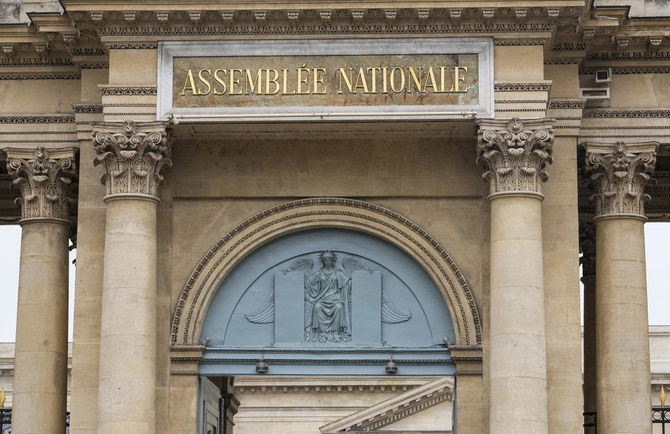
PARIS: French President Emmanuel Macron will this week hold talks with representatives of France’s main political parties to find a way forward after his coalition failed to win a majority in parliamentary elections, the presidency said Monday.
The aim of the talks Tuesday and Wednesday at the Elysee Palace will be to “build solutions to serve the French” at a time when there is no “alternative majority” to that of Macron’s ruling alliance, said a presidential official who asked not to be named.
The official said representatives of the parties represented in parliament would be received at the Elysee separately and successively but without specifying which figures would attend.
But this appears to indicate the invitations have been extended to the parties of hard left leader Jean-Luc Melenchon and far-right chief Marine Le Pen who both made big gains in the polls.
“As guarantor of the institutions, the president of the Republic is determined to act in the interest of the French,” said the official. Macron has yet to publicly comment on the outcome of the elections.
Analysts say that Macron may be eyeing a deal with the traditional right-wing party The Republicans (LR). It confirmed that its leader Christian Jacob had accepted the invitation to attend. There was no immediate comment from the other parties.

Macron to hold talks with French opposition parties over parliament deadlock: Elysee
https://arab.news/ygac5
Macron to hold talks with French opposition parties over parliament deadlock: Elysee
- Many voted for far-right or far-left candidates, denying President Emmanuel Macron's centrist alliance a straight majority in the National Assembly
Venezuela’s acting president calls for oil industry reforms to attract more foreign investment
- In her speech, Rodríguez said money earned from foreign oil sales would go into two funds: one dedicated to social services for workers and the public health care system, and another to economic development and infrastructure projects
CARACAS, Venezuela: Venezuela’s acting President Delcy Rodriguez used her first state of the union address on Thursday to promote oil industry reforms that would attract foreign investment, an objective aggressively pushed by the Trump administration since it toppled the country’s longtime leader less than two weeks ago.
Rodríguez, who has been under pressure from the US to fall in line with its vision for the oil-rich nation, said sales of Venezuelan oil would go to bolster crisis-stricken health services, economic development and other infrastructure projects.
While she sharply criticized the Trump administration and said there was a “stain on our relations,” the former vice president also outlined a distinct vision for the future between the two historic adversaries, straying from her predecessors, who have long railed against American intervention in Venezuela.
“Let us not be afraid of diplomacy” with the US, said Rodriguez, who must now navigate competing pressures from the Trump administration and a government loyal to former President Nicolás Maduro.
The speech, which was broadcast on a delay in Venezuela, came one day after Rodríguez said her government would continue releasing prisoners detained under Maduro in what she described as “a new political moment” since his ouster.
Trump on Thursday met at the White House with Venezuelan opposition leader María Corina Machado, whose political party is widely considered to have won 2024 elections rejected by Maduro. But in endorsing Rodríguez, who served as Maduro’s vice president since 2018, Trump has sidelined Machado.
In her speech, Rodríguez said money earned from foreign oil sales would go into two funds: one dedicated to social services for workers and the public health care system, and another to economic development and infrastructure projects.
Hospitals and other health care facilities across the country have long suffered. Patients are asked to provide practically all supplies needed for their care, from syringes to surgical screws. Economic turmoil, among other factors, has pushed millions of Venezuelans to migrate from the South American nation in recent years.
In moving forward, the acting president must walk a tightrope, balancing pressures from both Washington and top Venezuelan officials who hold sway over Venezuela’s security forces and strongly oppose the US Her recent public speeches reflect those tensions — vacillating from conciliatory calls for cooperation with the US, to defiant rants echoing the anti-imperialist rhetoric of her toppled predecessor.
American authorities have long railed against a government they describe as a “dictatorship,” while Venezuela’s government has built a powerful populist ethos sharply opposed to US meddling in its affairs.
For the foreseeable future, Rodríguez’s government has been effectively relieved of having to hold elections. That’s because when Venezuela’s high court granted Rodríguez presidential powers on an acting basis, it cited a provision of the constitution that allows the vice president to take over for a renewable period of 90 days.
Trump enlisted Rodríguez to help secure US control over Venezuela’s oil sales despite sanctioning her for human rights violations during his first term. To ensure she does his bidding, Trump threatened Rodríguez earlier this month with a “situation probably worse than Maduro.”
Maduro, who is being held in a Brooklyn jail, has pleaded not guilty to drug-trafficking charges.
Before Rodríguez’s speech on Thursday, a group of government supporters was allowed into the presidential palace, where they chanted for Maduro, who the government insists remains the country’s president. “Maduro, resist, the people are rising,” they shouted.