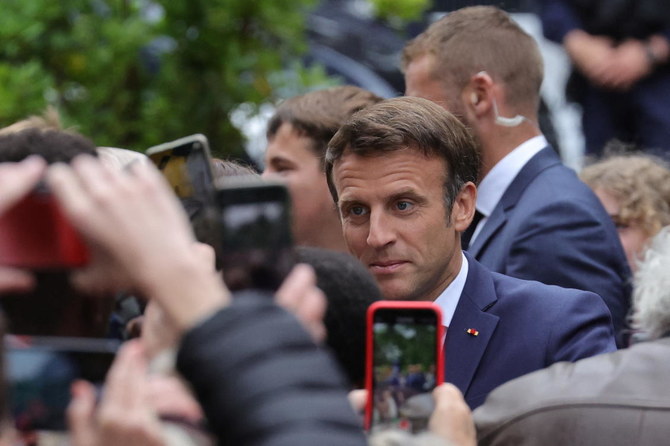
PARIS: French President Emmanuel Macron on Monday lost his parliamentary majority after major election gains by a newly formed left-wing alliance and the far right, in a stunning blow to his plans for major second-term reform.
The result from Sunday’s second round poll threw French politics into turmoil, raising the prospect of a paralyzed legislature or messy coalitions with Macron forced to reach out to new allies.
Macron, 44, now also risks being distracted by domestic problems as he seeks to play a prominent role in putting an end to Russia’s invasion of Ukraine and as a key statesman in the EU.
Macron’s “Together” coalition will still be the biggest party in the next National Assembly. But with 245 seats, according to full interior ministry results announced in the early hours of Monday, it is well short of the 289 seats needed for a majority in the 577-member chamber.
“This situation constitutes a risk for our country, given the challenges that we have to confront,” Prime Minister Elisabeth Borne said in a televised statement, vowing: “We will work from tomorrow to build a working majority.”
The outcome severely tarnished Macron’s April presidential election victory when he defeated the far-right to be the first French president to win a second term in over two decades.
“It’s a turning point for his image of invincibility,” said Bruno Cautres, a researcher at the Center for Political Research of Sciences Po.
Le Monde daily headlined on its website: “Macron faces the risk of political paralysis,” while the Le Figaro daily said the results raised the spectre of a “stillborn new mandate.”
The new left-wing coalition NUPES under 70-year-old hard-left figurehead Jean-Luc Melenchon won 135 seats, according to an AFP count based on the results published by the ministry.
The coalition, formed in May after the left splintered for April’s presidential elections, brings together Socialists, the hard left, Communists and greens.
Melenchon called Sunday’s results “above all an electoral failure” for Macron.
“The rout of the presidential party is total and there will be no majority” in parliament, he told cheering supporters in Paris.
A prominent MP from Melenchon’s party, Alexis Corbiere, said the result meant Macron’s plan to raise the French retirement age to 65 had been “sunk.”
Far-right leader Marine Le Pen’s National Rally party made huge gains and will send 89 MPs to the new parliament, making it the biggest rightwing force in parliament ahead of the traditional right The Republicans (LR).
Le Pen hailed a historic result for her party, saying it would send “by far” its highest number of MPs to the next National Assembly.
Macron had hoped to stamp his second term with an ambitious program of tax cuts, welfare reform and raising the retirement age. All that is now in question.
“This will complicate the reforms... It will be much more difficult to govern,” said Dominique Rousseau, professor of law at Paris Pantheon-Sorbonne University.
“The slap,” said the headline in the left-leaning Liberation’s Monday edition, adding the results represented the “fall” of Macron’s way of governing.
There could now potentially be weeks of political deadlock as the president seeks to reach out to new parties.
The most likely option would be an alliance with the Republicans, the traditional party of the French right, which has 61 MPs.
LR president Christian Jacob however made clear there would be no easy partnership, saying his party intended to “stay in opposition.”
Economy Minister Bruno Le Maire denied that France would be ungovernable but admitted “a lot of imagination would be needed” from the ruling party in an “unprecedented situation.”
Macron had called on voters to hand his coalition a “solid majority” last week, adding “nothing would be worse than adding French disorder to the world disorder.”
In another blow, key ministers standing for election were set to lose their jobs under a convention that they should resign if they fail to win seats.
Health Minister Brigitte Bourguignon, Maritime Minister Justine Benin and Environment Minister Amelie de Montchalin — a pillar of Macron’s administration over the last years — all lost and will now exit the government.
Two other close Macron allies, parliament speaker Richard Ferrand and former interior minister Christophe Castaner, both acknowledged defeat in the fight for their seats.
In a rare spot of good news for the president, Europe Minister Clement Beaune and Public Service Minister Stanislas Guerini — both young pillars of his party — won tight battles for their seats.
On the left, Rachel Keke, a former cleaning lady who campaigned for better working conditions at her hotel, was also elected, defeating Macron’s former sports minister Roxana Maracineanu.
Turnout was low, with the abstention rate recorded at 53.77 percent, according to the interior ministry, higher than the first round but not beating the record worst turnout of 2017.

Macron loses parliament majority in stunning setback
https://arab.news/v268j
Macron loses parliament majority in stunning setback
- The outcome severely tarnished Macron’s April presidential election victory when he defeated the far-right to be the first French president to win a second term in over two decades
Analysis: Understanding the illegitimacy of Somaliland independence
- Israel’s recognition of Somaliland has drawn condemnation as a violation of international law and Somalia’s sovereignty
- Regional and global critics warn the move risks militarizing the Red Sea and destabilizing the Horn of Africa
LONDON: For 34 years, the breakaway state of Somaliland, which declared independence from Somalia in 1991, has wandered in the diplomatic wilderness, its claim to sovereignty unrecognized by the entire world.
All that changed on Dec. 26 with the surprise announcement by the Israeli government that it was establishing full diplomatic relations with the territory, which occupies a strategically sensitive position along the northern coast of the Horn of Africa, overlooking the Gulf of Aden and the mouth of the Red Sea.
On Dec. 28, Israel’s Foreign Minister Gideon Sa’ar, took to Facebook to publish the declaration of recognition, signed by himself and Prime Minister Benjamin Netanyahu.
The recognition, it read, had been made “in light of the shared values, strategic interests, and the spirit of mutual respect that binds our people.”

The relationship, it added, “will contribute to advancing peace, stability, and prosperity in the Horn of Africa, the Middle East, and beyond.”
But for the many international critics of the move, including Turkiye, Saudi Arabia, the EU, the UK, China and the African Union, the Israeli recognition of Somaliland’s sovereignty is likely to only increase tensions in an already turbulent region.
Somalia’s President Hassan Sheikh Mohamud has claimed that, as the price for Israel’s recognition, Somaliland has agreed to accept Palestinians displaced from Gaza by Israel. The Somaliland regime has denied this, but pro-Palestinian states are not convinced.
On Dec. 27, Saudi Arabia was among 21 Arab, Islamic and African nations that issued a joint statement declaring their “unequivocal rejection of Israel’s recognition of the ‘Somaliland’ region of the Federal Republic of Somalia.”
They rejected “any potential link between such a measure and any attempts to forcibly expel the Palestinian people out of their land, which is unequivocally rejected in any form as a matter of principle.”
Israel’s recognition of Somaliland, they added, constituted “a grave violation of the principles of international law and the UN Charter, which explicitly stipulates the imperative of protecting the sovereignty of states and their territorial integrity.”
There would, they added, be “serious repercussions of such an unprecedented measure on peace and security in the Horn of Africa, the Red Sea, and … serious effects on international peace and security as a whole.”
Much of the rest of the world, including Europe, is in lockstep with the Arab states on the issue.

On Dec. 26, the EU issued a statement in which it “reaffirms the importance of respecting the unity, the sovereignty and the territorial integrity of the Federal Republic of Somalia pursuant of its constitution, the Charters of the African Union and the UN.”
It added: “This is key for the peace and stability of the entire Horn of Africa region.”
China, too, has criticized the Israeli move. In a statement, the Foreign Ministry said that “no country should encourage or support other countries’ internal separatist forces for its own selfish interests.”
At a meeting of the UN Security Council on Dec. 29, Khaled Khiari, assistant secretary-general for the Middle East, Asia and the Pacific, relayed Somalia’s indignation at what it called “a deliberate attack” on its sovereignty.
Khiari said Somalia had “also underscored that it would not permit the establishment of any foreign military bases or arrangements that would draw the country into proxy conflicts.”
Somalia declared that “no external actor has the authority” to alter its territorial configuration.

The UK was among numerous countries that spoke up for Somalia, with its charge d’affaires reaffirming his country’s continuing “support for the sovereignty, territorial integrity, political independence, and unity of Somalia.”
The UK, added Ambassador James Kariuki, “does not recognize Somaliland’s independence.
“We maintain that any change to Somaliland’s status depends on mutual agreement between Mogadishu and Hargeisa, through dialogue, and must conform to the purposes and principles of the UN Charter.”
Israel’s Sa’ar, who visited Somaliland on Tuesday, brushed aside the chorus of criticism. “Somaliland was not created this past weekend,” he wrote on Facebook. “It has existed as a functioning state for more than 34 years.
“The attacks on Israel’s recognition of Somaliland are hypocritical. Only Israel will decide who to recognize and with whom to maintain diplomatic relations.”
Netanyahu, meanwhile, has said he only wants to “support a democratic, moderate country, a Muslim country, that wants to join the Abraham Accords.”

But some observers believe Israel may be planning to use Somaliland as a military base from which to attack the Houthis in Yemen. Since 2023, the Houthis have launched several missile attacks on Israel, and Israel has struck many targets in Yemen in response.
Now the Houthis have warned that any Israeli military presence in Somaliland would be considered a target, which puts Somalis in the firing line of a war that has nothing to do with them.
Israel’s act of recognition appears likely to stoke tensions in the region.
For example, relations between Somalia and Ethiopia, its western neighbor, are already fraught following talks between Somaliland and Addis Ababa aimed at giving the landlocked state access to the Red Sea.
Ethiopia lost its own coastline in 1993 when its northern region of Eritrea declared independence.
The plan to give Ethiopia a naval base on Somaliland’s Red Sea coast is bitterly opposed by Somalia, which resents what it sees as its territory being given away.
It has also angered Egypt. Cairo has its own dispute with Ethiopia over the Grand Ethiopian Renaissance Dam, which the country has built on the Blue Nile and which Egypt says is threatening its water supplies.
The region’s current crisis is rooted in colonialism.

Before the European “scramble for Africa,” there was no central “Somalian” state. Instead, a region roughly equivalent to modern-day Somaliland, Somalia, Djibouti, the eastern Ogaden region of Ethiopia and parts of northern Kenya was occupied by scattered groups of Somali-speaking pastoral tribes.
In the 19th century, European powers divided up the area into French Somaliland (Djibouti) in the extreme northwest, British Somaliland (today’s Somaliland), and Italian Somaliland (now Somalia).
The British and Italian-held territories gained their independence in 1960 and came together briefly as the Somali Republic. The union proved fragile, however, and in 1969 ended with the assassination of President Abdirashid Ali Sharmarke and a subsequent military coup.
The leader of the coup was Mohamed Siad Barre, the commander of the army, who declared himself president.
In 1991, widespread anger at the regime escalated into civil war. Barre fled to Kenya (reportedly in a tank loaded with millions of dollars of the state’s money), and the government collapsed.
This was the moment, in May 1991, that political leaders in the former British Somaliland declared independence as the Republic of Somaliland, an entity that until now had received no international recognition.
Abdirahman Sahal Yusuf, former media adviser to the Office of the Prime Minister of Somalia and editor of the Qiraat Somali online news platform, says it is clear that “Israel has no right to recognize Somaliland. It is a move that violates international law.”

In doing so, he told Arab News, he believes Israel has two strategic goals: “Establishing a military base in this region to confront the Houthis, but at the same time there is an agreement to transfer Palestinians to Somaliland, which is a red line.”
Establishing an Israeli military base in Somaliland, he said, “would pose a threat to the national security of Egypt and Saudi Arabia, since this region is very sensitive.
“Israel wants to move its battles to this region, ruining Arab national security and dividing countries. The unity of Somalia must be protected.”
For Abdihakim Kalale, an Ethiopian political and security analyst, “the core issue is not recognition itself. States recognize one another, exchange interests, and recalibrate alliances as part of normal international politics.
“The problem lies in how Israel recognized Somaliland and the assumptions that informed that decision.”
Israel, he told Arab News, “appears to have treated Somaliland as a single, unified separatist movement. In reality, it is neither politically nor socially homogeneous. Fragmentation exists, not only in the east, but also in the west.”
In western Somaliland, two major clans inhabiting territories that represent roughly 15-20 percent of the claimed area have not fully integrated into the Somaliland system.
“These groups are actively pursuing the creation of a separate federal member state aligned with Mogadishu rather than Hargeisa. This alone demonstrates that Somaliland lacks internal political cohesion.”

In the east, the situation is even more fragmented. Here, following clan-based fighting in 2023, “a new federal member state, the Northeastern State of Somalia, emerged from territories internationally referred to as Somaliland.
“This entity is now aligned with Mogadishu and exercises effective control over large areas where the Somaliland government has no presence. These eastern territories account for approximately 40 to 45 percent of the land Somaliland claims.”
Furthermore, he said: “Somaliland is neither institutionally nor socially prepared to be integrated into larger geopolitical frameworks such as the Abraham Accords,” which Netanyahu has suggested is on the cards.
“Israel engaged with a leadership eager for recognition but lacking the capacity to manage the profound internal and regional consequences that recognition entails. This creates a governance vacuum that radical and violent actors are well positioned to exploit.
“There is a real risk that this decision could accelerate radicalization and a region long regarded as relatively stable compared to southern Somalia could, in the coming years, evolve into a new security hotspot.”
Liban Abd Ali, a consultant and former media and communications director in the Office of the Prime Minister of Somalia, agrees that Israeli recognition of the breakaway territory is “a very bad move.
“It’s a violation of a sovereign state and a violation of international laws and norms, and Israel is going to divide Somalia’s territorial integrity, fuel conflicts and destroy domestic cohesion,” he told Arab News.

He believes “the main objective is to forcibly move over 1.5 million Palestinians from their own land to northern Somalia.
“They also want to use this area as a launchpad for their fight against the Houthis in Yemen, and beyond that to control the Gulf of Aden and the Red Sea. Israel’s main goal is to destabilize the region by dividing countries.”


