

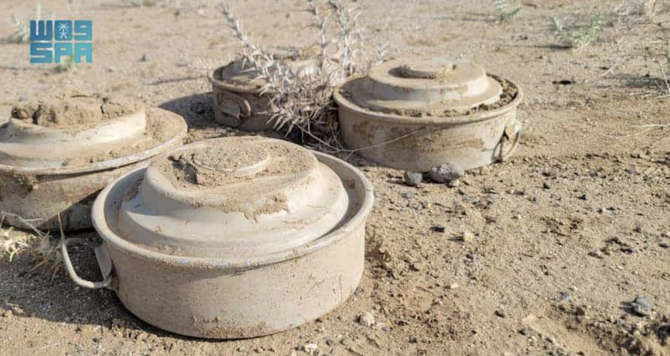
KSrelief demining project ‘Masam’ removes more than 1,400 mines in Yemen within a week

The number of mines dismantled since the beginning of the “Masam” project so far has reached 346,570. (SPA)
Short Url
Updated 19 June 2022
Follow

KSrelief demining project ‘Masam’ removes more than 1,400 mines in Yemen within a week

  • The project, launched in 2018, aims to remove mines planted by the Houthi militia indiscriminately throughout Yemen

RIYADH: More than 1,400 landmines planted by the Houthi milita in various regions of Yemen haev been cleared by a Saudi-backed demining program, Saudi Press Agency (SPA) reported on Sunday.

The “Masam” demining project, run by the King Salman Humanitarian Aid and Relief Center (KSrelief), dismantled 1,423 mines, including 19 anti-personnel mines, 316 anti-tank mines, 1,087 unexploded ordnance and one explosive device during the third week of June.

The number of mines dismantled since the beginning of the “Masam” project so far has reached 346,570, according to the SPA report.

The project, launched in 2018, aims to remove mines planted by the Houthi militia indiscriminately throughout Yemen, which often claim the lives of children, women and the elderly.

According to human rights groups, the Houthis lay landmines randomly across Yemen, often around roads, schools and farms, in clear violation of international laws.


SDAIA president says Saudi Arabia is building an integrated AI ecosystem

Updated 20 February 2026
Follow

SDAIA president says Saudi Arabia is building an integrated AI ecosystem

RIYADH: Saudi Data and Artificial Intelligence Authority President Abdullah Al-Ghamdi says that Saudi Arabia is moving steadily to establish artificial intelligence as a trusted national capability, the Saudi Press Agency reported.

Guided by the objectives of Saudi Vision 2030, Al-Ghamdi said the goal is to use AI to help develop government services, enhance competitiveness, build human capacity and improve quality of life through a comprehensive strategy based on three main pillars that unlock the potential of this technology and achieve sustainable developmental impact.

“The first pillar focuses on building human capacity and enhancing readiness to engage with AI technologies,” he said.

The second pillar is building an integrated national AI ecosystem that drives expansion and innovation by developing advanced digital infrastructure that enables various sectors to adopt AI applications efficiently, consistently and with effective governance, Al-Ghamdi said.

The third pillar, he said, is governance that ensures responsible and measurable AI through a national framework aligned with international standards.

This came during Al-Ghamdi’s speech at a high-level ministerial session held on Thursday on the sidelines of the AI Impact Summit 2026 in New Delhi.

He is heading the Saudi delegation, and the session saw broad participation from heads of state, decision-makers and technology leaders from around the world.

Al-Ghamdi also had a meeting with Indian Prime Minister Narendra Modi on Thursday evening, discussed AI cooperation and expressed his gratitude for hosting the summit and for the hospitality extended to the participants.