Saudi Arabia highlights responsible leadership at AI Impact Summit in India

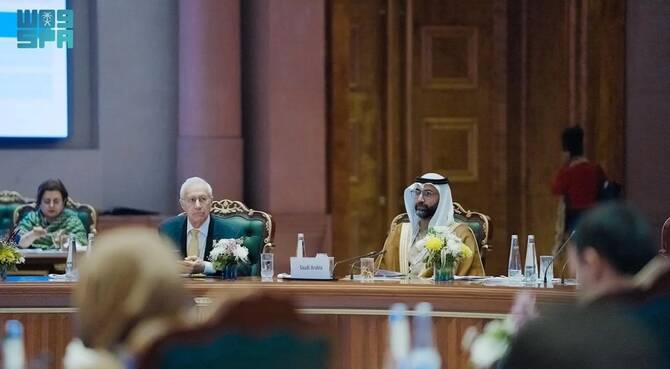
Abdulrahman Habib, deputy chief strategy officer at SDAIA, during a session of AI Impact Summit in India. (SPA)
Short Url
Updated 20 February 2026
Follow

Saudi Arabia highlights responsible leadership at AI Impact Summit in India

  • Kingdom among more than 70 countries at event discussing cooperation over artificial intelligence

NEW DELHI: Saudi Arabia, represented by the Saudi Data and Artificial Intelligence Authority, participated in a high-level session on harnessing the latest technology for people and the planet during the AI Impact Summit 2026, hosted by India. 

The summit brought together representatives from more than 70 countries and 25 international organizations, alongside senior policymakers and technology experts, to discuss the transformative potential of AI and the importance of global cooperation. 

The Saudi delegation was led by SDAIA President Abdullah Alghamdi and included Saudi Ambassador to India Haitham Al-Maliki, as well as officials from relevant government entities. 

The session focused on launching a global network of specialized AI scientific institutions, accelerating research and innovation through advanced technologies, strengthening collaboration among governments and research bodies, and promoting the use of AI to address pressing global challenges. Discussions also focused on leveraging AI to advance the objectives of the UN Sustainable Development Goals. 

Abdulrahman Habib, deputy chief strategy officer at SDAIA, stressed the importance of unifying international efforts to ensure the responsible and ethical use of AI. He highlighted the need for AI development to deliver sustainable and positive outcomes for societies and economies worldwide. 

Habib also outlined Saudi initiatives, noting the Kingdom’s progress in establishing regulatory frameworks and national policies that balance innovation with effective governance of emerging technologies. He pointed to applied AI models that have improved quality of life, enhanced the efficiency of government services, and contributed to environmental sustainability. 

SDAIA’s participation in the summit reflects Saudi Arabia’s growing role in shaping the global AI agenda and strengthening its presence in international technology forums. The engagement aligns with the objectives of Saudi Vision 2030, which places digital transformation and innovation at the core of the Kingdom’s long-term development strategy. 


Northern Borders rock art reveals ancient life

Updated 07 March 2026
Follow

Northern Borders rock art reveals ancient life

  • Among the most notable remains are stone structures scattered northwest of Arar
  • Evidence ranges from the Neolithic era to Islamic times, forming a chronological record

JEDDAH: Saudi Arabia’s Northern Borders region contains numerous archaeological sites, reflecting a long history of human settlement dating back to early periods, the Saudi Press Agency reported.
Among the most notable remains are stone structures scattered northwest of Arar.
Varying in shape, size and design, specialists believe these structures date to the end of the Neolithic period and the beginning of subsequent eras. They are thought to have been used as stone tombs to preserve the remains of the dead.
Evidence ranges from the Neolithic era to Islamic times, forming a chronological record that highlights the diversity of communities that once lived in the region and how they interacted with their natural environment over centuries.
Ajab Al-Otaibi, director general of antiquities at the Heritage Commission, said the stone structures and rock art sites in the Northern Borders region represent an integral part of Saudi Arabia’s national cultural heritage and serve as an important resource for archaeological studies and scientific research.
He highlighted the importance of surveys, documentation and protection efforts to preserve these cultural landmarks as a historical legacy for future generations.
The region is also home to several important rock art sites, such as Shu’ayb Hamer, which features a wide and diverse collection of drawings carved on natural rock surfaces, marking it as a key site that documented early human activity in the area.
The artworks depict scenes of hunting, horsemanship, dancing, daily life and social rituals. They were created using a variety of artistic styles, most notably framed and abstract forms, and produced through different techniques including incizing and pecking, both direct and indirect.
The carvings portray human figures and a range of animals, including camels, horses and gazelles, as well as some wild and predatory species that have long since disappeared.
These images provide insight into the richness of the natural environment in earlier periods and help researchers understand the evolving relationship between humans and their surroundings.