

Sri Lanka orders schools in capital to close as fuel crisis deepens

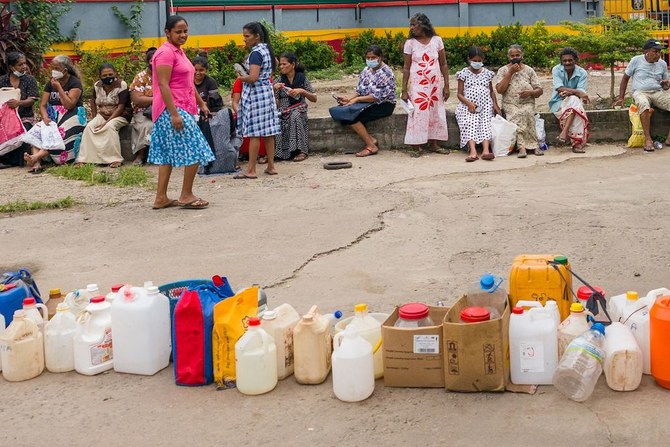
People queue up to buy kerosene for domestic use at a supply station in Colombo on June 17, 2022. (AFP)
Short Url
Updated 18 June 2022
Follow

Sri Lanka orders schools in capital to close as fuel crisis deepens

  • About 80 percent of people in country have started skipping meals, UN warns
  • Students losing essential part of their education, teachers said

COLOMBO: Sri Lanka’s Ministry of Education ordered on Saturday the closure of schools in Colombo for the next week, as the island nation grapples with an acute fuel shortage that has ground transportation across the country almost to a halt.

Sri Lanka, facing its worst economic crisis since gaining independence in 1948, has lacked the foreign currency to finance the import of essential goods, including food, medicines and fuel, since late last year. The country’s existing stock of petrol and diesel is projected to run out in days.

The nation of 22 million people defaulted on a multimillion-dollar foreign debt payment last month, as inflation reached almost 40 percent. Long queues of people outside fuel stations are now a common sight, with many having waited for days to fill up their vehicles.  

As the economic turmoil worsens, the Ministry of Education has announced that schools in the capital were to close for at least one week, citing “the transportation difficulties owing to the current fuel crisis.

“The Ministry of Education states that all government and government-approved private schools in Colombo city limits will remain closed for the next week,” a circular issued by the ministry reads.

Online education is to replace in-school learning for the time being, with authorities in the education sector scheduled to meet next Saturday to decide on the continuation of academic activities.

The announcement comes after the public administration ministry ordered on Friday the shutdown of government offices and schools across the country due to the fuel shortage. Earlier this week, the government had approved a four-day work week for public sector workers in a bid to conserve fuel.

The Ministry of Education said that schools outside Colombo, where transportation issues are not as prominent as in the capital, will continue in person.

Teachers in the capital said that students are losing an essential part of their education experience, while some raised concerns that some students may not be able to access virtual education.

“They are talking of online classes — how many children can afford this scheme? The smartphones and laptops are so costly, which makes them a distant dream,” Mohammed Nizar Mohamed, a master teacher formerly employed by the Ministry of Education, told Arab News.

Mohamed said that children in Sri Lanka have been psychologically impacted by a series of events that occurred in the last few years, including the COVID-19 pandemic and the Easter Sunday bombings in 2019. The deepening economic crisis and its impact on the education sector “adds fuel to the fire,” he said.

“The poor children, who are the future generation of our nation, have got caught innocently in this cycle,” M.S.M. Suhar, principal at Al-Meelad High School in Dehiwela, told Arab News.

“Children learn a lot from attending school daily. If that is lost, a major part of their school career which gives a variety of childhood experiences is lost,” Suhar said.

Nasriya Munas, principal of Muslim Ladies College in Colombo, said that even though lessons can also be conducted virtually, “classroom education is only a part of their school experience.

“But social interaction, the student-teacher relationship and the school environment cannot be enjoyed by the students,” Munas told Arab News. 


US Justice Department official eyes cases against Cuba leaders as Trump floats ‘friendly takeover’

Updated 07 March 2026
Follow

US Justice Department official eyes cases against Cuba leaders as Trump floats ‘friendly takeover’

  • “Working group” formed to build cases against people connected to the Cuban government
  • Trump’s has increasingly displayed aggressive stance against Cuba’s communist leadership

MIAMI: The top Justice Department prosecutor in Miami is considering criminal investigations of Cuban government officials, according to people familiar with the matter. The inquiry comes as President Donald Trump has raised the possibility of a “friendly takeover” of the communist-run island.
Jason Reding Quiñones, the US attorney for the Southern District of Florida, has created a “working group” that includes federal prosecutors and officials from the Drug Enforcement Administration and other agencies to try to build cases against people connected to the Cuban government and its Communist Party, according to one of the people. They spoke on the condition of anonymity because they were not authorized to publicly discuss the effort.
It was not immediately clear which Cuban officials the office is targeting or what criminal charges prosecutors may be looking to bring.
The Justice Department said in a statement Friday that “federal prosecutors from across the country work every day to pursue justice, which includes efforts to combat transnational crime.”
The effort is taking place against the backdrop of Trump’s increasingly aggressive stance against Cuba’s communist leadership.
Emboldened by the US capture of Cuba’s close ally, Venezuelan President Nicolás Maduro, Trump last month said his administration was in high-level talks with officials in Havana to pursue “a friendly takeover” of the country. He repeated those claims this week, saying his attention would turn back to Cuba once the war with Iran winds down.
“They want to make a deal so bad,” Trump said of Cuba’s leadership.
While Cuba has faded from Washington’s radar as a major national security threat in recent decades, it remains a priority in the US Attorney’s office in Miami, whose political, economic and cultural life is dominated by Cuban-American exiles.
The FBI field office has a dedicated Cuba group that in 2024 was instrumental in the arrest of former US Ambassador Victor Manuel Rocha on charges of serving as a secret agent of Cuba stretching back to the 1970s.
In recent weeks, several Miami Republicans, in addition to Florida Sen. Rick Scott, have called on the Trump administration to reopen its criminal investigation into the 1996 shootdown of four planes operated by anti-communist exiles.
In a letter to Trump on Feb. 13, lawmakers including Reps. Maria Elvira Salazar and Carlos Gimenez highlighted decades-old news reports indicating that former President Raúl Castro — the head of Cuba’s military at the time — gave the order to shoot down the unarmed Cessna aircraft.
“We believe unequivocally that Raúl Castro is responsible for this heinous crime,” lawmakers wrote. “It is time for him to be brought to justice.”
While no indictment against Castro has been announced, Florida’s attorney general said this week that he would open a state-level investigation into the crime.
The Trump administration has also accused Cuba of not cooperating with American counterterrorism efforts, adding it alongside North Korea and Iran to a select few nations the US considers state sponsors of terrorism.
The designation stems from Cuba’s harboring of US fugitives and its refusal to extradite several Colombian rebel leaders while they were engaged in peace talks with the South American nation.