

At Lahore’s famed Rang Mahal bazaar, scavengers sift through dirt for gold

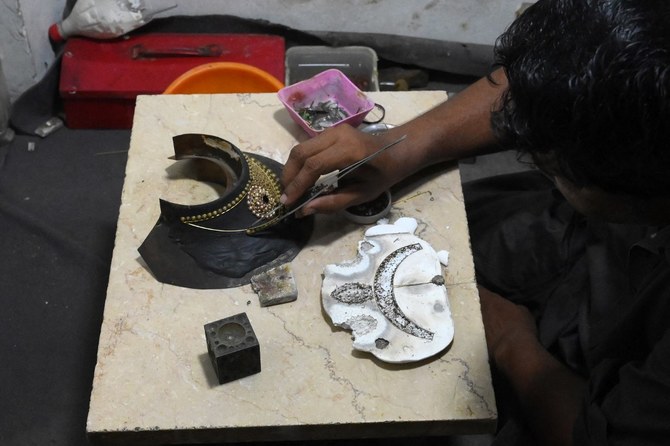
A goldsmith prepares a necklace at his workshop in Lahore, Pakistan, on June 23, 2020. (AFP/File)
Short Url
Updated 16 June 2022
Follow

At Lahore’s famed Rang Mahal bazaar, scavengers sift through dirt for gold

  • Known as niyarias, scavengers scour dirt for particles of gold left behind during the jewelry-making process
  • To extract the gold, niyarias pour dirt into a metal tub and mix in acid until precious yellow slivers separate

LAHORE: Last week, after bargaining for hours with more than a dozen goldsmiths in Lahore’s largest gold market, the famed Rang Mahal bazar, Maulvi Jamshaid finally returned home with a 10 kg bag of dirt he had bought for 100,000 Pakistani rupees ($487).

But why did he pay such a hefty sum for a sack of dirt?

Jamshaid, 55, comes from a long line of niyarias, or gold scavengers, who do the often filthy, always painstaking work of extracting gold — and other precious metals such as platinum, palladium and silver — from literally anything one can find in a goldsmith’s workshop — including dirt.

The grinding, filing, polishing and buffing processes required to make jewelry send microscopic clouds of precious dust flying into the air, Jamshaid explained, which ultimately settles down on mats, carpets, earthen pots used to melt metals, tools and floors at Rang Mahal’s gold shops.

It was always a hard bargain, Jamshaid said, to convince goldsmiths to let him sweep the floors of their shops for dust and filth that may contain minute particles of gold. Often, the niyarias also scour out gold dust from sewerage drains.

“I couldn’t afford to buy the other scrap from the workshop so I only bought the dirt collected there,” Jamshaid told Arab News at his rented home in Gumti Bazar, as he sat down with his 10-year-old son, who is also learning the trade, to begin to extract gold.

Gold is trading at historic high rates in Pakistan, mainly due to price fluctuations in the global bullion market. Twenty-four karat gold was trading in Pakistan at $690 per tola (12.6 grams) on Tuesday. The highest level of $695 was hit last week.

The Pakistani bullion market follows the international gold market. Gold rates in the international market were $1,822 per ounce on Tuesday. The yellow metal hit a high of $2,052 an ounce in March this year.

But despite having paid almost $500 dollars for his sack of dirt, Jamshaid, who has for decades practiced the occupation he inherited from his forefathers, said he had a feeling he had struck a good deal this time.

“At least 17 grams of gold are there in this dirt,” he said. “My experience tells me that.”

To extract the gold, Jamshaid pours the dirt into a metal tub on his rooftop and mixes in nitric acid until precious yellow slivers, sometimes barely visible to the naked eye, separate.

The gold scavenger’s hands and upper arms bear signs of years spent in this thankless line of work, with burns in many places from the toxic chemicals that are an integral part of the process.

To the health hazards of the craft, a new fear has recently been added: That technology will render the niyaria’s skill redundant.

“I think machines will soon take the majority of jobs away from these people, because now the latest machines can sift gold from anything, tell the amount of gold in anything,” goldsmith Asim Ali, who also owns a testing laboratory, told Arab News. “They’re not so common in Pakistan but soon, I fear, they will be.”

But Ali added it was in the goldsmiths’ interest to help sustain the niyaria profession since it protected against pilferage by their own workers. “If they stole items with small amounts of gold embedded in it, without niyarias to extract it, they would not be able to sell it.”

“So most of the goldsmiths maintain their cordiality with these scavengers . . . just in case there is pilferage from their shops,” the goldsmith said.

But Jamshaid does not appreciate the good faith. From his perspective, niyarias feed their children literally by “washing the dirt off the feet of goldsmiths.”

And poverty keeps them trapped in the profession.”I’m making my son learn this trade as I cannot send him to school. But he will help me earn more in the future,” he said.

Then, as the first glitter of yellow appeared on the surface of the gray dirt in the tub, Jamshaid exclaimed: “Look! This is a relatively big speck of gold. I knew I had made a good deal!”


Boys recount ‘torment’ at hands of armed rebels in DR Congo

Updated 2 sec ago
Follow

Boys recount ‘torment’ at hands of armed rebels in DR Congo

BUNIA: Forcibly recruited into a rebel militia affiliated with the Daesh group, two boys revealed the “torment” of living in its camps as members committed massacres in the Democratic Republic of Congo’s northeast.
The two minors freed from the Allied Democratic Forces (ADF) gave AFP an unprecedented account of the shadowy group, notorious for its extreme brutality.
Paluku, a frail 12-year-old, spent two months with the ADF after rebels killed his mother during an attack on his village in eastern North Kivu province. His brother and sister were also captured.
Edouard, 17, spent a gruelling four years with the ADF — formed by Ugandan rebels who took refuge in DRC — after he was kidnapped at age 12.
The two boys, using pseudonyms, spoke on condition of anonymity at a center specializing in the care of minors recruited by armed groups in the region, whose location AFP has chosen not to disclose to avoid potential reprisals.
Their accounts were confirmed by health and security sources.
Round-faced Edouard, a fast-talker, did not mince his words in describing his years of “torment” within the ADF.
“We suffered terribly,” he said.
After their capture, Edouard and Paluku were sent to ADF bases hidden in the dense forest of northeast DRC where the elusive rebels avoid patrols by the Congolese army and Ugandan forces deployed there since 2021.
The bases consist of simple tents and tarps, easy to move in the event of an attack.
Most occupants are women and children, according to security sources, contributing to the group’s operations — but also serving as human shields.
New recruits are swiftly forced to convert to Islam and learn Arabic, but also English and Swahili, Edouard said.
“I was also trained in medicine to treat the wounded, and we learned how to handle weapons and clean them,” he said.
Paluku said he underwent similar training, as well as learning how to “steal food, clothing and medicine to bring back to the ADF camp.”

- Floggings -

Children play a central role in supplying the group, security sources said. Those who fail to bring back loot face severe punishment.
The wives of the ADF commanders, some of whom are particularly influential, also exercise power over the young recruits.
When the fighters go out on “operations,” the youngest among them like Paluku, were “supposed to bring something back for the chief’s wife,” he said, like soap, cooking oil or fabric.
“To get it we have to loot people’s belongings, and if a chief’s wife accuses you to her husband of not bringing back what she asked for, she can demand that you be killed,” he said.
Edouard and Paluku said they were subjected to incessant corporal punishment.
Girls and boys were whipped or thrown into pits for several weeks over the slightest misbehavior.
“I was punished with lashes because I refused to go kill people,” Paluku said with a long stare.
Edouard took part in combat with the group at least three times against the Congolese army or local militias.
“They beat us mostly when we lost our weapons and ammunition, claiming we had wasted them for nothing or lost them on the front,” he explained.
Faced with such an accusation, Edouard said a chief ordered that he be whipped.
“I fell ill because of those lashes. I told the chief outright I was no longer able to go fight on the front, I begged him to send others who were capable, but that made him even more angry, and I was whipped once again,” he said.

- Trauma -

About 10 children freed from the ADF arrive on average each month at the reception center in the troubled northeast Ituri province.
“These children have suffered psychological trauma and torture, and when they arrive here, most are aggressive,” said Madeleine, a psychologist at the center.
After a few weeks spent around other children and staff, their aggression fades, she said.
But there are other scars to contend with.
Edouard became addicted to drugs administered by the rebels after he was wounded in combat.
Suffering from speech disorders, he talks constantly and sometimes incoherently, disturbing other residents, Madeleine said.
After a year at the center receiving ongoing treatment, Edouard recounted the horrors of his experience with a shy smile and a lively, excitable gaze.
Paluku meanwhile had a darker expression, recalling his sister who remains a hostage.
“She has become the wife of one of the ADF chiefs,” he said.