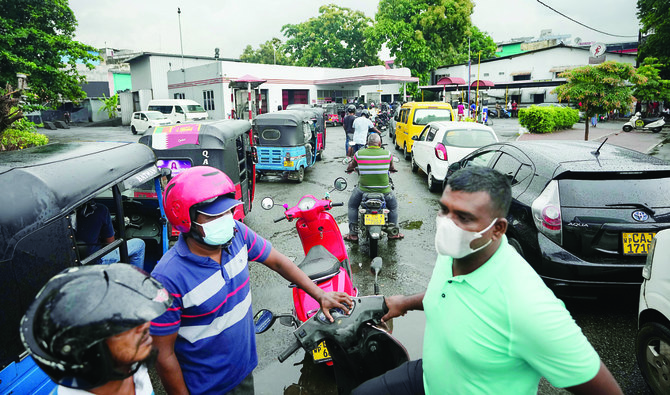

COLOMBO: The Sri Lankan government approved on Tuesday a four-day workweek for public sector employees to help them cope with a chronic lack of fuel and encourage them to grow food at home, as the country struggles with the worst shortages of basic commodities in decades.
The island country of 22 million, which defaulted on international debts of more than $50 billion last month, has been facing a severe shortfall in imports of essential goods, including fuel and food.
The country has about 1 million employees in the public sector, many of whom have struggled to travel to their offices as transportation has been upended by fuel shortages.
Starting this week, all public sector employees — excluding those in essential services such as health, utilities, education, transport and defense — will get an additional holiday on Fridays until at least September, and will receive training in farming to help avert a looming food crisis.
“The Cabinet of Ministers has given its approval to close all government institutions except agencies providing essential services on Fridays for the next three months,” the Ministry of Home Affairs said in a statement.
“It was decided to provide the government officials with the necessary facilities to engage in agricultural activities in their backyards or elsewhere as a solution to the looming food shortage.”
Currency depreciation and rising global commodity prices pushed food inflation in Sri Lanka to 57 percent in April.
Officials have been looking for ways to boost domestic production since the government warned of a food crisis by August.
Public sector workers encouraged to start farming say they will try to help.
Three days in a week will give me ample opportunity to grow our own veggies and fruits at home,” Chaminda Jayalal, administrative assistant at the Western Province governor’s office in Colombo, told Arab News.
But not all, despite their will to get involved, may have the space to do so.
“Most of the public servants who are attached to government offices in the capital of Colombo are living in small, rented houses, as well as flats and apartments that do not have places for such cultivation,” Ashraff A. Samad, public relations officer at the Department of National Housing, said.
“The government should give us arable lands in the nearby rural areas for such cultivation. Such an arrangement will give us an incentive to do larger scale cultivation in rural lands from Friday to Sunday.”
Local authorities say they are planning to step in. The Colombo administration said that it has already started to provide land for the cultivation of fruits and vegetables.
“To support the government’s efforts to grow food, our Colombo Municipal Council has identified some 10 acres of bare lands and gardens within the municipal limits,” Colombo Deputy Mayor Mohammed Thulba Mohammed Iqbal told Arab News
“We are also requesting owners of bare lands in the Colombo city to lease out them for the same purpose,” he said.
Earlier this month, Sri Lanka’s agriculture minister called on all citizens to start growing food in their home gardens, as the country is expecting shortages of rice — a staple source of food.
Local rice production has dropped in Sri Lanka after a government decision last year to ban all chemical fertilizer. Although the ban has been lifted, the country was unable to secure fertilizer imports for the current cultivation season.
Sri Lanka needs at least $3 billion in emergency funds this year and its leaders have been trying to negotiate a deal with the International Monetary Fund.
In May, the IMF began technical discussions with the government, and a new round of talks is expected this month.