

OIC committee launches capacity-building program for Yemeni health professionals in Pakistan

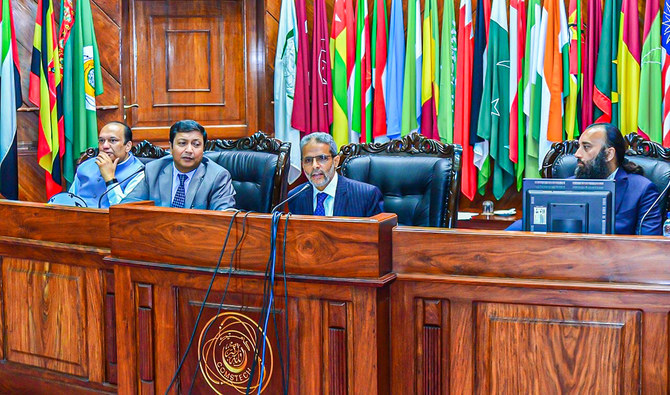
Yemen's Ambassador to Pakistan Mohammed Motahar Alashabi, center, speaks during the launch of a capacity-building programme for Yemeni health professionals in Islamabad, on June 13, 2022. (Photo courtesy: COMSTECH)
Short Url
Updated 13 June 2022
Follow

OIC committee launches capacity-building program for Yemeni health professionals in Pakistan

  • Under the fully funded program, 50 Yemeni health professionals will be trained at Pakistani institutions
  • Yemeni envoy appreciates the initiative, says it will provide much-needed boost to Yemen’s health sector

ISLAMABAD: The Organization of Islamic Cooperation’s (OIC) Standing Committee on Scientific and Technological Cooperation (COMSTECH), in collaboration with the Yemeni embassy and Pakistani universities, on Monday launched the COMSTECH Consortium of Excellence (CCoE) Yemen Programme for the capacity-building of Yemeni healthcare professionals on fully-funded scholarships in Pakistan. 

The capacity-building program for Yemeni healthcare professionals was launched in Islamabad in the presence of the COMSTECH coordinator-general, the ambassador of Yemen, and officials of Pakistani universities and the ministry of foreign affairs. These Yemeni professionals will be trained at Islamabad’s Health Services Academy (HSA), the University of Lahore (UoL), and the International Center for Chemical and Biological Sciences (ICCBS) at the University of Karachi. 

Headquartered in Pakistan, COMSTECH was launched in 1981 during the Islamic Summit in Makkah to enhance cooperation in the field of science and technology, including healthcare, among OIC member states.  

“Under this program, 50 fellowships will be given to Yemeni health professionals and scientists to obtain training in public health and medical technologies,” Professor Dr. Muhammad Iqbal Choudhary, the COMSTECH coordinator-general, told Arab News.  

He said there was so much willingness by excellent institutions in Pakistan to help brothers and sisters in the Muslim world. “Yemen is in need of several things, but we have identified to work with them in the healthcare sector.”  

Professor Choudhary there were many gaps in Yemen’s healthcare sector but the most important one was in its capacity. 

“We are building capacity in three areas,” he said. "Public health interventions at the policy level, training technicians so that they can be able to use complex medical devices and the third is focused on research to know the reasons of spread of diseases like cholera and others in Yemen." 

Professor Choudhary said the stay of Yemeni professionals would depend on the type of training, ranging from a few weeks to two years. 

“On behalf of the people of Yemen, we appreciate this initiative by COMSTECH and Pakistani universities,” Yemen's Ambassador Mohammed Motahar Alashabi told Arab News. 

These fellowships, which were divided into healthcare services, technical side and research, would provide a much-needed boost to Yemen’s health sector by enhancing professional skills of its healthcare practitioners, the envoy said. 

Ambassador Alashabi said this fully-funded opportunity was for all Yemeni nationals. “The embassy is working for all Yemeni people irrespective of their affiliation or territory.” 

HSA Vice-Chancellor Professor Dr. Shahzad Ali Khan said Yemeni professionals would be provided state-of-the-art training at the academy and its affiliated hospitals. 

He said the project was under consideration for quite some time and the academy would offer multiple courses to Yemeni professionals. 

“In order to help the people of Yemen as their health system was disrupted due to internal war-like situation, we have decided to train their people,” Professor Khan told Arab News. 

Awais Raoof, chairman UoL board of governors, said his university was committed to not only training biomedical engineers, but nurses and operation theater technicians as well.  

“We are anticipating 20 biomedical engineers for training in the first phase and then subsequently in other areas as well,” Raoof told Arab News.


Pakistan orders four-day workweek, shuts schools to save fuel amid Middle East oil crisis

Updated 58 min 40 sec ago
Follow

Pakistan orders four-day workweek, shuts schools to save fuel amid Middle East oil crisis

  • The development comes as ongoing US-Israeli strikes on Iran disrupt oil supplies in Strait of Hormuz, push prices past $119 a barrel
  • Islamabad bans government purchases, cuts fuel allocation for vehicles as well as workforce in public and private offices by 50 percent

ISLAMABAD: Prime Minister Shehbaz Sharif on Monday announced austerity measures, including a four-day work week, cuts in government expenditures and closure of schools, to offset the impact of rising global oil prices due to an ongoing conflict in the Middle East.

Global fuel supply lines have been disrupted in the Strait of Hormuz, which supplies nearly a fourth of world oil consumption, after Tehran blocked it following United States-Israeli strikes on Iran and counterattacks against US interests in the Gulf region.

Oil prices surged more than 25 percent globally on Monday to $119.50 a barrel, the highest levels since mid-2022, as some major producers cut supplies and fears of prolonged shipping disruptions gripped the market due to the expanding US-Israeli war with Iran.

In his televised address on Sunday night, Sharif said global oil prices were expected to rise again in the coming days but vowed not to let the people bear their brunt, announcing austerity measures to lessen the impact of fuel price hikes.

“Fifty percent staff in public and private entities will work from home,” he announced, adding this would not be applicable to essential services. “Offices will remain open for four days a week. One-day additional off is being given to conserve oil, but it would not be applicable to banks.”

Sharif didn’t specify working days of the week and the government was likely to issue a notification in this regard.

He said a decrease of 50 percent was being made in fuel allocation for government vehicles immediately for the next two months, but they would not include ambulances and public buses.

“Cabinet members, advisers and special assistants will not draw salaries for the next two months, 25 percent salaries of parliamentarians are being deducted, two-day salaries of Grade 20 and above officers, or those who are paid Rs300,000 ($1,067) a month, are being deducted for public relief,” he said.

Similarly, there will be 20 percent reduction in public department expenses and a complete ban on the purchase of cars, furniture, air conditioners and other goods, according to the prime minister.

Foreign trips of ministers and other government officials will also be banned along with government dinners and iftar buffets, while teleconferences and online meetings will be given priority.

“All schools will be off for two weeks, starting from the end of this week, and all higher education institutions should immediately begin online classes,” he said.

Sharif’s comments were aired hours after Pakistani authorities said the country had “comfortable levels” of petroleum stocks and the supply chains were functioning smoothly, despite intensifying Middle East conflict.

Petroleum Minister Ali Pervaiz Malik said three oil shipments were due to reach Pakistan this week, state media reported.

Meanwhile, Pakistan Navy (PN) launched ‘Operation Muhafiz-ul-Bahr’ to safeguard national energy shipments, the Pakistani military said on Monday, amid disruptions to critical sea lanes due to the conflict.

The navy is conducting escort operations in close coordination with the Pakistan National Shipping Corporation (PNSC), according to the Inter-Services Public Relations (ISPR), the military’s media wing. It is fully cognizant of the prevailing maritime situation and is actively monitoring and controlling the movement of merchant vessels to ensure their safe and secure transit.

“With approximately 90 percent of Pakistan’s trade conducted via sea, the operation aims to ensure that vital sea routes remain safe, secure, and uninterrupted,” the ISPR said on Monday. “Currently, PN ships are escorting 2 x Merchant Vessels, one of which is scheduled to arrive Karachi today.”