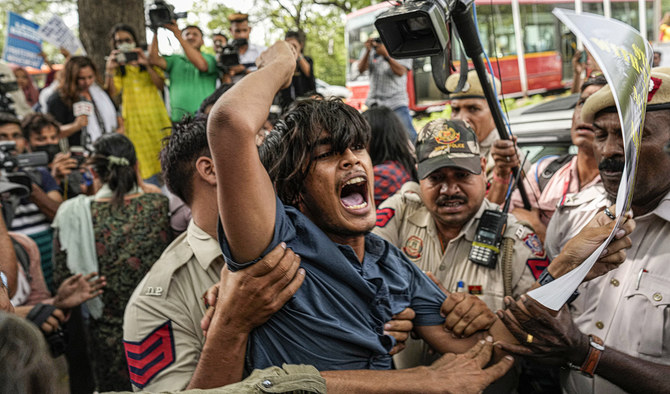

NEW DELHI: Hundreds protested in New Delhi on Monday following the demolition of homes belonging to Muslim activists in India’s Uttar Pradesh, as demonstrations sparked by remarks made by ruling party figures about the Prophet Muhammad have erupted across the country.
People have taken to the streets in India in recent weeks to protest against derogatory references about Islam and the Prophet Muhammad made by prominent spokespersons from Prime Minister Narendra Modi’s Bharatiya Janata Party, which have also caused a diplomatic row with several Muslim countries.
The government has said that the comments do not reflect its views, but protests turned violent last week when two teenagers were killed in the eastern state of Jharkhand. Hundreds of alleged rioters have also been arrested in the northern state of Uttar Pradesh, where authorities demolished houses of Muslim activists on Sunday.
The demolition sparked further unrest on Monday, as activists and students took part in protests in the Indian capital.
“The government is persecuting Muslims for being Muslim,” Raniya Zulaikha, a protester in New Delhi, told Arab News.
“By targeting protesting Muslims the government is sending the message loud and clear that it is not apologetic to hurt sentiments of the community,” said Zulaikha, who is a member of the Fraternity Movement student group.
Authorities in Uttar Pradesh razed three houses on Sunday, one of which belonged to politician Javed Ahmed, whose daughter, Afreen Fatima, is a prominent Muslim rights activist. Authorities said that Ahmed had built his house illegally and that he had planned the protests in the state last week.
“The main accused, Javed Ahmed, who is the main mastermind of the whole incident — we have acted against his illegal construction,” Ajay Kumar, senior superintendent of police in Prayagraj city of Uttar Pradesh, told reporters.
The controversial remarks made by BJP members followed increasing violence targeting India’s Muslim minority carried out by Hindu nationalists, who have been emboldened by Modi’s regular silences about such attacks since taking office in 2014.
“Since 2014, Muslims in particular and other minorities have been treated as second-class citizens by the present fundamentalist government in India,” Delhi-based human rights activist Ravi Nair, who also protested on Monday, told Arab News.
Officials have previously razed Muslim-owned properties and said that the demolitions targeted illegal buildings and not any particular religious group. However, critics argue that such moves are part of attempts to harass and marginalize Muslims, who represent 14 percent of India’s 1.4 billion population.
“The BJP is using bulldozers to punish vocal Muslims, Muslims who speak for their rights, who resists violence on them,” Apoorvanand Jha, a professor at the University of Delhi, told Arab News.
In Uttar Pradesh, where the demolitions took place, there was fear and apprehension within the Muslim community, said Kulsum Talha, a social activist based in the Uttar Pradesh capital Lucknow.
“The Muslim minority is feeling that it is being pushed against the wall. It looks like a vendetta by the state government and nothing to do with justice,” Talha told Arab News.
“The atmosphere is not of trust but mistrust all around, especially among minorities,” she said. “They are losing all kinds of hope in administration and law-enforcing agencies.”