

More protests in India after authorities raze homes of Muslim activists

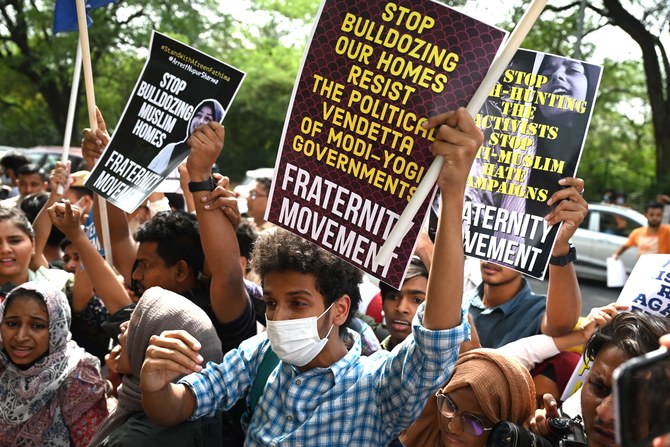
Students display placards and shout slogans during a demonstration outside the Uttar Pradesh Bhawan in New Delhi on June 13, 2022, to protest against the state government for demolishing the house of a local Muslim leader in Allahabad. (AFP)
Short Url
Updated 13 June 2022
Follow

More protests in India after authorities raze homes of Muslim activists

  • Derogatory remarks made by ruling party members against Prophet Muhammad have sparked unrest across India
  • Controversial comments follow increasing violence targeting India’s Muslim minority

NEW DELHI: Hundreds protested in New Delhi on Monday after the demolition of homes belonging to Muslim activists in India’s Uttar Pradesh, as demonstrations sparked by remarks by ruling party figures about the Prophet Muhammad erupted across the country.

People have taken to the streets in India in recent weeks to protest against derogatory references about Islam and the Prophet Muhammad made by prominent spokespersons from Prime Minister Narendra Modi’s Bharatiya Janata Party, which have also caused a diplomatic row with several Muslim countries.

The government has said that the comments do not reflect its views, but protests turned violent last week when two teenagers were killed in the eastern state of Jharkhand. Hundreds of alleged rioters have also been arrested in the northern state of Uttar Pradesh, where authorities demolished houses of Muslim activists on Sunday.

The demolition sparked further unrest on Monday, as activists and students took part in protests in the Indian capital.

“The government is persecuting Muslims for being Muslim,” Raniya Zulaikha, a protester in New Delhi, told Arab News.

“By targeting protesting Muslims the government is sending the message loud and clear that it is not apologetic to hurt sentiments of the community,” said Zulaikha, who is a member of the Fraternity Movement student group.

Authorities in Uttar Pradesh razed three houses on Sunday, one of which belonged to politician Javed Ahmed, whose daughter, Afreen Fatima, is a prominent Muslim rights activist. Authorities said that Ahmed had built his house illegally and that he had planned the protests in the state last week.

“The main accused, Javed Ahmed, who is the main mastermind of the whole incident — we have acted against his illegal construction,” Ajay Kumar, senior superintendent of police in Prayagraj city of Uttar Pradesh, told reporters.

The controversial remarks made by BJP members followed increasing violence targeting India’s Muslim minority carried out by Hindu nationalists, who have been emboldened by Modi’s regular silences about such attacks since taking office in 2014.

“Since 2014, Muslims in particular and other minorities have been treated as second-class citizens by the present fundamentalist government in India,” Delhi-based human rights activist Ravi Nair, who also protested on Monday, told Arab News.

Officials have previously razed Muslim-owned properties and said that the demolitions targeted illegal buildings and not any particular religious group. However, critics argue that such moves are part of attempts to harass and marginalize Muslims, who represent 14 percent of India’s 1.4 billion population.

“The BJP is using bulldozers to punish vocal Muslims, Muslims who speak for their rights, who resists violence on them,” Apoorvanand Jha, a professor at the University of Delhi, told Arab News.

In Uttar Pradesh, where the demolitions took place, there was fear and apprehension within the Muslim community, said Kulsum Talha, a social activist based in the Uttar Pradesh capital Lucknow.

“The Muslim minority is feeling that it is being pushed against the wall. It looks like a vendetta by the state government and nothing to do with justice,” Talha told Arab News.

“The atmosphere is not of trust but mistrust all around, especially among minorities,” she said. “They are losing all kinds of hope in administration and law-enforcing agencies.”


Ukraine hosts talks with security allies in Kyiv

Updated 11 sec ago
Follow

Ukraine hosts talks with security allies in Kyiv

KYIV: Ukraine is hosting security advisers for crunch talks on Saturday as Kyiv insists negotiations are zeroing in on a deal, while Russia claims a deadly New Year strike torpedoed the efforts.
Ukrainian President Volodymyr Zelensky said around 15 countries would attend the talks, along with representatives from the European Union and NATO, with a US delegation joining via video link.
Leaders from the so-called coalition of the willing are expected to convene in France next week after Saturday’s talks.
The latest peace push comes after Zelensky announced in his New Year’s Eve address that the US-brokered plan was “90 percent” ready, but cautioned that important territorial issues remain.
Russia occupies around a fifth of Ukraine and has hit its smaller neighbor with an almost daily barrage of missiles and drones that have killed thousands of civilians and displaced millions.
Kyiv has repeatedly said Russia is not interested in peace and is deliberately trying to sabotage diplomatic efforts in order to seize more Ukrainian territory.
Russia captured the most Ukrainian land last year since launching its all-out invasion in 2022, an AFP analysis showed.
Moscow has meanwhile accused Ukraine of carrying out a “terrorist attack” and “deliberately torpedoing” a peaceful resolution after a strike on a hotel in Kherson killed 28 people celebrating the New Year.
Moscow warned of “consequences,” but Ukraine said the attack targeted a military gathering that was closed to civilians.
AFP was not able to verify either account.

- Concessions -

After US special envoy Steve Witkoff boasted about putting peace efforts back on track in the New Year, Ukraine ordered the evacuation of more than 3,000 children and their parents from frontline settlements in the Zaporizhzhia and Dnipropetrovsk regions, where Russian troops have been advancing.
More than 150,000 people have been evacuated from front-line areas since June 1, according to Ukrainian Restoration Minister Oleksiy Kuleba.
Underlining the risks for civilians, authorities in Kharkiv reported on Saturday morning that another body had been pulled from the rubble after an aerial barrage reduced multi-story buildings to smoldering heaps.
At least two people, including a three-year-old, were killed and another 19 people wounded, local officials said.
Under the current US-backed blueprint for ending the war, Ukraine would cede parts of the eastern Donbas region and agree not to join NATO.
Zelensky said last week that Ukraine has been able to wrest some concessions, notably removing the provision that land seized by Moscow’s army would be recognized as Russian.
The Russian army captured more than 5,600 square kilometers (2,160 square miles), or 0.94 percent, of Ukrainian territory in 2025, according to an analysis of data from the Institute for the Study of War, which works with the Critical Threats Project.
This includes areas that Kyiv and military analysts say are controlled by Russia, as well as those claimed by Moscow’s army.
That is more land than the previous two years combined, though far short of the more than 60,000 square kilometers it took in the first year of its invasion.
Russia made its biggest advance in 2025 in November — 701 square kilometers — whereas the 244 square kilometers it gained in December was the smallest since March, the data showed.
Russian President Vladimir Putin has consistently told his citizens that the military intends to seize the rest of the Ukrainian land he has proclaimed as Russian if talks fail.

- New cabinet appointees -

Zelensky has shuffled his cabinet ahead of the January 6 summit in France.
He announced on Friday that he offered the defense ministry to his 34-year-old minister of digital transformation, Mikhailo Fedorov.
Without explaining his decision to replace Denys Shmygal, the Ukrainian leader said he had proposed the incumbent “head another area of government work that is no less important for our stability.”
Zelensky also recently named Ukrainian military intelligence chief Kyrylo Budanov to head his presidential office.
Budanov will succeed Zelensky’s most important ally, Andriy Yermak, who resigned in November after investigators raided his house as part of a sweeping corruption probe.
“At this time, Ukraine needs greater focus on security issues, the development of the Defense and Security Forces of Ukraine, as well as on the diplomatic track of negotiations,” Zelensky said.
“Kyrylo has specialized experience in these areas and sufficient strength to deliver results.”
Budanov said he had accepted the nomination and would “continue to serve Ukraine.”