

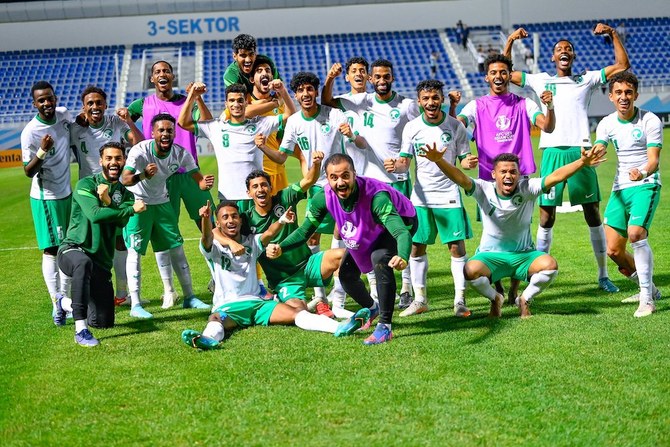

Saudi Arabia defeated Vietnam 2-0 on Sunday to book a place in the 2022 AFC U-23 Asian Cup semifinal against Australia. Having disposed of the UAE in the group stages, the Young Falcons are the last remaining Arab team in the competition going into Wednesday’s last four clash.
Here are five things we learned from the quarterfinals.
1. Al-Buraikan and Tambakti are fine mid-tournament additions
Saudi Arabia won their group despite missing two of their best players, Firas Al-Buraikan and Hassan Tambakti. The forward and the central defender were on duty with the senior national team at a training camp in Spain and had played against Colombia and Venezuela. Now that the group stage is finished, they have joined up with Saad Al-Shehri’s men.
They have made one of the strongest teams in Uzbekistan even stronger and they come at the right time. Tambakti added authority to a backline that had yet to concede a goal in the group stage. With the Al-Shabab man coming in, the Saudi defense, already the tightest at the tournament, has been strengthened further and that spells bad news for semifinal opponent Australia who have only scored five goals so far.
The addition of Al-Buraikan, perhaps the best Saudi Arabian striker at the moment, or at least the best fit one, also adds a cutting edge as was demonstrated with his header for the second goal. It showed a striker’s instinct and highlighted Al-Buraikan’s current form and confidence. With these two experienced senior international stars back in the lineup, it adds to a self belief that was already growing among the team due to results and performances.
2. Vietnam punished after switching off
It was not long before half-time and Vietnam were looking pretty good. Saudi Arabia had the lion’s share of the possession but the Southeast Asians were looking dangerous on the counterattack and came very close to scoring on two occasions with one rasping shot hitting the bar.
Then Al-Buraikan went down in the area and stayed there, clutching his hamstring. Play continued but it seemed like the Vietnamese defense was distracted by the prone attacker and took their eyes off the ball. That is not to take anything away from Moteb Al-Harbi who picked up possession well outside the area, beat his man, advanced to the left side of the area and fired a delicious low left shot that went across the goalkeeper and into the far corner.
It was a perfect finish and ruthless punishment for a team that were distracted for just a couple of seconds. After that the result didn’t look too much in doubt and it was a fine example of game management from the 2020 finalists.
3. Not a great tournament for Arab countries
Okay, so this is only the fifth edition of this particular tournament but of the Arab nations, just Iraq have ended up victorious, defeating Saudi Arabia in the final back in 2013. Since then, Saudi Arabia have made the final, losing to South Korea just over two years ago, but that is it.
Apart from the Green Falcons’ performance this time, the 2022 tournament has not been one to remember either. Qatar finished in last place in Group A while Kuwait ended at the bottom of Group B with zero points. Jordan did better but were still eliminated. In Group D, the UAE fell by the wayside. Of the six Arab teams that started out earlier this month, just two made the knockout stages. Now only Saudi Arabia are left and they are flying the flag for the region.
4. Goalkeeper Al-Aqidi making name for himself
So far, it has been almost the perfect tournament for the Green Falcons. There was an opening game thrashing of Tajikistan followed by a solid goalless draw with Japan in a meeting that could well be repeated in the final. Then came victory over the UAE — when a defeat would have meant elimination — and a solid quarterfinal win. The one common thread running through so far is zero goals conceded.
Nawaf Al-Aqidi is starting to make headlines as he continues to keep clean sheets. The goalkeeper, currently on loan at Al-Tai, has been as solid as they come. Against Vietnam, the 22-year-old made a spectacular save to push a fierce shot onto the bar, and keep the scoreline at 0-0. It was a game-changing moment, and just another example of his shot-stopping abilities.
Loaned out by Al-Nassr and last seen keeping a clean sheet against Al-Ittihad in the league, Al-Aqidi must have caught the eye of senior coach Herve Renard. With the World Cup looming, a goalkeeper who has already excelled in a tournament situation could be a real blessing.
5. Bad news for Qatar
As Qatar prepares to make a World Cup appearance for the first time and with it coming on home soil, it is understandable that the nation’s football focus is elsewhere.
This is the biggest year in Qatar’s sporting history but there should be some concern about another failure at the under-23 level. In 2020, the young Maroons failed to win a game and crashed out at the group stage. The same happened this time around. It started with a 1-1 draw against Iran then there was a humiliating 6-0 thrashing at the hands of Uzbekistan. It ended with them throwing away a two-goal lead to draw 2-2 with Turkmenistan.
The 2022 World Cup was supposed to signal the start of a new dawn for Qatar but the failures of the under-23 team for a second successive tournament suggest that the focus should not be on the senior side alone. By the time the next edition comes around, it will be six years since Qatar have won a game and that is not good enough.


