
CAIRO/TRIPOLI: The United Nations mission to Libya expressed concern Saturday over clashes in Tripoli, after a night of heavy fire between militias in the capital.
The latest fighting comes as Libya is once again divided between competing governments — one of which is based in Tripoli — despite more than a year of tentative steps toward unification.
In a statement, the mission said the clashes endangered civilians and called on Libyans “to do everything possible to preserve the country’s fragile stability at this sensitive time.”
Stephanie Williams, the UN secretary-general’s special adviser on Libya said: “Enough is enough! I call for absolute calm and protection of civilians,” alongside a statement calling on parties to exercise “maximum restraint.”
The European Union’s envoy to Libya, Jose Sabadell, condemned the fighting as “shocking and shameful.”
“Arms were fired at a park where children run and play. Public spaces in Tripoli belong to families, not to men with guns,” he wrote on Twitter.
The intense fighting that erupted late Friday between two armed groups that back rival prime ministers left at least one person dead and caused significant material damage, a security source told AFP.
Gunfire and explosions rang out across Tripoli during the fighting, described by one resident as possibly the “heaviest” seen in the city for more than a decade.
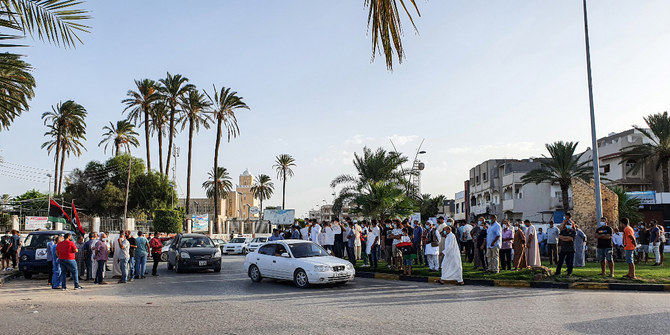
The cause of the violence in the seaside neighborhood was unclear, but footage aired by Libyan media showed civilians, including women pushing children in prams, fleeing on busy streets in a built-up area after being caught in the crossfire.
It was the latest violence to rock the country after a failed bid last month by former interior minister Fathi Bashagha — voted in as prime minister by parliament — to take power from interim premier Abdulhamid Dbeibah.
The fighting broke out in Souk Talat neighborhood and pitted two militias — Al-Nawasi, considered close to Bashagha, and the pro-Dbeibah Stability Support Apparatus — against one another, said the security source.
It came amid tensions following the arrest of fighters from both militias, said the source, who spoke on condition of anonymity.
“The clashes stopped after mediation by a neutral military force (Brigade 444), which deployed a number of its armored vehicles” in the area of the fighting, he added.
A video released overnight showed Dbeibah ordering members of the force to intervene to secure the area and protect civilians.
The source said there had been no civilian casualties, but cited “material damage.”
By Saturday, normality had largely been restored to the area, but the violence sparked renewed outrage among residents.
“This situation is unacceptable and it is unbearable for civilians to be caught in an ambush that puts their lives at risk because of the settling of scores by criminal militias,” 25-year-old student Maha Mokhtar told AFP.
“What is the fault of these families who fled their homes?” she added.
Rida Said, another resident, said he had seen the fighting from his own balcony, describing the clashes as “perhaps the heaviest in our area since 2011.”
“It was clear that they were firing randomly at civilian areas with a lot of buildings,” the 67-year-old said.
“I was struck by panic and I feared for my children, who went out with their friends as they do every weekend... but thankfully they returned safely.”
Libya has for years been split between rival administrations in the east and the west, each supported by various well-armed militias and foreign governments. The Mediterranean nation has been in a state of upheaval since the 2011 NATO-backed uprising toppled and later killed longtime dictator Muammar Qaddafi.
(With AP and AFP)