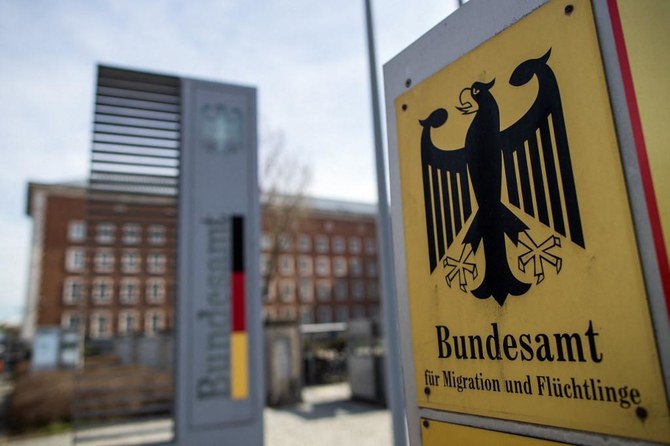
BERLIN: The number of Syrians who became naturalized German citizens was three times higher in 2021 than the year before, as many of those who fled between 2014 and 2016 fulfilled eligibility criteria, data showed on Friday.
The overall number of foreigners who became naturalized Germans grew 20 percent in 2021, reaching roughly 131,600, the Federal Statistical Office said. Of those, 19,100 were Syrians who became German citizens.
Hundreds of thousands of migrants entered Germany after former Chancellor Angela Merkel opened the borders in 2015 to refugees fleeing war and poverty in the Middle East and beyond.
While, in general, a person has to live in Germany for at least eight years to qualify for citizenship, the majority of Syrians qualified earlier — on average after 6.5 years — by showing particular willingness to integrate, for example with strong language skills and civic commitment, it said.
The office said 2021 saw the highest number to date of people who naturalized early, with just under 12,400 cases. Of those, 43 percent were Syrian.
The number of Syrians who naturalize is expected to also rise in 2022. At the start of the year, 449,000 Syrian nationals had been in Germany at least six years, more than four times as many as at the start of 2021, the office added.

Number of Syrians becoming German citizens tripled in 2021
https://arab.news/2cwwn
Number of Syrians becoming German citizens tripled in 2021
- Hundreds of thousands of migrants entered Germany after former Chancellor Angela Merkel opened the borders in 2015 to refugees fleeing war and poverty
Nigeria mosque bombing kills at least seven
- The bomb went off inside a crowded mosque in the city’s Gamboru market during early evening prayers
- Maiduguri is the capital of Borno state, home to a years-long insurgency by Boko Haram jihadis
MAIDUGURI, Nigeria: An explosion ripped through a mosque in the northeastern Nigerian city of Maiduguri and killed at least seven worshippers Wednesday, witnesses and security sources told AFP.
No armed groups immediately claimed responsibility for what anti-jihadist militia leader Babakura Kolo said was a suspected bombing.
Maiduguri is the capital of Borno state, home to a years-long insurgency by jihadist groups Boko Haram and an offshoot, Islamic State West Africa Province, though the city itself has not seen a major attack in years.
The bomb went off inside a crowded mosque in the city’s Gamboru market, as Muslim faithful gathered for evening prayers around 6 p.m. (1700 GMT), according to witnesses.
One of the leaders of the mosque, Malam Abuna Yusuf, put the toll at eight dead, though officials have not yet released a casualty count.
“We can confirm there has been an explosion,” police spokesman Nahum Daso told AFP, adding that an explosive ordnance disposal team was already on-site.
Kolo said that seven were killed.
He said it was suspected that the bomb was placed inside the mosque and exploded midway through prayers, while some witnesses described a suicide bombing.
It was not immediately clear how many people were injured, though witness Isa Musa Yusha’u told AFP: “I saw many victims being taken away for medical treatment.”
Videos taken in the aftermath and seen by AFP showed a person covered in blood writhing on the ground, and what appeared to be bodies covered by a sheet.
A security alert sent by an international NGO to its staff in Maiduguri, seen by AFP, advised its workers to stay away from the Gamboru market area.
Deadly insurgency
Nigeria has been battling a jihadist insurgency since 2009 in a conflict that has killed at least 40,000 and displaced around two million from their homes in the northeast, according to the UN.
Though the violence has waned since its peak a decade ago, it has spilt into neighboring Niger, Chad and Cameroon.
And concerns are growing about a resurgence of violence in parts of the northeast, where insurgent groups remain capable of mounting deadly attacks despite years of sustained military operations.
Maiduguri itself — once the scene of nightly gunbattles and bombings — has been calm in recent years, with the last major attack recorded in 2021.
But reminders of the conflict are never far off in the state capital, where major military operations are headquartered.
Military pick-ups lumber through town daily, their beds filled with soldiers whose helmets shield them from the hot afternoon sun.
Evening checkpoints are still in effect, even as markets that once closed in the early afternoon throng into the night.
Meanwhile, in the countryside, the insurgency continues to rage, with analysts warning of an uptick in jihadist violence this year.


