

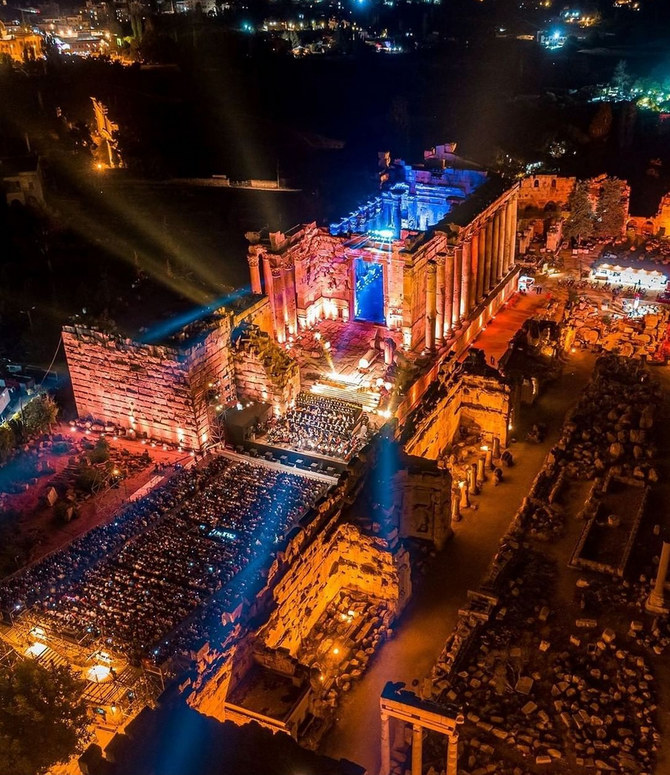

BEIRUT: Lebanon is hoping a summer influx of tourists and visitors will help revive its flagging economy, with the return of live performances at the Baalbeck International Festival expected to be a major drawcard.
The festival, a global cultural highlight for more than six decades, was held virtually in 2020 and 2021 because of pandemic restrictions, but previews of its Baalbeck Castle line-up between July 8-17 have attracted more than 17 million views on social media.
Minister of Tourism Walid Nassar said that up to 12,000 people are expected to arrive in Beirut each day during the next three months, with over 1 million arrivals over the summer.
“Given its location and all its tourism components, Lebanon does not need marketing,” he said.
Speaking during an inspection tour of Rafic Hariri International Airport in Beirut, Nassar said that flights, hotels and even guest houses were fully booked for the summer.
Travel agencies and airlines say that many Lebanese expatriates planning to spend their summer vacation in Lebanon with their families have booked tickets.
“We have a 100 percent reservation rate between July 1 and mid-September,” Jean Abboud, head of the Syndicate of Tourism and Travel Agencies, told Arab News.
“A total of 110 planes will be landing in Beirut during this period, carrying 15,000 passengers, the vast majority of whom are Lebanese, in addition to Jordanians, Iraqis and Egyptians.”
He said that the number of flights to and from Lebanon may have to be increased to cope with the rising demand.
According to Abboud, holidaying expats will help revive Lebanon’s economy by pumping US dollars into the economy.
However, the surge in tourist numbers is putting pressure on the capital’s accommodation, with some five-star hotels on the Beirut waterfront destroyed in the 2020 Beirut port explosion yet to be rebuilt.
“The remaining options are four-star hotels in the capital, and there are a few five-star hotels outside the capital, in addition to the guest houses that have recently proliferated in various regions. A total of 17,000 hotel rooms have been set to receive the Lebanese in their homeland,” Abboud said.
He pointed to a decline in Gulf tourism to Lebanon, saying: “For decades, Gulf tourists used to spend long weeks in Lebanon. In 2011, their contribution to our economy amounted to $11 billion, while now it barely exceeds $4 billion.”
In Baalbeck, the city’s major festivals are regaining their appeal after organizers were unable to attract foreign performers in recent years amid the economic collapse and the local currency’s depreciation.
Caretaker Interior Minister Bassam Mawlawi said that “the security situation in Lebanon is stable and under control.”
Four concerts are scheduled to be held at Baalbek Castle between July 8-17, featuring Lebanese, Spanish and French artists. The festival opens with a performance of traditional songs by Somaya Baalbaki, who will be backed by an orchestra of more than 35 musicians led by Lebnan Baalbaki.
Nayla de Freij, head of the Baalbeck festival committee, told Arab News that Lebanon’s festivals are struggling in the face of difficult economic conditions, but were determined to “emphasize cultural exchange between East and West.”
Without state funding for the Baalbeck festival this year, organizers were relying on contributions from a limited number of sponsors, she said.
However, de Freij said that “austerity measures and the limited budget do not mean we will be cutting corners when it comes to the technical level that we want to maintain in the Baalbeck festivals. This is why we will only be holding four concerts this year, and we will not build the huge amphitheater.”
Performers at the festival “have accepted relatively small payments because they want to help Lebanon as well,” she added.
“Our role in these circumstances is to encourage the dying Lebanese art. There are creative artists who must continue their artistic careers. And we wanted to present art that resembles people and preserves their heritage.”
Both Abboud and de Freij said that security is the key to reviving summer activities in Lebanon.
“The committee contacted army and security services officials, and they confirmed that security will be under control to and from Baalbeck,” de Freij said.


