

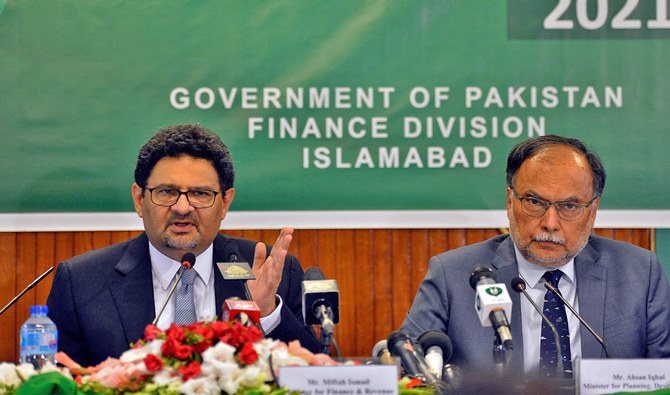

KARACHI: Pakistani finance minister Miftah Ismail unveiled the annual Economic Survey on Thursday, acknowledging Pakistan’s structural economic challenges but saying the country had historically always experienced current account deficits after undergoing economic growth but was now “headed toward stability.”
The Economic Survey is a document released each year a day before the presentation of the federal budget to outline the economic performance during the outgoing fiscal year.
Pakistan will present its budget tomorrow, Friday, as it tackles a stuttering economy with huge deficits, dwindling foreign reserves, a widening current account deficit and inflation in the double digits.
“As soon as the economy starts growing, the current account deficit goes out of control and [the nation] begins to face [exchange rate] and balance of payment crises,” the finance minister said at a press conference in Islamabad.
According to Pakistan Economic Survey 2021-22, the GDP at current market rate stood at Rs66,950 billion after a growth of 20 percent in comparison to the previous year. In dollar terms, it remained at $383 billion.
The document also informed that Pakistan’s per capita income was recorded at $1,798 during FY2022, reflecting an improvement in the overall economic prosperity of the country.
The finance minister said that Pakistan’s economic woes were mainly caused by its growing imports which were likely to reach around $77 billion by the end of the new fiscal year.
“Pakistan’s imports have rapidly increased and have gone up by about 48 percent in comparison to the last year,” he added. “While our exports have grown as well, they have only increased by 28 percent. So, your trade deficit has reached $45 billion.”
Ismail said Pakistan’s forex reserves would rise to more than $12 billion after it receives some $2.4 billion from China in the next two to three days.
“I hope that by tomorrow or by the coming Monday or Tuesday, our reserves will increase to $12 billion,” Ismail said. “We are very grateful to China as we are about to receive $2.4 billion from them in the next few days.”
Pakistan’s forex reserves currently stand at $9.7 billion, or enough to cover less than 45 days of its imports. However, the finance minister said the country was not facing a threat of default on its financial commitments.
“We have avoided the imminent default that Pakistan was facing and ... we are headed toward stability,” he maintained. “We will ensure Pakistan grows with sustainability ... a growth where we will not face a balance of payment crisis.”
According to the survey document, the total public debt of the country stood at Rs44.36 trillion by the end of March, including domestic and external debt of Rs28.07 trillion and $88.8 billion (Rs16.29 trillion), respectively.
“Pakistan’s strategy to reduce its debt burden to a sustainable level includes a commitment to run primary surpluses, maintain low and stable inflation, promote measures that support higher long-term economic growth and follow an exchange rate regime based on economic fundamentals,” said the document.
“With a narrower fiscal deficit, public debt is projected to enter a firm downward path, while the Government’s efforts to improve maturity structure will enhance public debt sustainability,” it continued.
Pakistan’s new federal budget will be closely watched by the IMF whose board has to clear a seventh review to resume a $6 billion rescue package signed in 2019. Bailout talks in Doha last month ended without a breakthrough.
Previously, Ismail promised an effective strategy to achieve GDP growth of up to 6 percent that would also help control inflation with strategic measures while addressing a day-long Pre-Budget Business Conference this week.
“We have prepared a very progressive budget which you will see but we are going to do fiscal consolidation,” he said.
Various estimates suggest the government will set a total budget outlay of between Rs9 trillion to Rs9.5 trillion for the next fiscal year.
Speaking at the occasion, Pakistan’s planning minister Ahsan Iqbal accused the previous government of not giving due significance to the multibillion-dollar China-Pakistan Economic Corridor (CPEC) while pointing out that the government was “reviewing it and taking other initiatives to improve the condition of the country’s least developed areas.”
According to the survey document, Pakistan and China have successfully launched 56 projects under the framework.
“Out of these projects, 26 projects worth approximately $17 billion have been completed so far and 30 projects worth $8.5 billion are under construction,” it said.
The document also pointed out Pakistan’s inflation from July to April of the outgoing fiscal year was recorded at 11 percent, compared to the targeted 8 percent, due to an increase in global commodity prices including the crude and edible oil.
“The pressures on headline inflation can fairly be attributed to adjustment in prices of electricity and gas, a significant increase in the non-perishable food prices, exchange rate depreciation along with rapid increase in global fuel and commodity prices,” it added.
Inflation in Pakistan was recorded at 13.8 percent in May, 13.4 percent in April and 10.9 percent in May 2021.


