

UN warns of unprecedented hunger worldwide as result of war in Ukraine

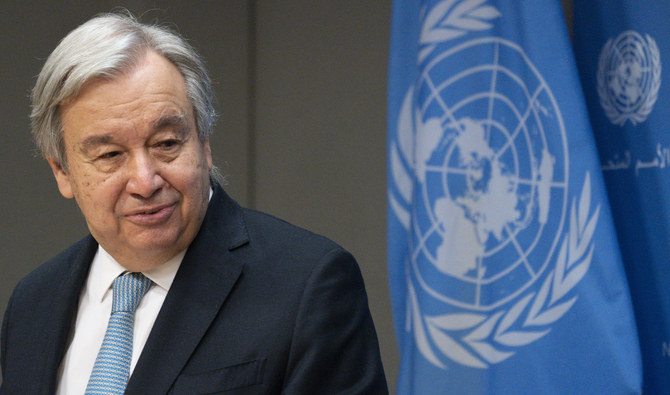
UN SG Antonio Guterres addresses reporters during a news conference to introduce the second report of the Global Crisis Response Group on the impact of the war in Ukraine on the food, fuel and finance sectors, June 8, 2022. (AP)
Short Url
Updated 09 June 2022
Follow

UN warns of unprecedented hunger worldwide as result of war in Ukraine

  • The food crisis this year is about lack of access; next year it could be about lack of food, Secretary-General Antonio Guterres warns
  • A new UN report warns that while the poorest nations are suffering most, no country will be spared the effects the escalating cost-of-living crisis

NEW YORK: The war in Ukraine threatens to unleash an unprecedented global wave of hunger and destitution, UN Secretary General Antonio Guterres said on Wednesday. While it is the vulnerable who are currently the worst affected, no country will be spared the effects of the cost-of-living crisis, he added.

Although he said the solution to the crisis ultimately lies in ending the war, Guterres called for two immediate courses of action. Firstly, the release of millions of tons of stockpiled Ukrainian grain to world markets, along with exports of Russian fertilizer, which are currently being withheld.

And secondly, efforts to ensure that resources are immediately available to help the poorest countries and communities cope with the crisis.

“Governments must be able to borrow the money they need to keep their economies afloat and their people thriving,” Guterres said during a press conference in New York to mark the publication of the latest report by the UN Global Crisis Response Group on the ways in which the war in Ukraine is affecting other countries.

“Today’s report makes clear that the war’s impact on food security, energy and finance is systemic, severe and speeding up,” he added.

“It is amplifying the consequences of the many other crises the world faces: climate, COVID-19, and the severe global inequalities in the resources available for the recovery from the pandemic.”

Food prices have skyrocketed since the conflict began and have reached near-record highs. In addition, the cost of fertilizer has more than doubled, sounding alarms all around the world.

“Without fertilizers, shortages will spread, from corn and wheat to all staple crops, including rice, with a devastating impact on billions of people in Asia and South America, too,” Guterres warned.

“This year’s food crisis is about lack of access. Next year’s could be about lack of food.”

Meanwhile, he added, record high energy prices are causing blackouts and fuel shortages worldwide, especially in Africa, as the escalating effects of “the financial squeeze” are particularly badly felt in poor nations that were already reeling from the risk of debt defaults and economic collapse as a result of COVID-19, the inequality of recovery from the pandemic, and the climate crisis.

“Now, both countries and individuals have no hope of balancing their budgets,” Guterres said. “Instead, families everywhere are being forced into impossible decisions: Whether to shut down their businesses, sell their livestock, or take their children out of school.”

In the past two years, the number of people classified as being severely food-insecure has doubled, and the World Food Program estimates the number of people affected by this will reach 47 million this year.

“In reality, there is only one way to stop this gathering storm in its tracks: The Russian invasion of Ukraine must end,” said Guterres.

“The death and destruction must stop. A political solution must be found in line with international law and the United Nations Charter.”

In the meantime, Guterres said he has asked Rebeca Grynspan, the secretary-general of the UN Conference on Trade and Development, and Martin Griffiths, the UN’s humanitarian chief, to coordinate on assembling a task force to provide the safe and secure export of food and crops from Ukraine via the Black Sea, and to ensure global markets have unimpeded access to the supply of Russian fertilizers.

“This deal is essential for hundreds of millions of people in developing countries, including in sub-Saharan Africa,” Guterres said.

“At this point, saying anything more in public would jeopardize the chances of success and I ask for your understanding,” he added, as he declined to take any questions.

“This is one of those moments when silent diplomacy is necessary — and the welfare of millions of people around the world could depend on it.”


Maduro’s fall tests Venezuela’s ruling ‘club’

Updated 5 sec ago
Follow

Maduro’s fall tests Venezuela’s ruling ‘club’

  • The ousting of Nicolas Maduro as Venezuela’s president puts to the test his “Chavista” factions that have governed the oil-rich nation for 27 years
CARACAS: The ousting of Nicolas Maduro as Venezuela’s president puts to the test his “Chavista” factions that have governed the oil-rich nation for 27 years.
What happens to the so-called “club of five” powerful leftist figures, now that two of its most important members — Maduro and his wife Cilia Flores — have been captured and sent to the United States to face trial?

’Club of five’
Anointed by his mentor Hugo Chavez before the latter’s death in 2013, Maduro kept a tight grip on power until his capture by US forces on Saturday.
Maduro ruled alongside Flores and three other powerful figures: former vice president Delcy Rodriguez — now Venezuela’s interim leader — her brother Jorge, and their rival: hard-line Interior Minister Diosdado Cabello.
“It’s like a club of five,” a diplomatic source in Caracas told AFP under the condition of anonymity.
“They can speak, they have a voice in the government, but Maduro was the one who kept the balance. Now that he’s gone, who knows?“
Maduro and ‘Super Cilita’
The image of Maduro handcuffed and blindfolded as US forces transported him to New York to face trial made headlines around the world.
During months in the crosshairs of US President Donald Trump, who accused him of being a drug trafficker, the 63-year-old former bus driver deflected pressure by dancing to techno music at near-daily rallies, always broadcast live, as he chanted the mantra “No war, yes peace!” — in English.
Frequently underestimated, Maduro managed to eliminate internal resistance and keep the opposition at bay.
Murals, songs and films celebrated him, as did the animated cartoon “Super Moustache,” in which he appeared as a superhero, fighting imperialism alongside “Super Cilita,” who is based on Flores.
Toy figurines of both characters were also produced.
The military swore absolute loyalty to him, led by Defense Minister Vladimir Padrino Lopez.
Though defiant at first and calling for Maduro’s return, Venezuela’s interim leader Rodriguez called for a “balanced and respectful relationship” between the South American country and the United States on Sunday.
“The top level of government has survival as its absolute priority,” Antulio Rosales, political scientist and professor at York University in Canada, told AFP.
The Rodriguez siblings
Rodriguez controlled the economy and the oil industry as vice president while her brother Jorge is the speaker of parliament.
They are known for their incendiary rhetoric, often mixing belligerence, irony and insults against the “enemies of the fatherland.”
But behind the scenes, they are skilled political operators.
Jorge Rodriguez was the chief negotiator with the opposition and the United States, and his sister represented Maduro in various international forums.
Experts also attribute purges within government to them, such as one that sent Tareck El Aissami, a powerful oil minister until 2023, to prison.
Rodriguez took over his post shortly afterwards.
The feared policeman
Diosdado Cabello meanwhile is widely feared in Venezuela. Under his ministry, some 2,400 people were detained during protests that followed Maduro’s disputed re-election in 2024, in a move that cowed the opposition.
Cabello is seen as representing the most radical wing of “Chavismo,” and some see him at odds with the pragmatism of the Rodriguez pair, though both sides have denied this.
Cabello acted as president for a few hours when Chavez was overthrown for two days in 2002.
He accompanied Chavez in a failed coup attempt in 1992. Today he is number two in the Socialist Party behind Maduro.
The US courts have now named Cabello among those wanted for trial alongside Maduro.
They have offered $25 million for his capture.
Having kept a low profile in the hours after Maduro’s capture, he appeared by Rodriguez’s side at her first cabinet meeting as acting president on Sunday.