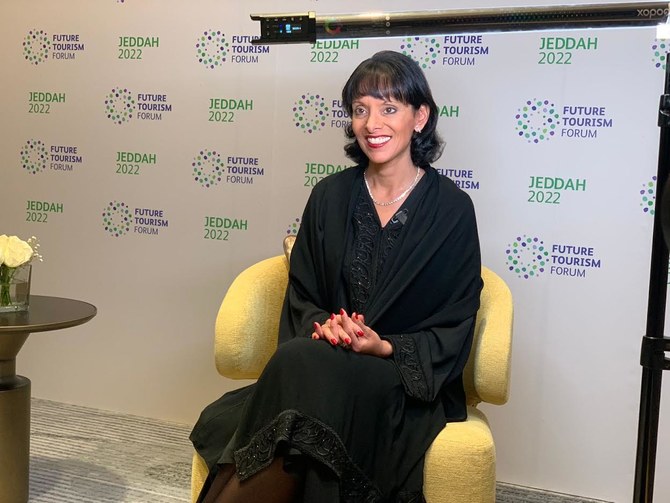
JEDDAH: AlUla is working toward becoming a living museum of culture with sustainability practices preserving its heritage and community, said a senior member of the Royal Commission for AlUla.
Speaking on the sidelines of the UN World Tourism Organization meeting in Jeddah, Anita Mendiratta, the commission’s advisory board member, told Arab News that AlUla was vastly different from other tourism projects.
“It’s incredibly special from other projects in the world because it is not a greenfield project where we’re starting with a clean slate with a space that has never been inhabited or developed,” said Mendiratta.
She added that AlUla had been here for thousands of years, and the project aims to preserve its heritage and culture and develop it.
“We have over 70,000 people who have been a community in AlUla and have always called it home. So, we are going there to develop tourism with them and for them, not just around them,” she said.
Mendiratta added: “We have the remarkable cultural heritage that makes it a living museum and a true masterpiece for the world. The city allows visitors to understand not just this part of the world, but its position in history.”
As the project aims to preserve the past and develop the future, Mendiratta said that technology would be a critical enabler for the project.
“It is an enabler first to help people understand the history of AlUla, and get to understand and respect all that it represents over 10,000 years of being chapters of a lifetime,” she said.
We have the remarkable cultural heritage that makes it a living museum and a true masterpiece for the world.
Anita Mendiratta
“People can learn about AlUla, whatever the platform may be and get a stronger sense of why they should visit AlUla, but appreciate it as a place and as a community,” she explained.
Mendiratta said that sustainability practices in AlUla play a considerable role in environmental, economic and cultural development.
“Cultural sustainability is about protecting and preserving all that AlUla represents, not just promoting it and looking at it from the point of view of making sure that we have that community integration for social, economic, cultural and environmental sustainability,” she said.
Moreover, Mendiratta said that there is a considerable focus and investment in environmental sustainability.
“Nothing is done in AlUla without a clear assessment of its fit into the master plan. When it comes to sustainability, we look at the impact in terms of environmental footprint and how we can engineer all of the critical metrics in the future,” she added.