

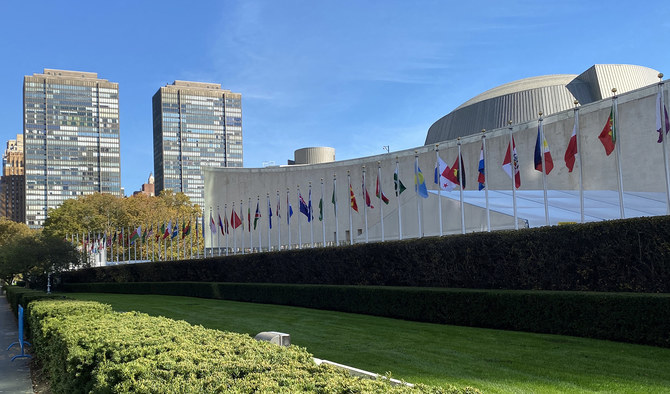
Pakistan calls on UN Security Council to act against India after anti-Islam remarks

A general view of the United Nations Security Council building in New York city on November 5, 2020. (AFP/File)
Short Url
Updated 08 June 2022
Follow

Pakistan calls on UN Security Council to act against India after anti-Islam remarks

  • Last week Bharatiya Janata Party spokeswoman and another party official made anti-Islamic remarks during a TV debate
  • Qatar, Saudi Arabia, Oman, United Arab Emirates, Indonesia, Afghanistan, Pakistan and Iran have made public complaints

ISLAMABAD: Foreign Secretary Sohail Mahmood this week called on permanent members of the United Nations Security Council to act against the “rising tide of Islamophobia” in India as derogatory remarks about the Prophet Mohammad from top ruling party officials have drawn protests from Islamic nations around the world.

Last week Prime Minister Narendra Modi's Bharatiya Janata Party suspended a spokeswoman and expelled another official after Islamic nations demanded apologies from the Indian government and summoned diplomats to protest against anti-Islamic remarks made during a TV debate.

Qatar, Saudi Arabia, Oman, the United Arab Emirates, Indonesia, Afghanistan, Pakistan and Iran were among the nations that made their complaints public.

India's minority Muslims have felt more pressure on everything from freedom of worship to hijab head scarves under Modi’s rule.

“The foreign secretary individually met the Envoys of the Permanent Members of the UN Security Council (P-5) to apprise them of the derogatory and offensive remarks made by two senior officials of India’s ruling party BJP, against the Holy Prophet Muhammad (Peace be upon him),” the foreign office said in a press release on Tuesday.

“The foreign secretary underscored that the BJP’s perfunctory and token disciplinary action against its spokespersons would not assuage the hurt they had caused to Muslims worldwide.”

Noting a “clear and consistent pattern of state-sanctioned persecution of Muslims” in India, he said the failure of the BJP leadership and the Indian government "to unequivocally condemn the recent sacrilegious comments was yet another proof of the impunity enjoyed by ‘Hindutva’ zealots."

Although Modi's party has denied any rise in communal tensions during his reign, BJP rule has emboldened hardline Hindu groups in recent years to take up causes they say defend their faith, stoking a rise in anti-Muslim sentiment.

The US State Department, in an annual report on international religious freedom released in June, said that attacks on members of minority communities, including killings, assaults, and intimidation, took place in India throughout 2021.

India's foreign ministry said on Monday the offensive tweets and comments did not in any way reflect the government's views.

"We are not barred from speaking on sensitive religious issues, but we must never insult the basic tenets of any religion," senior BJP spokesperson Gopal Krishna Agarwal said. 

Modi in recent years has improved economic ties with energy-rich Islamic nations, the main source for India's fuel imports, but relations have come under stress from the anti-Islamic utterances of the two BJP members, foreign policy experts have said.

Small-scale protests erupted in parts of India as Muslim groups demanded the arrest of the suspended BJP spokeswoman.


Pakistani man convicted in US in political assassination plot tied to Iranian paramilitary

Updated 4 sec ago
Follow

Pakistani man convicted in US in political assassination plot tied to Iranian paramilitary

  • Asif Merchant, 47, worked for Pakistani banks for decades before going into clothing and other businesses
  • He testified he met a Revolutionary Guard operative who gave him countersurveillance training, assignments

NEW YORK: A Pakistani business owner who tried to hire hit men to kill a US politician was convicted Friday in a trial that showcased allegations of Iran-backed plotting on American soil.

As the Iran war unfolded in the Mideast, Asif Merchant acknowledged in a US court that he sought to put an assassination in motion during the 2024 presidential campaign — a plot that was quickly disrupted by American investigators before it had a chance to proceed.

A jury in Brooklyn convicted Merchant on terrorism and murder for hire charges.

The verdict after only a couple hours of deliberations followed a weeklong trial that included remarkable testimony from Merchant himself.

Merchant told the jury he was carrying out instructions from a contact in the Islamic Republic’s powerful paramilitary Revolutionary Guard. According to Merchant, the handler never specified a target but broached names including then-candidate Donald Trump, then-President Joe Biden and Nikki Haley, the former UN ambassador who was also in the race for a time.

The Iranian government has denied trying to kill US officials.

The nascent plot fell apart after Merchant showed an acquaintance what he had in mind by using objects on a napkin to depict a shooting at a rally. He asked the man to help him hire assassins. Instead, he was introduced to undercover FBI agents who were secretly recording him, as had the acquaintance.

Merchant told the supposed hit men he needed services that could include killing “some political person” and paid them $5,000 in cash in a parked car in Manhattan.

“This man landed on American soil hoping to kill President Trump — instead, he was met with the might of American law enforcement,” US Attorney General Pam Bondi said in a statement released after the conviction.

Merchant’s attorney, Avraham Moskowitz, didn’t immediately reply to a message seeking comment.

Merchant, 47, worked for Pakistani banks for decades before going into clothing and other businesses. He has two families, in Pakistan and Iran, and he sometimes visited the US for his garment business.

Merchant testified that he met a Revolutionary Guard intelligence operative about three years ago. The contact gave him countersurveillance training and assignments including the assassination scheme, Merchant said.

He maintained that he had to do his handler’s bidding to protect loved ones in Iran. The defendant said he reluctantly went through the motions but thought he’d be arrested and explain his situation to authorities before anyone was killed.

“I was going along with it,” he said, speaking in Urdu through a court interpreter.

Prosecutors emphasized that Merchant admitted taking steps to enact the plan on behalf of the Revolutionary Guard, which the US considers a foreign terrorist organization, and he didn’t proactively go to authorities.

Instead, he was packing for a flight to Pakistan when he was arrested on July 12, 2024, a day before an unrelated attempt on Trump’s life in Butler, Pennsylvania. Officials said it appeared the Butler gunman acted alone but that they had been tracking a threat on Trump’s life from Iran, a claim that the Islamic Republic called “unsubstantiated and malicious.”

When Merchant subsequently spoke to FBI agents to explore the possibility of a cooperation agreement, he didn’t say he had acted out of fear for his family.

Prosecutors argued that he didn’t back up a defense of acting under duress. Merchant sought to persuade jurors he simply didn’t think the agents would believe him because they seemed to “think that I am some type of super-spy,” which he said he was “absolutely not.”