

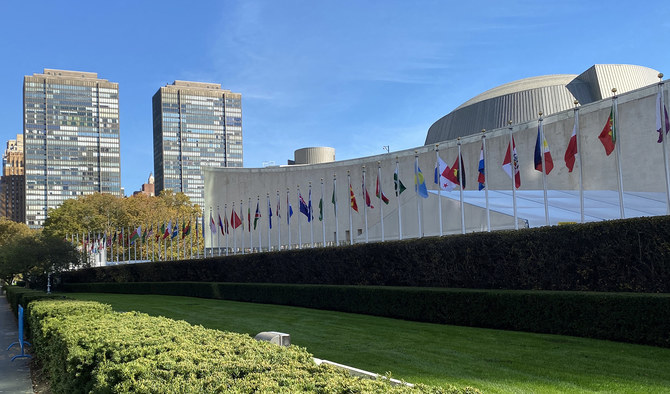
Pakistan calls on UN Security Council to act against India after anti-Islam remarks

A general view of the United Nations Security Council building in New York city on November 5, 2020. (AFP/File)
Short Url
Updated 08 June 2022
Follow

Pakistan calls on UN Security Council to act against India after anti-Islam remarks

  • Last week Bharatiya Janata Party spokeswoman and another party official made anti-Islamic remarks during a TV debate
  • Qatar, Saudi Arabia, Oman, United Arab Emirates, Indonesia, Afghanistan, Pakistan and Iran have made public complaints

ISLAMABAD: Foreign Secretary Sohail Mahmood this week called on permanent members of the United Nations Security Council to act against the “rising tide of Islamophobia” in India as derogatory remarks about the Prophet Mohammad from top ruling party officials have drawn protests from Islamic nations around the world.

Last week Prime Minister Narendra Modi's Bharatiya Janata Party suspended a spokeswoman and expelled another official after Islamic nations demanded apologies from the Indian government and summoned diplomats to protest against anti-Islamic remarks made during a TV debate.

Qatar, Saudi Arabia, Oman, the United Arab Emirates, Indonesia, Afghanistan, Pakistan and Iran were among the nations that made their complaints public.

India's minority Muslims have felt more pressure on everything from freedom of worship to hijab head scarves under Modi’s rule.

“The foreign secretary individually met the Envoys of the Permanent Members of the UN Security Council (P-5) to apprise them of the derogatory and offensive remarks made by two senior officials of India’s ruling party BJP, against the Holy Prophet Muhammad (Peace be upon him),” the foreign office said in a press release on Tuesday.

“The foreign secretary underscored that the BJP’s perfunctory and token disciplinary action against its spokespersons would not assuage the hurt they had caused to Muslims worldwide.”

Noting a “clear and consistent pattern of state-sanctioned persecution of Muslims” in India, he said the failure of the BJP leadership and the Indian government "to unequivocally condemn the recent sacrilegious comments was yet another proof of the impunity enjoyed by ‘Hindutva’ zealots."

Although Modi's party has denied any rise in communal tensions during his reign, BJP rule has emboldened hardline Hindu groups in recent years to take up causes they say defend their faith, stoking a rise in anti-Muslim sentiment.

The US State Department, in an annual report on international religious freedom released in June, said that attacks on members of minority communities, including killings, assaults, and intimidation, took place in India throughout 2021.

India's foreign ministry said on Monday the offensive tweets and comments did not in any way reflect the government's views.

"We are not barred from speaking on sensitive religious issues, but we must never insult the basic tenets of any religion," senior BJP spokesperson Gopal Krishna Agarwal said. 

Modi in recent years has improved economic ties with energy-rich Islamic nations, the main source for India's fuel imports, but relations have come under stress from the anti-Islamic utterances of the two BJP members, foreign policy experts have said.

Small-scale protests erupted in parts of India as Muslim groups demanded the arrest of the suspended BJP spokeswoman.


Pakistan says it seized 32 square kilometers inside Afghanistan as border clashes escalate

Updated 28 February 2026
Follow

Pakistan says it seized 32 square kilometers inside Afghanistan as border clashes escalate

  • Security official describes ‘limited tactical action’ in Gudwana after Afghan assaults
  • Islamabad accuses Kabul of sheltering militants as UN, China and Russia urge restraint

ISLAMABAD: Pakistan has seized a 32-square-kilometer area inside Afghanistan following overnight fighting, a security official said on Saturday, as cross-border clashes between the two countries escalated sharply.

A Pakistani security official, speaking on condition of anonymity, said troops carried out a “limited tactical action” in the Gudwana area opposite the Zhob sector along the frontier, capturing Afghan territory after responding to attacks on Pakistani positions.

“On the night of Feb. 26/27, posts opposite the Zhob sector launched anticipated physical attacks on multiple Pakistani positions,” the official said, referring to fighters linked to Afghanistan’s Taliban authorities, whom Islamabad identifies as Tehreek-e-Taliban Afghanistan (TTA).

“In response to aggressive unprovoked fire and physical attacks, Pakistan security forces launched a limited tactical action on the night of Feb. 27/28 in the general area of Gudwana with a view to capture TTA Tahir Post,” he continued, adding that 32 square kilometers of Afghan territory were seized.

The official said special combat teams crossed the border after preparatory bombardment, supported by intelligence, surveillance and reconnaissance assets providing “real-time battlefield awareness.”

He said 24 Afghan Taliban fighters were killed and 37 wounded, with no Pakistani casualties reported.

The claims could not be independently verified, and there was no immediate confirmation from Taliban authorities in Kabul of any territorial loss in the Gudwana area.

The latest clashes erupted after Pakistani airstrikes targeted what Islamabad described as militant hideouts inside Afghanistan over the weekend, triggering retaliatory fire along the frontier and sharply escalating long-running tensions. Islamabad accuses Kabul of sheltering Pakistani Taliban militants responsible for attacks inside Pakistan, an allegation that Afghanistan denies.

Pakistan’s Information Minister Attaullah Tarar said on Saturday evening that 352 Afghan Taliban fighters had been killed and more than 535 wounded since the latest phase of hostilities began.

Tarar said Pakistani strikes had destroyed 130 check posts, 171 tanks and armored vehicles and targeted 41 locations across Afghanistan by air. Those figures could not be independently verified.

The United Nations, as well as China and Russia, have called for restraint.

The United States said Pakistan has the right to defend itself against cross-border militancy.
