

Iran train derailment kills at least 21, injures 87

1 / 4
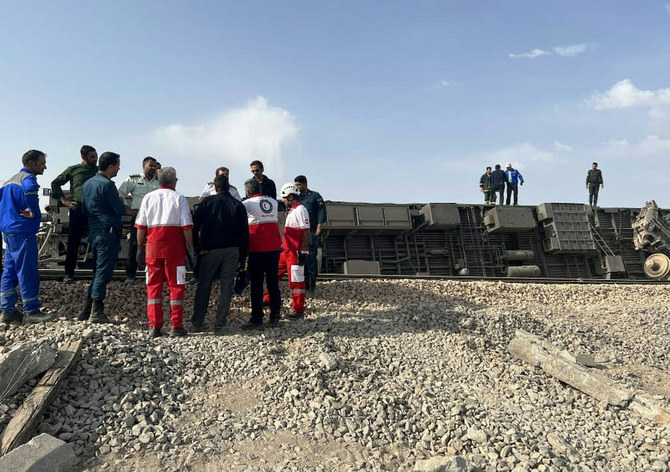
Above, the train derailed after hitting an excavator near the central Iranian city of Tabas, on the line between the cities of Mashhad and Yazd. (Iranian Red Crescent via AFP)
2 / 4
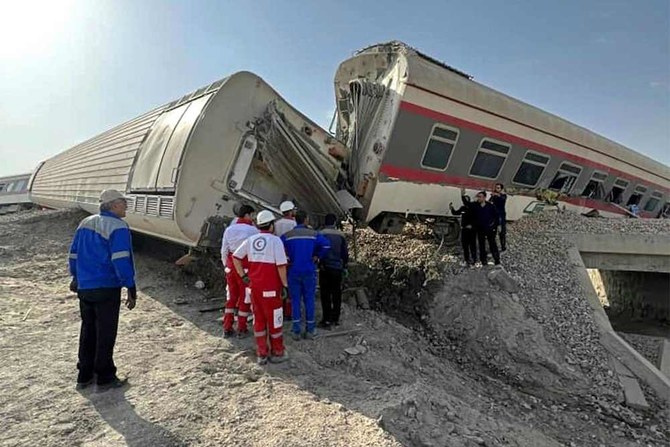
Above, the train derailed after hitting an excavator near the central Iranian city of Tabas, on the line between the cities of Mashhad and Yazd. (Iranian Red Crescent via AFP)
3 / 4
Above, the train derailed after hitting an excavator near the central Iranian city of Tabas, on the line between the cities of Mashhad and Yazd. (Iranian Red Crescent via AFP)
4 / 4
Above, the train derailed after hitting an excavator near the central Iranian city of Tabas, on the line between the cities of Mashhad and Yazd. (Iranian Red Crescent via AFP)
Short Url
Updated 08 June 2022
Follow

Iran train derailment kills at least 21, injures 87

  • Passengers were bouncing in the car like balls in the air, victim tells TV channel

TEHRAN: A passenger train traveling through eastern Iran struck an excavator and nearly half its cars derailed before dawn on Wednesday, killing at least 21 people and injuring 87, officials said.

The derailment near the desert city of Tabas was the latest disaster to strike the Islamic Republic in recent weeks as Tehran struggles under US sanctions and any return to its nuclear deal with world powers remains in doubt.

The train, operated by the state-run Islamic Republic Railway, carried some 350 people as it traveled from the town of Tabas, some 550 km southeast of Tehran, to the city of Yazd. The route had began as an overnight train out of Iran’s holy city of Mashhad.

Based on images after the crash, it appeared the train’s locomotive passed the excavator and the later cars somehow hit the digger and caused the derailment, though authorities did not immediately explain how the disaster happened in the rural scrubland near a railway bridge.

“Passengers were bouncing in the car like balls in the air,” one unnamed injured passenger told Iranian state television.

The state-run IRNA news agency gave the casualty figures, citing emergency officials.

Rescue teams with ambulances and helicopters arrived in the remote area where communication is poor. Over a dozen people suffered critical injuries, with some transferred to local hospitals, officials said.

Aerial footage of the desert site of the disaster showed train cars on their side, with some rescuers running at the scene as they tried to care for those injured.

State TV later aired images from a hospital where the injured received treatment.

One of those injured told the broadcaster they felt the train suddenly brake and then slow before the derailment.

The incident happened some 50 km outside of Tabas.

The report said the crash is under investigation. Initial reports suggested the train collided with an excavator near the track, though it wasn’t immediately clear why an excavator would have been close to the train track in the dark. One official suggested it could have been part of a repair project.

Iran’s President Ebrahim Raisi offered condolences over the crash and announced an investigation would be undertaken into its causes. Iran’s worst train disaster came in 2004, when a runaway train loaded with gasoline, fertilizer, sulfur and cotton crashed near the historic city of Neyshabur, killing some 320 people, injuring 460 others and damaging five villages. In 2016, a train collision in northern Iran killed at least 43 people and injured about 100.

Iran has some 14,000 km of railway lines throughout the country that’s about two and a half times the size of Texas.

Its rail system sends both people and goods across the country, particularly in rural areas.

Iran also has some 17,000 annual deaths on its highways, one of the world’s worst traffic safety records. The high toll is blamed on wide disregard for traffic laws, unsafe vehicles and inadequate emergency services.

Iran, already straining under US sanctions over its collapsed nuclear deal, has been mourning the deaths of at least 41 people killed in a building collapse in May in the city of Abadan in the country’s southwest.


Israel orders Gaza families to move in first forced evacuation since ceasefire

Updated 5 sec ago
Follow

Israel orders Gaza families to move in first forced evacuation since ceasefire

CAIRO: Israeli forces have ordered dozens of Palestinian families in the southern Gaza Strip to leave their homes in the first forced evacuation since October’s ceasefire, as residents and Hamas said on Tuesday the military was ​expanding the area under its control.
Residents of Bani Suhaila, east of Khan Younis, said the leaflets were dropped on Monday on families living in tent encampments in the Al-Reqeb neighborhood.
“Urgent message. The area is under IDF control. You must evacuate immediately,” said the leaflets, written in Arabic, Hebrew, and English, which the army dropped over the Al-Reqeb neighborhood in the town of Bani Suhaila.
In the two-year war before the US brokered ceasefire was signed in October, Israel dropped leaflets over areas that were subsequently raided or bombarded, forcing some families to move several times.
Residents and a source from the Hamas militant group said this was the first time they had been ‌dropped since then. ‌The Israeli military did not immediately respond to a request for comment.

SIDES FAR ‌APART ⁠ON ​NEXT PHASES
The ‌ceasefire has not progressed beyond its first phase, under which major fighting has stopped, Israel withdrew from less than half of Gaza, and Hamas released hostages in return for Palestinian detainees and prisoners.
Virtually the entire population of more than 2 million people are confined to around a third of Gaza’s territory, mostly in makeshift tents and damaged buildings, where life has resumed under control of an administration led by Hamas.
Israel and Hamas have accused each other of major breaches of the ceasefire and remain far apart on the more difficult steps planned for the next phase.
Mahmoud, a resident from the ⁠Bani Suhaila area, who asked not to give his family name, said the evacuation orders impacted at least 70 families, living in tents and homes, ‌some of which were partially damaged, in the area.
“We have fled ‍the area and relocated westward. It is maybe the ‍fourth or fifth time the occupation expanded the yellow line since last month,” he told Reuters by phone ‍from Khan Younis, referring to the line behind which Israel has withdrawn.
“Each time they move it around 120 to 150 meters (yards) inside the Palestinian-controlled territory, swallowing more land,” the father-of-three said.

HAMAS CITES STATE OF HUMANITARIAN DISRUPTION
Ismail Al-Thawabta, director of the Hamas-run Gaza government media office, said the Israeli military had expanded the area under its control in eastern Khan Younis five times since ​the ceasefire, forcing the displacement of at least 9,000 people.
“On Monday, 19 January 2026, the Israeli occupation forces dropped warning leaflets demanding the forced evacuation of the Bani Suhaila area in eastern ⁠Khan Younis Governorate, in a measure that falls within a policy of intimidation and pressure on civilians,” Thawabta told Reuters.
He said the new evacuation orders affected approximately 3,000 people.
“The move created a state of humanitarian disruption, increased pressure on the already limited shelter areas, and further deepened the internal displacement crisis in the governorate,” Thawabta added.
Israel’s military has previously said it has opened fire after identifying what it called “terrorists” crossing the yellow line and approaching its troops, posing an immediate threat to them.
It has continued to conduct air strikes and targeted operations across Gaza. The Israeli military has said it views “with utmost severity” any attempts by militant groups in Gaza to attack Israel.
Under future phases of the ceasefire that have yet to be hammered out, US President Donald Trump’s plan envisages Hamas disarming, Israel pulling out further, and an internationally backed administration rebuilding Gaza.
More than 460 Palestinians and three Israeli soldiers have been reported killed since the ceasefire took ‌effect.
Israel launched its operations in Gaza in the wake of an attack by Hamas-led fighters in October 2023 which killed 1,200 people, according to Israeli tallies. Israel’s assault has killed 71,000 people, according to health authorities in the enclave.