Apple offers glimpse at upcoming changes to iPhone software

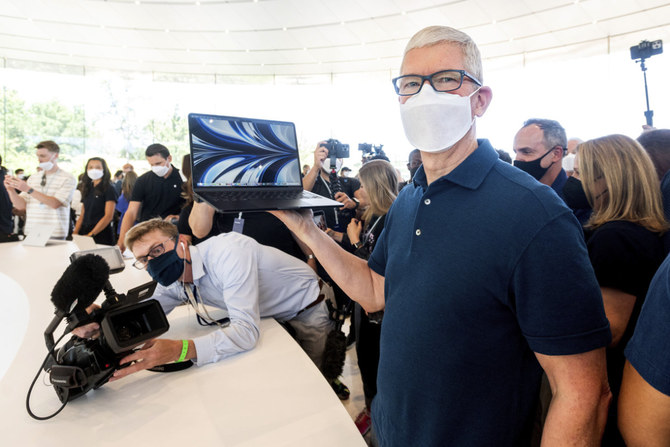
Apple CEO Tim Cook poses for photos as he holds one of the new Apple MacBook Air computers with an M2 processor on June 6, 2022, during the Apple's World Wide Developer Conference in California. (AP)
Short Url
Updated 07 June 2022
Follow

Apple offers glimpse at upcoming changes to iPhone software

  • iOS 16, the iPhone’s next operating system, will revamp the look of the device’s lock screen
  • iPhone’s messaging system will allow texts to be edited after they are sent or even rescinded in their entirety if the sender has a change of heart

Apple on Monday provided a peek at upcoming tweaks to the software that powers more than 1 billion iPhones and rolled out two laptops that will be the first available with the next generation of a company-designed microprocessor.
As usual, Apple spent most of the opening day of its annual developers conference touting the next versions of software for the iPhone, iPad, Apple Watch and Mac computers instead of the sleek devices that established it as a technology trendsetter and the world’s most valuable company.
The iPhone’s next operating system, called iOS 16, will revamp the look of the device’s lock screen and make make mostly minor improvements to the current software. The software updates have become increasingly important in recent years as iPhone owners have started to hold to their existing devices for longer periods of time than they once did.
One of iOS 16’se most noticeable differences will occur on the iPhone lock screen. The new software, which will be released this fall as a free download, will allow users to anchor their favorite apps as small widgets on the lock screen.
The new software also will enable the lock screen to display live notifications, such the status of a Uber ride on its way to pick up a passenger. Other authorized notifications will come in from the bottom of the screen instead of the current distribution from the top in an effort to avoid clutter on the display.
The iPhone’s messaging system will be revamped so texts can be edited after they are sent or even rescinded in their entirety if the sender has a change of heart. Those options will only be available when both users are using Apple’s messaging app for texting.
The Apple Pay service that’s part of the iPhone’s digital wallet is adding a new financing feature likely to be popular as soaring inflation rates squeeze more household budgets. The option will allow consumers to stagger the cost of any purchase made through Apple Pay over four installments completed within a six-week period with no additional fees. Similar financing is already offered through digital services such as Affirm, whose stock price sank by more than 5 percent Monday after the news about Apple Pay came out.
Several of the new features for Apple’s Macs and iPads are designed to make it easier to sync with the iPhone for things like making video calls. Other tools will enable more apps to run side by side to perform multiple tasks on the same screen.
Helping people toggle from one Apple device to another is one of the main reasons that the company began making Macs that run on the same kind of chips that power the iPhone and iPad in late 2020.
Now Apple in putting the next generation of its Mac chip in it two most popular laptops, the MacBook Air and MacBook Pro, which the company said will be available in stores at some point next month. The MacBook Air will sell for $1,200 and the MacBook Pro will sell for $1,300.
The event was held at Apple headquarters in Cupertino, California.


Gulf-EU value chain integration signals shift toward long-term economic partnership: GCC secretary general

Updated 03 February 2026
Follow

Gulf-EU value chain integration signals shift toward long-term economic partnership: GCC secretary general

RIYADH: Value chains between the Gulf and Europe are poised to become deeper and more resilient as economic ties shift beyond traditional trade toward long-term industrial and investment integration, according to the secretary general of the Gulf Cooperation Council.

Speaking on the sidelines of the World Governments Summit 2026 in Dubai, Jasem Al-Budaiwi said Gulf-European economic relations are shifting from simple commodity trade toward the joint development of sustainable value chains, reflecting a more strategic and lasting partnership.

His remarks were made during a dialogue session titled “The next investment and trade race,” held with Luigi Di Maio, the EU’s special representative for external affairs.

Al-Budaiwi said relations between the GCC and the EU are among the bloc’s most established partnerships, built on decades of institutional collaboration that began with the signing of the 1988 cooperation agreement.

He noted that the deal laid a solid foundation for political and economic dialogue and opened broad avenues for collaboration in trade, investment, and energy, as well as development and education.

The secretary general added that the partnership has undergone a qualitative shift in recent years, particularly following the adoption of the joint action program for the 2022–2027 period and the convening of the Gulf–European summit in Brussels.

Subsequent ministerial meetings, he said, have focused on implementing agreed outcomes, enhancing trade and investment cooperation, improving market access, and supporting supply chains and sustainable development.

According to Al-Budaiwi, merchandise trade between the two sides has reached around $197 billion, positioning the EU as one of the GCC’s most important trading partners.

He also pointed to the continued growth of European foreign direct investment into Gulf countries, which he said reflects the depth of economic interdependence and rising confidence in the Gulf business environment.

Looking ahead, Al-Budaiwi emphasized that the economic transformation across GCC states, driven by ambitious national visions, is creating broad opportunities for expanded cooperation with Europe. 

He highlighted clean energy, green hydrogen, and digital transformation, as well as artificial intelligence, smart infrastructure, and cybersecurity, as priority areas for future partnership.

He added that the success of Gulf-European cooperation should not be measured solely by trade volumes or investment flows, but by its ability to evolve into an integrated model based on trust, risk-sharing, and the joint creation of economic value, contributing to stability and growth in the global economy.

GCC–EU plans to build shared value chains look well-timed as trade policy volatility rises.

In recent weeks, Washington’s renewed push over Greenland has been tied to tariff threats against European countries, prompting the EU to keep a €93 billion ($109.7 billion) retaliation package on standby. 

At the same time, tighter US sanctions on Iran are increasing compliance risks for energy and shipping-related finance. Meanwhile, the World Trade Organization and UNCTAD warn that higher tariffs and ongoing uncertainty could weaken trade and investment across both regions in 2026.