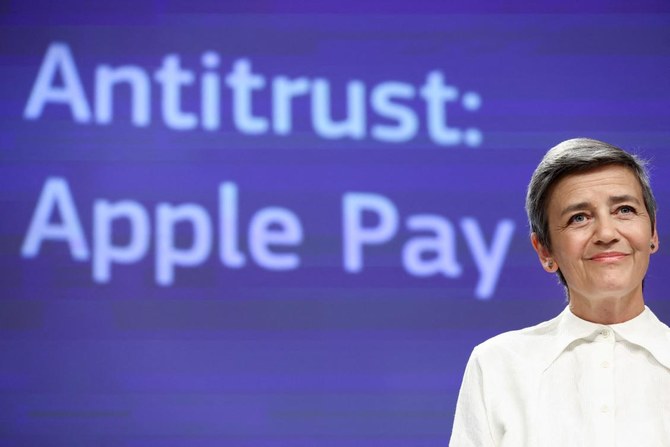
Apple hit with EU antitrust charge over mobile payments technology

The EU accused Apple of blocking rivals from its popular "tap-as-you-go" iPhone payment system, opening a fresh battlefront between the US tech giant and Brussels. (AFP)
Short Url
Updated 02 May 2022
Follow

Apple hit with EU antitrust charge over mobile payments technology

  • Apple Pay is used by more than 2,500 banks in Europe and over 250 fintechs and challenger banks

BRUSSELS: Apple faces a possible hefty fine and may have to open its mobile payment system to competitors after EU antitrust regulators charged the iPhone maker with restricting rivals’ access to its technology used for mobile wallets.
This marks the second EU charge against Apple after EU regulators last year accused the company of distorting competition in the music streaming market following a complaint from Spotify.
The European Commission said on Monday it had sent a charge sheet known as a statement of objections to Apple, detailing how the company had abused its dominant position in markets for mobile wallets on iOS devices.
The Commission said Apple’s anti-competitive practices dated back to 2015 when Apple Pay was launched.
“We have indications that Apple restricted third-party access to key technology necessary to develop rival mobile wallet solutions on Apple’s devices,” EU antitrust chief Margrethe Vestager said in a statement.
“In our statement of objections, we preliminarily found that Apple may have restricted competition, to the benefit of its own solution Apple Pay,” she said.
Apple, which could face a fine up to 10 percent of its global turnover or $36.6 billion based on its revenue last year, though EU penalties rarely reach the cap, said it would continue to engage with the Commission.
“Apple Pay is only one of many options available to European consumers for making payments, and has ensured equal access to NFC while setting industry-leading standards for privacy and security,” the company said in a statement.
Apple’s Frankfurt-listed shares fell on the news and were down 0.7 percent at 1216 GMT.
Apple Pay is used by more than 2,500 banks in Europe and over 250 fintechs and challenger banks. The NFC chip enables tap-and-go payments on iPhones and iPads.
Vestager rejected the company’s security argument.
“Our investigation to date did not reveal any evidence that would point to such a higher security risk. On the contrary, evidence on our file indicates that Apple’s conduct cannot be justified by security concerns,” she told a news conference.
Apple can ask for a closed-door hearing to defend its case and also send a written response before the Commission issues a decision, which could take a year or more.
The EU is set to implement new tech rules next year called the Digital Markets Act which will force Apple to open up its closed eco-system or face fines as much as 10 percent of its global turnover.
The Commission’s decision to send its statement of objections to Apple confirmed a Reuters story in October last year.


Grok faces more scrutiny over deepfakes as Irish regulator opens EU privacy investigation

Updated 17 February 2026
Follow

Grok faces more scrutiny over deepfakes as Irish regulator opens EU privacy investigation

  • The regulator says Grok has created and shared sexualized images of real people, including children. Researchers say some examples appear to involve minors
  • X also faces other probes in Europe over illegal content and user safety

LONDON: Elon Musk’s social media platform X faces a European Union privacy investigation after its Grok AI chatbot started spitting out nonconsensual deepfake images, Ireland’s data privacy regulator said Tuesday.
Ireland’s Data Protection Commission said it notified X on Monday that it was opening the inquiry under the 27-nation EU’s strict data privacy regulations, adding to the scrutiny X is facing in Europe and other parts of the world over Grok’s behavior.
Grok sparked a global backlash last month after it started granting requests from X users to undress people with its AI image generation and editing capabilities, including putting females in transparent bikinis or revealing clothing. Researchers said some images appeared to include children. The company later introduced some restrictions on Grok, though authorities in Europe weren’t satisfied.
The Irish watchdog said its investigation focuses on the apparent creation and posting on X of “potentially harmful” nonconsensual intimate or sexualized images containing or involving personal data from Europeans, including children.
X did not respond to a request for comment.
Grok was built by Musk’s artificial intelligence company xAI and is available through X, where its responses to user requests are publicly visible.
The watchdog said the investigation will seek to determine whether X complied with the EU data privacy rules known as GDPR, or the General Data Protection Regulation. Under the rules, the Irish regulator takes the lead on enforcing the bloc’s privacy rules because X’s European headquarters is in Dublin. Violations can result in hefty fines.
The regulator “has been engaging” with X since media reports started circulating weeks earlier about “the alleged ability of X users to prompt the @Grok account on X to generate sexualized images of real people, including children,” Deputy Commissioner Graham Doyle said in a press statement.
Spain’s government has ordered prosecutors to investigate X, Meta and TikTok for alleged crimes related to the creation and proliferation of AI-generated child sex abuse material on their platforms, Spanish Prime Minister Pedro Sánchez said on Tuesday.
“These platforms are attacking the mental health, dignity and rights of our sons and daughters,” Sánchez wrote on X.
Spain announced earlier this month that it was pursuing a ban on access to social media platforms for under-16s.
Earlier this month, French prosecutors raided X’s Paris offices and summoned Musk for questioning. Meanwhile, the data privacy and media regulators in Britain, which has left the EU, have opened their own investigations into X.
The platform is already facing a separate EU investigation from Brussels over whether it has been complying with the bloc’s digital rulebook for protecting social media users that requires platforms to curb the spread of illegal content such as child sexual abuse material.