

Pakistan’s defense budget expected to increase by six percent amid rising inflation — media

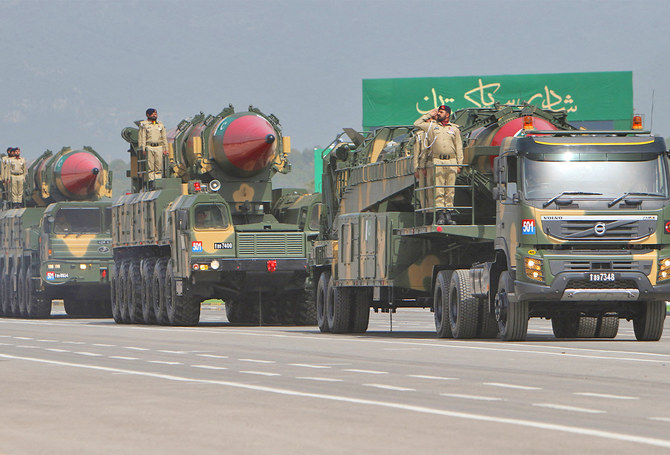
Pakistan's military vehicles carry long-range ballistic missiles Shaheen during the Pakistan Day parade in Islamabad on March 23, 2022. (AFP)
Short Url
Updated 05 June 2022
Follow

Pakistan’s defense budget expected to increase by six percent amid rising inflation — media

  • Despite a likely increase of Rs1.37 trillion, armed forces are expected to get Rs53 billion less in real terms
  • Pakistan’s per soldier spending of about Rs2.65 million is not even one-third of India’s usual allocation

ISLAMABAD: Pakistan is likely to allocate Rs1.453 trillion to its armed forces in the next federal budget, reported the local media on Sunday, indicating about six percent increase which still does not completely account for the average inflationary pressure of 11.3 percent in the national economy.

The government is scheduled to present the next annual budget on Friday, June 10, as its forex reserves have sharply declined to $9.7 billion amid a widening current account deficit and double-digit inflation.

Pakistan is striving for a staff-level agreement with the International Monetary Fund (IMF) for the resumption of a loan program amounting to $6 billion since it desperately needs external finances.

As the government finalizes details of the next federal budget, the country’s defense spending has also come under scrutiny under the prevailing economic context.

“The armed forces are likely to be allocated Rs1.453 trillion in the budget for the next fiscal year, which would be about Rs83 billion higher than the outgoing year’s allocation of Rs 1.37tr, an increase of almost six percent,” reported Dawn newspaper after talking to defense sources.

“This year a Rs136bn raise was expected after taking into account an average of 11.3pc inflation for the outgoing year,” it added. “Therefore, in number terms, the armed forces would be getting about Rs53bn less than what they say was needed for coping with inflation.”

Much like the outgoing year, the newspaper informed, the defense budget was likely to be about 16 percent of the total outlay, though the share was expected to go down in GDP terms from 2.54 to 2.2 percent in the next fiscal year.
Dawn said that Pakistan’s per soldier spending stood at about Rs2.65 million per annum which was “not even one-third of what India spends.”

The report also noted that the armed forces and their welfare entities paid Rs935 billion in taxes in the outgoing fiscal year, adding that the army saved and returned Rs500 million to the government from COVID-19 allocation and $16.9 million against procurements.


Pakistan to send over 10,000 workers to Italy over three years after securing employment quota

Updated 27 December 2025
Follow

Pakistan to send over 10,000 workers to Italy over three years after securing employment quota

  • Government says Italy will admit 3,500 workers annually under seasonal and non-seasonal labor schemes
  • It calls the deal a 'milestone' as Italy becomes the first European country to allocate job quota for Pakistan

ISLAMABAD: Pakistan has secured a quota of 10,500 jobs from Italy over the next three years, an official statement said on Saturday, opening legal employment pathways for Pakistani workers in Europe under Italy’s seasonal and non-seasonal labor programs.

Under the arrangement, 3,500 Pakistani workers will be employed in Italy each year, including 1,500 seasonal workers hired for time-bound roles, and 2,000 non-seasonal workers for longer-term employment across sectors.

The Ministry of Overseas Pakistanis and Human Resource Development said Italy is the first European country to allocate a dedicated labor quota to Pakistan, describing the move as a milestone in Pakistan’s efforts to expand overseas employment opportunities beyond traditional labor markets in the Middle East.

“After prolonged efforts, doors to employment for the Pakistani workforce in Italy are about to open,” Federal Minister for Overseas Pakistanis Chaudhry Salik Hussain said, calling the quota allocation a “historic milestone.”

The jobs will be available across multiple sectors, including shipbreaking, hospitality, healthcare and agriculture, with opportunities for skilled and semi-skilled workers in professions such as welding, technical trades, food services, housekeeping, nursing, medical technology and farming.

The agreement comes as Pakistan seeks to diversify overseas employment destinations for its workforce and increase remittance inflows, which remain a key source of foreign exchange for the country’s economy.

The ministry said a second meeting of the Pakistan-Italy Joint Working Group on labor cooperation is scheduled to be held in Islamabad in February 2026, where implementation and future cooperation are expected to be discussed.