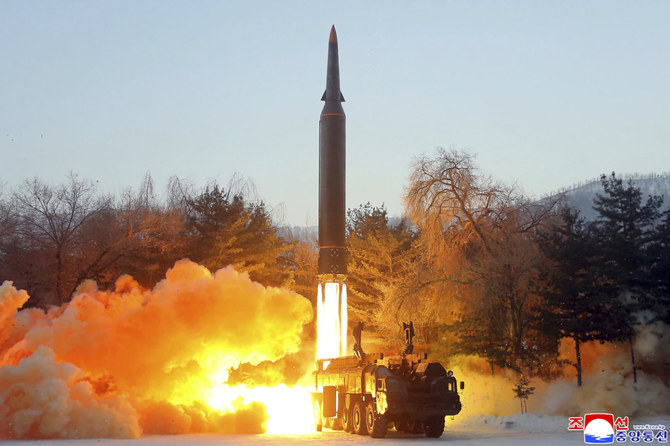
SEOUL: North Korea fired at least one ballistic missile toward the sea off its east coast on Sunday, a day after South Korea and the US wrapped up their first combined military exercises involving an American aircraft carrier in more than four years.
South Korea’s Joint Chiefs of Staff said North Korea had fired an “unknown” missile, without elaborating.
Japan’s government also reported that the North had launched a suspected ballistic missile.
The launch also followed a visit to Seoul by the US point man on North Korean affairs, US Special Representative Sung Kim, who departed on Saturday.
He met his South Korean and Japanese counterparts, Kim Gunn and Takehiro Funakoshi, on Friday to prepare for “all contingencies” amid signs North Korea was preparing to conduct a nuclear test for the first time since 2017.
Washington has made very clear directly to Pyongyang that it is open to diplomacy, Kim said during the visit, which wrapped up on Sunday, noting that he was willing to discuss items of interest to Pyongyang, such as sanctions relief.
Last week, the US called for more UN sanctions on North Korea over its ballistic missile launches, but China and Russia vetoed the suggestion, publicly splitting the UN Security Council on North Korea for the first time since it started punishing it in 2006, when North Korea conducted its first nuclear test.
In recent weeks, North Korea has test-fired a range of missiles, including its largest intercontinental ballistic missile (ICBM).
North Korea’s last tests were on May 25, when it launched three missiles after US President Joe Biden ended an Asia trip where he agreed to new measures to deter the nuclear-armed state.
The first missile appeared to be the North’s largest ICBM, the Hwasong-17, while a second unspecified missile appeared to have failed mid-flight, South Korean officials said at the time. The third missile was a short-range ballistic missile (SRBM).
On Saturday South Korean and American ships concluded three days of drills in international waters off the Japanese island of Okinawa, including air defense, anti-ship, anti-submarine, and maritime interdiction operations, South Korea’s Joint Chiefs of Staff said.
The exercises included the USS Ronald Reagan, a 100,000-ton nuclear-powered aircraft carrier, among other major warships.
South Korean President Yoon Suk-yeol, who took office on May 10, had agreed with Biden to increase bilateral military drills to deter North Korea.
North Korea has criticized previous joint drills as an example of Washington’s continued “hostile policies” toward Pyongyang, despite its talk of diplomacy.

North Korea fires ballistic missile after US, South Korea stage drills
Short Url
https://arab.news/jvxej
North Korea fires ballistic missile after US, South Korea stage drills
- Last week, the US called for more UN sanctions on North Korea over its ballistic missile launches, but China and Russia vetoed the suggestion
Taiwan says reached ‘general consensus’ with US on trade deal
- Taiwan has reached a “general consensus” with the United Sates on a trade deal, the democratic island’s negotiators said Tuesday, after months of talks
TAIPEI: Taiwan has reached a “general consensus” with the United Sates on a trade deal, the democratic island’s negotiators said Tuesday, after months of talks.
Taiwan and the United States began negotiations in April to hash out a trade deal after US President Donald Trump slapped a 32 percent tariff on Taiwanese exports, which was later lowered to 20 percent, as part of his sweep of measures against dozens of trade partners.
Taiwanese President Lai Ching-te has pledged to boost investment in the United States and increase defense spending as his government tries to further reduce the levy on its shipments, as well as avoid a toll on its semiconductor chip exports.
“The goal of the US-Taiwan tariff negotiations has always been to seek reciprocal tariff reductions without stacking tariffs, and to obtain preferential treatment under Section 232 for semiconductors, semiconductor derivatives, and other items,” the Office of Trade Negotiations said in a statement, adding there was a “general consensus” on these issues.
Section 232 refers to part of the US Trade Expansion Act that allows tariffs to be imposed when national security is found to be at risk.
“Both sides are currently discussing the schedule for a concluding meeting, and an announcement will be made once it is confirmed,” the statement said.
Taiwan’s trade officials also vowed to provide “a complete explanation of the negotiations and the agreement” to the opposition-controlled parliament and the public.
American soil
Taiwan is a powerhouse in the manufacturing of semiconductor chips, which are the lifeblood of the global economy, as well as other electronics.
Trump has previously accused Taiwan of stealing the US chip industry and his administration had made clear it wants more of the critical technology made on American soil.
The US government launched investigations under Section 232 into semiconductors and chip-making equipment last year.
Taiwan’s trade surplus with the United States was the seventh highest of any country in 2024, reaching $73.9 billion.
More than half of its exports to the United States are information and communications technology products, including semiconductors.
Lai has been at pains to find favor with Trump, vowing to raise defense spending to more than three percent of GDP this year and five percent by 2030.
TSMC, which is the world’s largest contract chip maker, also has pledged to invest an additional $100 billion in the United States.
But Taiwanese Deputy Foreign Minister Francois Chih-chung Wu told AFP recently that Taiwan planned to keep making the “most advanced” chips on home soil.
Taiwan and the United States began negotiations in April to hash out a trade deal after US President Donald Trump slapped a 32 percent tariff on Taiwanese exports, which was later lowered to 20 percent, as part of his sweep of measures against dozens of trade partners.
Taiwanese President Lai Ching-te has pledged to boost investment in the United States and increase defense spending as his government tries to further reduce the levy on its shipments, as well as avoid a toll on its semiconductor chip exports.
“The goal of the US-Taiwan tariff negotiations has always been to seek reciprocal tariff reductions without stacking tariffs, and to obtain preferential treatment under Section 232 for semiconductors, semiconductor derivatives, and other items,” the Office of Trade Negotiations said in a statement, adding there was a “general consensus” on these issues.
Section 232 refers to part of the US Trade Expansion Act that allows tariffs to be imposed when national security is found to be at risk.
“Both sides are currently discussing the schedule for a concluding meeting, and an announcement will be made once it is confirmed,” the statement said.
Taiwan’s trade officials also vowed to provide “a complete explanation of the negotiations and the agreement” to the opposition-controlled parliament and the public.
American soil
Taiwan is a powerhouse in the manufacturing of semiconductor chips, which are the lifeblood of the global economy, as well as other electronics.
Trump has previously accused Taiwan of stealing the US chip industry and his administration had made clear it wants more of the critical technology made on American soil.
The US government launched investigations under Section 232 into semiconductors and chip-making equipment last year.
Taiwan’s trade surplus with the United States was the seventh highest of any country in 2024, reaching $73.9 billion.
More than half of its exports to the United States are information and communications technology products, including semiconductors.
Lai has been at pains to find favor with Trump, vowing to raise defense spending to more than three percent of GDP this year and five percent by 2030.
TSMC, which is the world’s largest contract chip maker, also has pledged to invest an additional $100 billion in the United States.
But Taiwanese Deputy Foreign Minister Francois Chih-chung Wu told AFP recently that Taiwan planned to keep making the “most advanced” chips on home soil.
© 2026 SAUDI RESEARCH & PUBLISHING COMPANY, All Rights Reserved And subject to Terms of Use Agreement.


