

Oman announces new oil discoveries, gas and oil deals with Iran

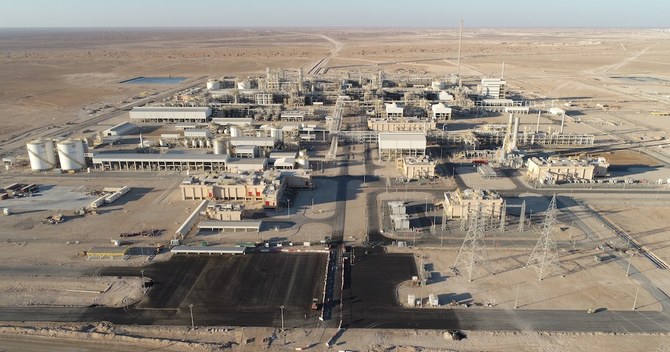
Crude oil reserves in Oman currently stand at 5.2 billion barrels, and gas reserves at around 24 trillion cubic feet. (ONA)
Short Url
Updated 04 June 2022
Follow

Oman announces new oil discoveries, gas and oil deals with Iran

  • Oil discoveries to boost production by up to 100,000 barrels, energy minister says

LONDON: Oman on Saturday announced new oil discoveries with companies operating in the sultanate that would increase production by 50,000 to 100,000 barrels in the next two or three years.
Minister of Energy and Minerals Mohammed bin Hamad Al-Rumhi said his ministry will continue exploration efforts so the country’s crude oil production remains as it is current rate or increases according to the market situation in the coming period, the official Oman News Agency reported.
He said he was optimistic about the improvement of conditions in the gas sector in the coming years, adding Oman’s crude oil reserves currently stand at 5.2 billion barrels, while gas reserves at about 24 trillion cubic feet.


Crude oil reserves in Oman currently stand at 5.2 billion barrels, and gas reserves at around 24 trillion cubic feet. (ONA)

Al-Rumhi said the sultanate had also signed a number of agreements with Iran to develop two gas pipeline projects linking the two countries and the Hengam oil field.
The announcement of the deals comes less than two weeks after Iranian President Ebrahim Raisi visited the sultanate and met with the country’s leaders.
Al-Rumhi said that the two sides agreed to form a technical team to review the gas pipeline project, whose agreement was signed in 2013. The pipeline is 400 square kilometers long and is expected to pump about 28 million cubic meters of gas for 15 years from Iran to Oman.


Minister of Energy and Minerals Mohammed bin Hamad Al-Rumhi said his ministry will continue exploration efforts. (ONA)

He stressed that “the two countries agreed upon developing the field that there would be a common roadmap that would benefit both parties by extracting more of it and reducing damage to the field.”
With regard to oil prices, the minister said it was difficult to predict prices during the coming period due to the Russian-Ukrainian crisis.
“Oil prices may remain at what they are now at the same level at least until the end of this year and may return to their levels before the outbreak of the war,” he added.
He expressed hope that the global economy will see further development and several factors that may help stabilize prices. adding the situation is expected to improve by the end of the year or early next year.


GCC chambers plan Gulf Guarantee project to boost intra-regional trade

Updated 14 sec ago
Follow

GCC chambers plan Gulf Guarantee project to boost intra-regional trade

DAMMAM: The Federation of GCC Chambers, in cooperation with the Customs Union Authority, intends to launch the Gulf Guarantee Project to provide a unified mechanism for exports and trade transactions and to enhance the efficiency of intra-GCC trade, which reached about $146 billion by the end of 2024, Saleh Al-Sharqi, Secretary-General of the federation, told Al-Eqtisadiah.  

Al-Sharqi said, on the sidelines of his meeting with media representatives at the federation’s headquarters in Dammam, that the initiative represents a qualitative leap in supporting intra-GCC trade by facilitating transit movement through a single point, contributing to cost reduction, accelerating the flow of goods, and enhancing the reliability of trade operations among Gulf markets.   

Saleh Al-Sharqi, Secretary-General of the Federation of GCC Chambers. Al-Eqtisadiah

He explained that the federation recently launched a package of strategic initiatives, including the Tawasul initiative aimed at strengthening communication among Gulf business owners and supporting the building of trade and investment partnerships, in addition to the Gulf Business Facilitation initiative, which seeks to address challenges facing Gulf investors and traders, simplify procedures, and improve the business environment across member states.    

He noted that these initiatives fall within an integrated vision to address obstacles hindering investment and intra-regional trade flows by developing regulatory frameworks, activating communication channels between the public and private sectors, and supporting Gulf economic integration in line with the objectives of the Gulf Common Market.    

In a related context, the Secretary-General affirmed the direction of GCC countries to leverage artificial intelligence technologies to support trade and investment flows, stressing the importance of establishing a unified Gulf committee for artificial intelligence to coordinate efforts and exchange expertise among member states. He said the federation will support this direction in the coming phase, drawing on leading international experiences, particularly the Chinese experience in this field.    

Regarding the recently announced electric railway project between Riyadh and Doha, Al-Sharqi revealed that technical and advisory committees are working to complete the necessary studies for the project, confirming that it will positively impact passenger and freight movement between the two countries, enhance Gulf logistical integration, and support regional supply chains.  

On investment opportunities available to Gulf nationals in the Syrian market, he said the federation is coordinating with private sector representatives in Syria to overcome obstacles that may face the flow of Gulf investments, in addition to working to provide adequate guarantees to protect these investments and ensure a stable and attractive investment environment.  

In response to a question from Al-Eqtisadiah about the impact of tariffs imposed by the US on imports of iron, steel, and aluminum, he said that economic and technical committees in GCC countries are continuously monitoring the repercussions of these tariffs on the Gulf private sector, assessing their effects, and taking the necessary measures to protect it from any potential negative impacts.    

Al-Sharqi also pointed to the launch of two specialized committees in the transport and logistics sectors and in real estate activities, given their pivotal role and active contribution to Gulf gross domestic product, stressing that developing these two sectors is a fundamental pillar for enhancing economic diversification and increasing the competitiveness of GCC economies.    

He added that during the past year the federation held more than 40 meetings and official engagements with Gulf and international entities, participated in nine regional and international events to strengthen the presence of the Gulf private sector on the global stage, and signed 12 agreements and memoranda of understanding with Gulf, regional, and international entities to open new horizons for economic and investment cooperation.    

During the same year, the federation launched four digital platforms to support the Gulf private sector, bringing the total number of its digital platforms to eight serving the business community across member states.    

The Secretary-General affirmed that the federation will continue working with relevant economic entities to unify procedures and regulations, reduce non-tariff barriers, and accelerate mutual recognition of products and standard specifications, in a way that enhances the competitiveness of the Gulf economy and supports the growth of intra-GCC trade.