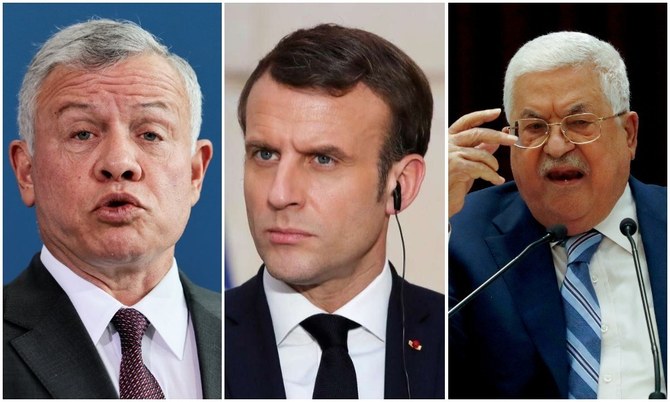
LONDON: Jordan’s King Abdullah II on Saturday discussed the situation in the Palestinian territories with French President Emmanuel Macron, where he reiterated the need “to end unilateral Israeli actions that undermine peace prospects.”
Speaking during a phone call, the two sides also held talks on ways to expand bilateral cooperation, especially in areas related to food security, and regional development, the kingdom’s state news agency Petra reported.
The Jordanian monarch congratulated Macron on his re-election and wished him success in leading his country to “greater progress and prosperity,” Petra added.
Meanwhile, Macron also held a call with his Palestinian counterpart Mahmoud Abbas to discuss the latest political developments in the occupied territories, and ways to strengthen relations between France and Palestine and with the European Union as France holds presidency of the EU council.
“Macron affirmed to President Mahmoud Abbas France’s unyielding support for peace and its continued efforts with the concerned sides and all international parties to stop the current escalation and move forward the initiatives that lead to the desired political horizon,” Palestinian news agency Wafa reported.
Abbas briefed him on the ongoing Israeli escalations against the Palestinian people, particularly in Jerusalem, including the expulsion of Palestinians from their homes, killing the defenseless Palestinians, including children, settlement construction, and settler extremism, and Israeli attacks on Christian and Islamic holy sites, especially the the Al-Aqsa mosque.
He stressed the need for the international community to take deterrent measures against Israeli practices, “because the situation on the ground is no longer acceptable.”
Macron invited the Palestinian leader to visit France in the coming period.


![]()

France’s Macron holds calls with Jordan’s king, Palestinian president
Short Url
https://arab.news/j2gbq
France’s Macron holds calls with Jordan’s king, Palestinian president
- They discusses the latest political developments in the Palestinian territories


Latest updates


© 2026 SAUDI RESEARCH & PUBLISHING COMPANY, All Rights Reserved And subject to Terms of Use Agreement.