Israeli troops kill Palestinian during West Bank crackdown

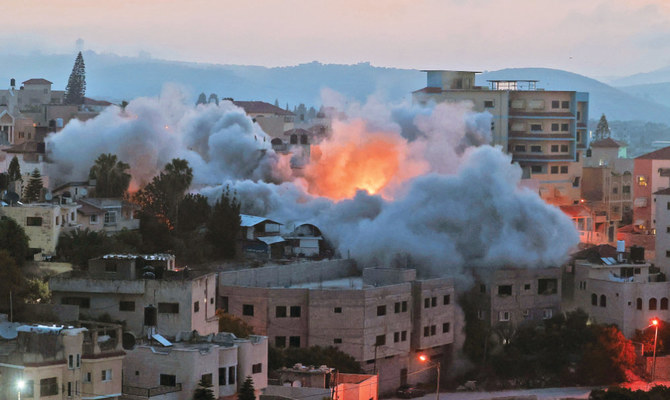
The Israeli Army blows up the family house of Diaa Hamarsha, a slain Palestinian, in the village of Yabad, near the occupied West Bank town of Jenin, on Thursday. (AFP)
Short Url
Updated 03 June 2022
Follow

Israeli troops kill Palestinian during West Bank crackdown

  • Soldiers entered village near Jenin to destroy family home of slain Palestinian attacker

TEL AVIV: Israeli forces shot and killed a Palestinian in the occupied West Bank early on Thursday. He was the third Palestinian to be killed in a little over 24 hours at a time of heightened Mideast tensions.

The Israeli military said forces operating in the Dheisheh refugee camp in the West Bank city of Bethlehem opened fire after being pelted with rocks and makeshift bombs. The Palestinian Health Ministry said Ayman Mheisen, 29, was killed.

Late on Wednesday, Israeli forces entered the village of Yabed, near the northern West Bank city of Jenin, to destroy the family home of a slain Palestinian attacker who had methodically gunned down five people in the Israeli city of Bnei Brak in March.

The military said Palestinians attacked the soldiers with stones and firebombs, and that the troops exchanged gunfire with Palestinian militants. The Palestinian Health Ministry said Bilal Kabaha, 24, was killed. Hamas said he was one of its fighters.

Video released by the Israeli military showed soldiers preparing the house for demolition and an explosion ripping through the three-floor building and lighting up the night sky.

Israel routinely demolishes the homes of slain or captured Palestinian militants, saying it serves as a deterrent, despite an internal army report from 2004 that questioned its effectiveness. The Palestinians and rights groups say it amounts to collective punishment.

The Israeli rights group HaMoked said the attacker’s parents and grandmother, as well as a brother who is a minor, were living in the home. It filed a petition against the demolition that was rejected by Israel’s Supreme Court.

Earlier on Wednesday, Israeli troops in the southern West Bank killed a Palestinian woman who they say approached them with a knife.

The West Bank is home to nearly 3 million Palestinians and has been under military rule since Israel captured the territory in the 1967 Mideast war.

The Palestinians want the West Bank to form the main part of their future state. The peace process collapsed more than a decade ago.

In recent months, Palestinians have carried out a wave of attacks against Israelis that have left 19 people dead. The military has launched near-daily operations across the West Bank that it says are aimed at breaking up militant networks to prevent more attacks.

Clashes at a flashpoint holy site in Jerusalem and the killing of a well-known Palestinian-American journalist have further heightened tensions. The Palestinians and witnesses say Shireen Abu Akleh was killed by Israeli fire, while Israel says it’s not clear if soldiers or Palestinian gunmen fired the deadly bullet.

The Palestinian Health Ministry said 62 Palestinians have been killed by Israeli forces since the start of the year. It does not differentiate between civilians, militants and those who were killed after carrying out deadly attacks.

The ministry’s count includes Abu Akleh, as well as an unarmed woman and two people who appear to have been bystanders during clashes.


Lebanese finance minister denies any plans for a Kushner-run economic zone in the south

Updated 22 January 2026
Follow

Lebanese finance minister denies any plans for a Kushner-run economic zone in the south

  • Proposal was made by US Envoy Morgan Ortagus but was ‘killed on the spot’
  • Priority is to regain control of state in all aspects, Yassine Jaber tells Arab News

DAVOS: Lebanon’s finance minister dismissed any plans of turning Lebanon’s battered southern region into an economic zone, telling Arab News on the sidelines of the World Economic Forum’s meeting in Davos that the proposal had died “on the spot.”

Yassine Jaber explained that US Envoy to Lebanon Morgan Ortagus had proposed the idea last december for the region, which has faced daily airstrikes by Israel, and it was immediately dismissed.

Jaber’s comments, made to Arab News on the sidelines of the World Economic Forum in Davos, were in response to reports which appeared in Lebanese media in December which suggested that parts of southern Lebanon would be turned into an economic zone, managed by a plan proposed by Jared Kushner, US President Donald Trump’s son in law.

Meanwhile, Jaber also dismissed information which had surfaced in Davos over the past two days of a bilateral meeting between Lebanese ministers, US Middle East Envoy Steve Witkoff and Kushner.

Jaber said that the meeting on Tuesday was a gathering of “all Arab ministers of finance and foreign affairs, where they (Witkoff and Kushner) came in for a small while, and explained to the audience the idea about deciding the board of peace for Gaza.”

He stressed that it did not develop beyond that.

When asked about attracting investment and boosting the economy, Jaber said: “The reality now is that we need to reach the situation where there is stability that will allow the Lebanese army, so the (Israeli) aggression has to stop.”

Over the past few years, Lebanon has witnessed one catastrophe after another: one of the world’s worst economic meltdowns, the largest non-nuclear explosion in its capital’s port, a paralyzed parliament and a war with Israel.

A formal mechanism was put in place between Lebanon and Israel to maintain a ceasefire and the plan to disarm Hezbollah in areas below the Litani river.

But, the minister said, Israel’s next step is not always so predictable.

“They’re actually putting pressure on the whole region. So, a lot of effort is being put on that issue,” he added.

“There are still attacks in the south of the country also, so stability is a top necessity that will really succeed in pushing the economy forward and making the reforms beneficial,” he said.

Lawmakers had also enacted reforms to overhaul the banking sector, curb the cash economy and abolish bank secrecy, alongside a bank resolution framework.

Jaber also stressed that the government had recently passed a “gap law” intended to help depositors recover funds and restore the banking system’s functionality.

“One of the priorities we have is really to deal with all the losses of the war, basically reconstruction … and we have started to get loans for reconstructing the destroyed infrastructure in the attacked areas.”

As Hezbollah was battered during the war, Lebanon had a political breakthrough as the army’s general, Joseph Aoun, was inaugurated as president. His chosen prime minister was the former president of the International Court of Justice, Nawaf Salam.

This year marks the first time a solid delegation from the country makes its way to Davos, with Salam being joined by Jaber, Economy and Trade Minister Amr Bisat, and Telecoms Minister Charles Al-Hage.

“Our priority is to really regain the role of the state in all aspects, and specifically in rebuilding the institutions,” Jaber said.