

PM inaugurates Eastbay Expressway connecting remote Gwadar port to Pakistan’s financial hub

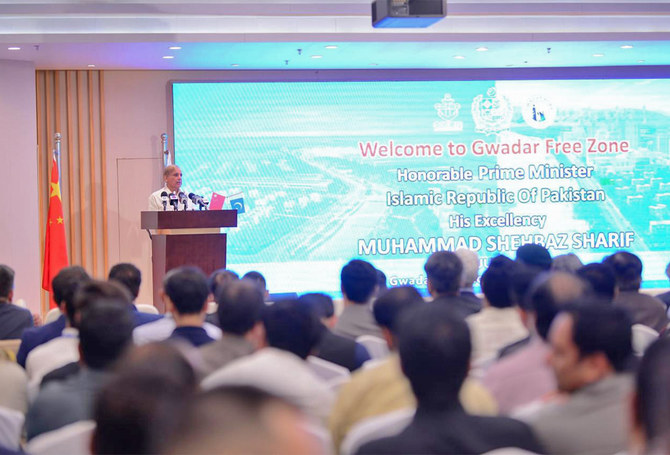
Pakistan Prime Minister Shehbaz Sharif inaugurates Gwadar Eastbay Expresswa in Gwadar, Pakistan, on June 3, 2022. (@president_pmln/Twitter)
Short Url
Updated 04 June 2022
Follow

PM inaugurates Eastbay Expressway connecting remote Gwadar port to Pakistan’s financial hub

  • The six-lane Eastbay Expressway was completed in three years with a cost of $162 million 
  • PM Sharif says China also arranged for a desalination plant, established a hospital in Gwadar

ISLAMABAD: Prime Minister Shehbaz Sharif on Friday inaugurated the Gwadar Eastbay Expressway, which connects the southwestern Pakistani port city to the country’s financial hub of Karachi. 

The 19-kilometer-long, six-lane Eastbay Expressway was built in three years with a cost of Rs32 billion ($162 million). It connects the remote Gwadar port in the impoverished Balochistan province with Karachi in the southern Pakistani province of Sindh through the Makran Coastal Highway. 

The primary objective of the expressway is to provide connectivity to the port and its special economic zone with the network of national highways for smooth transportation of import, export and transit goods. 

“Today, we have inaugurated the Eastbay motorway constructed by China and it has been completed,” PM Sharif told attendees at the inauguration ceremony in Gwadar. 

“This Eastbay will be linked to the highway to transport goods up till Karachi.” 

Similarly, the prime minister said, China had arranged for a desalination plant, established a hospital and provided solar panels to 3,200 families in Gwadar. 

Gwadar, a fishing town in southwest Pakistan, lies at the heart of multi-billion-dollar China-Pakistan Economic Corridor (CPEC), part of China’s wider Belt and Road Initiative to forge “Silk Road” land and sea routes to markets in the Middle East and Europe. 

Beijing has undertaken several infrastructure and energy projects in Pakistan under the CPEC. 


Pakistan capital market transitions to T+1 settlement cycle ahead of multiple advanced markets

Updated 7 sec ago
Follow

Pakistan capital market transitions to T+1 settlement cycle ahead of multiple advanced markets

  • A T+1 settlement cycle means that securities transactions are finalized and settled one business day after trade date
  • Effective from Feb. 9, all eligible trades at the PSX are now settled on a T+1 basis, replacing the previous T+2 cycle

KARACHI: Pakistan’s capital market has officially transitioned to the Trade plus one (T+1) settlement cycle, a landmark reform that strengthens efficiency, reduces risk and aligns the country with international best practices, the Pakistan Stock Exchange (PSX) said on Tuesday.

A T+1 settlement cycle means that securities transactions are finalized and settled one business day after the trade date, which reduces counterparty risk and improves capital efficiency in the exchange of funds and securities. 

Effective from Feb. 9, all eligible trades at the PSX are now settled on a T+1 basis, replacing the previous T+2 cycle. The transition was implemented under the guidance of the Securities and Exchange Commission of Pakistan (SECP) through close collaboration among all stakeholders, according to the PSX.

It aligns Pakistan’s capital market with leading markets such as the United States, Canada, Mexico, Argentina, Jamaica and China, which have already adopted shorter settlement cycles. Europe, the UK and Switzerland are set to follow by 2027. By moving early, Pakistan has demonstrated its commitment to modernization and investor protection.

“The transition to the T+1 settlement cycle brings important advantages for Pakistan’s capital market. It enables faster access to funds and securities, improving liquidity, while reducing settlement and counterparty risk through shorter exposure periods,” the PSX said.

“Quicker trade finalization enhances efficiency and the reform strengthens investor confidence, particularly among institutional and foreign investors. Together, these benefits support a stronger and more resilient market aligned with global best practices.”

Pakistan’s stock market has touched historic highs in recent months as broad institutional buying boosted investor confidence amid ongoing economic reforms under international lending programs. Pakistani state media reported in Jan. around 135,000 new investors had joined the PSX over the last 18 months.

SECP Chairman Dr. Kabir Ahmed Sidhu commended the PSX, the Central Depository Company and the National Clearing Company of Pakistan for the successful implementation of the T+1 settlement system.

“The reform brings Pakistan’s capital market at par with modern jurisdictions by accelerating trade settlement, reducing counterparty and market risks, and enhancing liquidity,” he was quoted as saying by the PSX.

“The adoption of T+1 will strengthen investor confidence and align Pakistan’s capital market with evolving international standards and global best practices.”