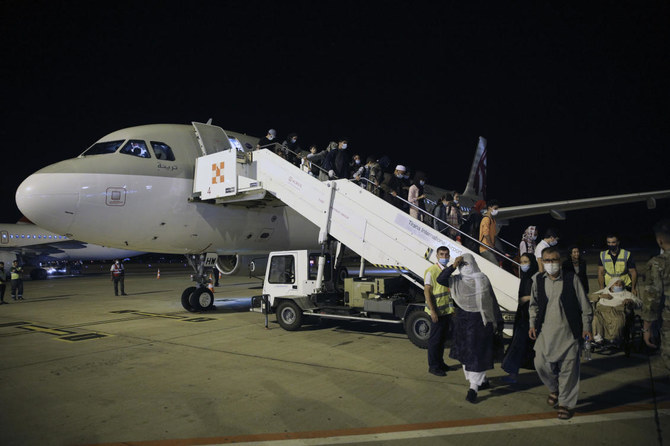
Afghans evacuated to Albania protest for faster move to US

A group of people evacuated from Afghanistan as the Taliban returned to power last year have held a protest on Wednesday in Albania over the failure to expedite their move to the United States. (File/AP)
Short Url
Updated 02 June 2022
Follow

Afghans evacuated to Albania protest for faster move to US

  • Some 2,400 Afghans were evacuated to Albania in August and September 2021
  • Non-governmental organizations from United States and other countries provided financial support for accommodating them

TIRANA, Albania: A group of people evacuated from Afghanistan as the Taliban returned to power last year held a protest Wednesday in Albania over the failure to expedite their move to the United States.
A small group of families in Shengjin, a town located 70 kilometers (45 miles) northwest of Albania’s capital, Tirana, called on the US to speed up the process of their transfer. Some women and children held posters reading, “We are forgotten.”
Some 2,400 Afghans were evacuated to Albania in August and September 2021 and given temporary shelter in Shengjin and another resort town, Durres.
Non-governmental organizations from United States and other countries provided financial support for accommodating them.
The Albanian government said at the time that it would house thousands of Afghans for at least a year before they moved to the United States for final settlement. More recently, the government pledged to keep them for longer than a year if their US visas were delayed.
The Foreign Ministry says 900 of the evacuees remain in Albania. Those no longer in the European country went to the US and Canada.
Bledar Shima, the manager of a resort in Shengjin sheltering 350 Afghans, said the property has not been paid for six months. Shima urged the Albanian government to intervene, according to private TV station Top Channel.


Australian bushfires raze homes, cut power to tens of thousands

Updated 58 min 1 sec ago
Follow

Australian bushfires raze homes, cut power to tens of thousands

  • PM Anthony Albanese said the nation faced a ‍day of “extreme and dangerous” fire weather, especially in Victoria, where much of the state has been declared a disaster zone

SYDNEY: Thousands of firefighters battled bushfires in Australia’s southeast on Saturday that have razed homes, cut power to thousands of homes and burned swathes of bushland. The blazes have torn through more than 300,000 hectares (741,316 acres) of bushland amid a heatwave in Victoria state since the middle of the week, authorities said on Saturday, and 10 major fires were still burning statewide. In neighboring New South ‌Wales state, several ‌fires close to the Victorian border were ‌burning ⁠at ​emergency level, ‌the highest danger rating, the Rural Fire Service said, as temperatures hit the mid-40s Celsius (111 degrees Fahrenheit). More than 130 structures, including homes, have been destroyed and around 38,000 homes and businesses were without power due to the fires in Victoria, authorities said. The fires were the worst to hit the state since the Black Summer blazes of 2019-2020 that destroyed an area ⁠the size of Turkiye and killed 33 people. “Where we can fires will be being brought ‌under control,” Victoria Premier Jacinta Allan told ‍reporters, adding thousands of firefighters were ‍in the field.
Prime Minister Anthony Albanese said the nation faced a ‍day of “extreme and dangerous” fire weather, especially in Victoria, where much of the state has been declared a disaster zone.
“My thoughts are with Australians in these regional communities at this very difficult time,” Albanese said in televised remarks from ​Canberra. One of the largest fires, near the town of Longwood, about 112 km (70 miles) north of Melbourne, has burned ⁠130,000 hectares (320,000 acres) of bushland, destroying 30 structures, vineyards and agricultural land, authorities said. Dozens of communities near the fires have been evacuated and many of the state’s parks and campgrounds were closed. A heatwave warning on Saturday was in place for large parts of Victoria, while a fire weather warning was active for large areas of the country including New South Wales, the nation’s weather forecaster said. In New South Wales capital Sydney, the temperature climbed to 42.2 C, more than 17 degrees above the average maximum for January, according to data from the nation’s weather forecaster.
It predicted ‌conditions to ease over the weekend as a southerly change brought milder temperatures to the state.